Concrete Strength (PSI & Grade) Guide
This concrete grade calculator matches a project type to a typical compressive strength in psi and MPa. Pick a patio, driveway, or structural job, then type any psi value to convert it. The results show the typical strength and the converted value, with M20 and M25 grades explained below.
 By Muhammad AsimPublished Updated How we calculate
Your result
- Typical strength
- about 3,000 psi (20 MPa)
- Converted strength
- 3,000 psi = 20.7 MPa
Formula with your numbers
MPa = psi ÷ 145.0377
Typical strengthabout 3,000 psi (20 MPa)
How to Use the Concrete Strength Selector
To use the concrete strength selector, follow these 3 steps.
- Pick the project type: patio, driveway, or structural work.
- Read the typical strength in pounds per square inch (psi) and megapascals (MPa).
- Type a psi value from a mix ticket or spec to convert it to MPa.
psi to MPa Conversion
To convert psi to MPa, divide the psi value by 145.0377. Both units measure compressive strength, the load per unit of area that a concrete sample carries before it fails.
MPa = psi ÷ 145.0377
psi = MPa × 145.0377
- psi: pounds per square inch, the US unit for concrete strength.
- MPa: megapascals, the metric unit for concrete strength.
- 145.0377: the number of psi in 1 MPa.
Metric grades already state the strength in MPa. Grade M20 means a characteristic compressive strength of 20 MPa, and M25 means 25 MPa. Multiply the grade number by 145.0377 for psi.
M20 = 20 MPa = 20 × 145.0377 = 2,901 psi
M25 = 25 MPa = 25 × 145.0377 = 3,626 psi
Worked Example: Driveway Strength and Grade M25
A driveway calls for about 4,000 psi (28 MPa), and grade M25 equals 3,626 psi. The 3 steps below show the conversions.
- Pick Driveway in the selector: the typical strength reads about 4,000 psi (28 MPa).
- Convert the driveway value: 4,000 psi = 27.6 MPa, so the metric figure of 28 MPa is a rounded value.
- Convert grade M25 to psi: 25 × 145.0377 = 3,626 psi.
Grade M25 sits between the patio value of 3,000 psi and the driveway value of 4,000 psi.
Where to Use the Strength Guide
The strength guide fits the 3 project types in the selector, plus spec checks:
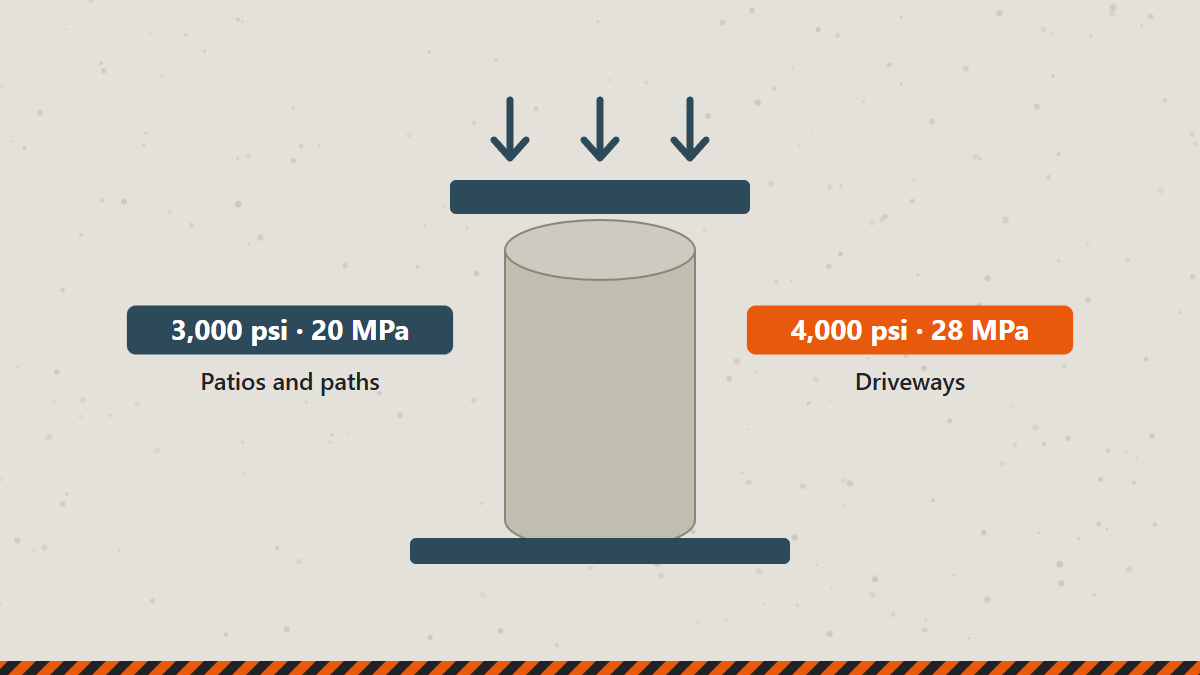
- Patios, walkways, and garden paths: about 3,000 psi (20 MPa).
- Driveways: about 4,000 psi (28 MPa).
- Footings, foundations, and structural members: set by local code or a structural engineer.
- Spec checks: convert a psi value on a mix ticket to MPa, or an M grade to psi.
Concrete Grades M20 and M25 Explained
Grades M20 and M25 name concrete by strength in MPa: the number after the M is the characteristic compressive strength. M20 equals 2,901 psi and M25 equals 3,626 psi. For structural work, the grade comes from local codes or a structural engineer.
European Strength Classes: C20/25, C25/30, and C30/37
UK and European suppliers sell concrete by EN 206 strength class. In a class such as C25/30, the first number is the 28-day strength of a test cylinder in MPa, and the second is the strength of a test cube of the same concrete. US psi values are cylinder strengths, so compare psi with the first number.
A 4,000 psi US driveway mix is 27.6 MPa as a cylinder strength, which sits between C25/30 (25 MPa) and C28/35 (28 MPa). Pick the class at or above the cylinder value your plans ask for.
| Class | Cylinder (MPa) | Cylinder (psi) | Cube (MPa) |
|---|---|---|---|
| C16/20 | 16 | 2,321 psi | 20 |
| C20/25 | 20 | 2,901 psi | 25 |
| C25/30 | 25 | 3,626 psi | 30 |
| C28/35 | 28 | 4,061 psi | 35 |
| C30/37 | 30 | 4,351 psi | 37 |
| C32/40 | 32 | 4,641 psi | 40 |
| C35/45 | 35 | 5,076 psi | 45 |
| C40/50 | 40 | 5,802 psi | 50 |
Concrete Grade Calculator Table: M Grades in psi
Grade M20 equals 2,901 psi. The table converts common M grades from MPa to psi.
| Grade | Strength (MPa) | Strength (psi) |
|---|---|---|
| M15 | 15 MPa | 2,176 psi |
| M20 | 20 MPa | 2,901 psi |
| M25 | 25 MPa | 3,626 psi |
| M30 | 30 MPa | 4,351 psi |
| M35 | 35 MPa | 5,076 psi |
| M40 | 40 MPa | 5,802 psi |
Common Concrete Strength Mistakes
The 4 most common strength mistakes involve units, rounding, project type, and structural work.
- Read the unit on the spec: 25 MPa and 25 psi are very different strengths.
- Treat rounded metric values as approximate. 3,000 psi converts to 20.7 MPa, listed as about 20 MPa.
- Order the driveway strength, about 4,000 psi, for a driveway, not the patio strength.
- Get footing and foundation strength from local codes or a structural engineer, not from this guide.
Concrete Strength (PSI & Grade) Guide FAQ
What strength concrete do I need?
A patio, walkway, or garden path needs about 3,000 psi (20 MPa), and a driveway needs about 4,000 psi (28 MPa). For footings, foundations, and other structural work, the strength comes from local codes or a structural engineer, so this guide gives no value for those jobs.
What does M20 concrete mean?
M20 concrete means concrete with a characteristic compressive strength of 20 MPa, which equals 2,901 psi. The M grades name concrete by strength in megapascals, so the number after the M is the strength. Grade use for structural members comes from local codes or a structural engineer.
How many psi is 25 MPa concrete?
25 MPa concrete equals 3,626 psi. Multiply the MPa value by 145.0377 to get psi, or divide psi by 145.0377 to get MPa. Grade M25 has the same 25 MPa characteristic compressive strength, so M25 equals 3,626 psi as well.
Is 3,000 psi concrete the same as 20 MPa?
No, 3,000 psi converts to 20.7 MPa, not exactly 20 MPa. This guide lists about 20 MPa for patios as the rounded metric value. Use the converter in the selector for an exact figure, and check the unit printed on the mix ticket before you compare 2 products.
Is a concrete calculator psi value a measure of concrete quality?
Yes, the psi value measures one part of concrete quality: compressive strength. A higher psi number means the concrete carries more load per square inch before it fails. The selector lists typical psi values for patios and driveways, and the converter turns any psi value into MPa.
What is C25/30 concrete in psi?
C25/30 concrete has a cylinder strength of 25 MPa, about 3,626 psi, and a cube strength of 30 MPa. The US psi rating is a cylinder strength, so compare it with the first number. A 4,000 psi mix is about 27.6 MPa, just above C25/30.
Sources
Strength conversions use the exact definition of the megapascal. The European classes come from the supplier documents below.
Related guides