Concrete Calculator India
This concrete calculator India page works out a pour in cubic meters (m³) and splits it into cement, sand, and aggregate. It applies length × width × depth, waste, and the 1.54 dry volume factor. The results show 50 kg cement bags, sand, and aggregate for an M20 or M25 nominal mix.
 By Muhammad AsimPublished How we calculate
Your estimate
Total volume with waste
1.10m³
- Cubic yards
- 1.44 yd³
- Cubic feet
- 38.8 ft³
Premixed bags
- Weight
- 2,640 kg · 5,820 lb
- Ready-mix truck loads (10 yd³ each)
- 0.14
- Concrete cost
Dry materials (M20 (1:1.5:3), × 1.54 dry volume)
- Cement
- 0.31 m³
- 10.9 ft³
- Sand
- 0.46 m³
- 16.3 ft³
- Aggregate
- 0.92 m³
- 32.6 ft³
Cement: 9 bags of 50 kg
Formula with your numbers
35.31 ft³ × 1.1 = 38.85 ft³
Includes a 10% waste allowance. Bags are rounded up. Weight uses 2,400 kg/m³ (150 lb/ft³).
Your estimate1.10 m³
Planning several pours or a cost sheet? Get the free Excel template (7 tabs, no sign-up).
How to Use the Concrete Calculator in India
To use the concrete calculator in India, follow these 4 steps.
- Choose Volume, Slab, Strip footing, or Column.
- Enter the sizes in m or mm, or type the volume in m³.
- Pick the grade: M20 (1:1.5:3) or M25 (1:1:2), and the cement density.
- Read the cubic meters, 50 kg cement bags, sand, and aggregate.
Concrete Calculator India Formula
The concrete calculator India formula has 3 parts: wet volume, dry volume, and the mix split, with each material taking its share of the ratio.
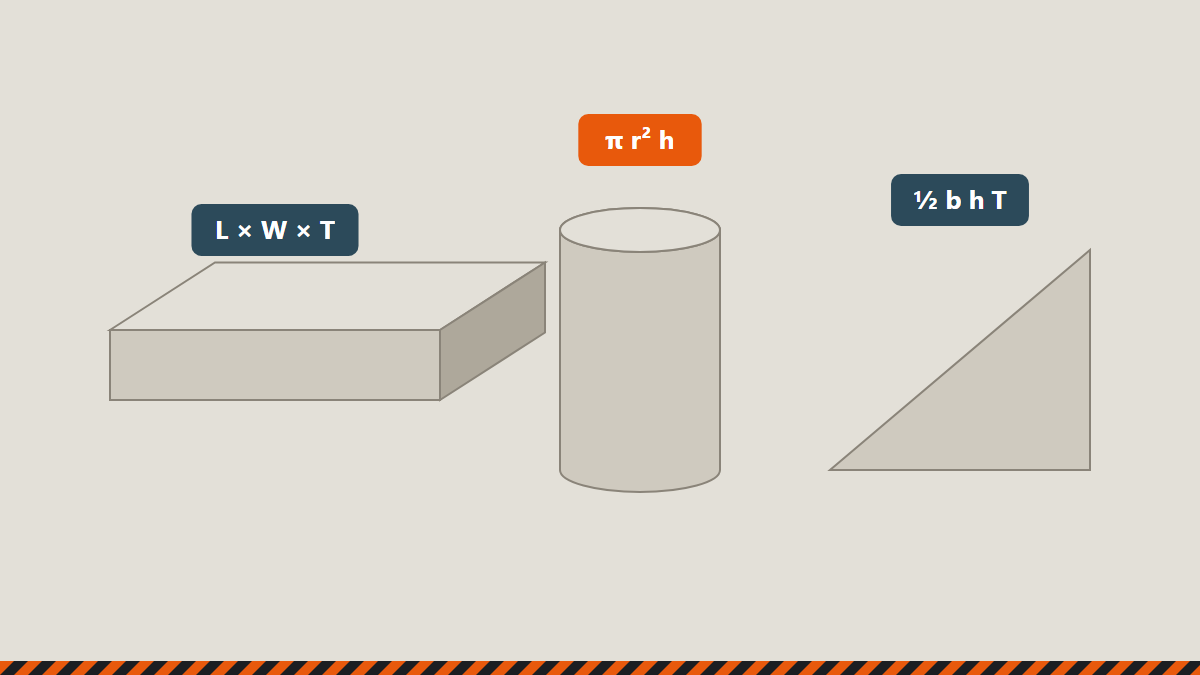
Wet volume (m³) = length (m) × width (m) × depth (m)
Dry volume (m³) = wet volume × 1.54
Material (m³) = dry volume × its part ÷ total parts
50 kg cement bags = cement (m³) ÷ 0.0347, rounded up
- 1.54: the dry volume factor for loose cement, sand, and aggregate.
- Total parts: 5.5 for M20 (1 + 1.5 + 3) and 4 for M25 (1 + 1 + 2).
- 0.0347 m³: the loose volume of one 50 kg cement bag at 1,440 kg/m³.
Sand and aggregate often sell by the cubic foot (cft).
Material (ft³) = material (m³) × 35.3
Worked Example: 1 m³ of M20 Concrete
One cubic meter (1.308 yd³) of M20 concrete at 1:1.5:3 takes 9 bags of 50 kg cement, 0.42 m³ of sand, and 0.84 m³ of aggregate, before waste.
- Find the dry volume: 1 m³ × 1.54 = 1.54 m³.
- Add the parts: 1 + 1.5 + 3 = 5.5. Cement is 1.54 × 1 ÷ 5.5 = 0.28 m³.
- Convert cement to bags: 0.28 ÷ 0.0347 = 8.06, rounded up to 9 bags of 50 kg.
- Sand is 1.5 parts: 0.42 m³ (14.8 ft³). Aggregate is 3 parts: 0.84 m³ (29.7 ft³).
At M25 (1:1:2), the same cubic meter takes 12 bags of cement, 0.39 m³ of sand, and 0.77 m³ of aggregate. The bag count uses loose cement at 1,440 kg/m³ from IS 875 (Part 1), Table 1. Switch to 1,506 kg/m³ (CMHA TEK 04-02A) in the calculator to compare.
Where to Use the Calculator in India
The calculator fits 3 common jobs on Indian building sites:
- Roof slabs: a 5 × 4 m slab at 125 mm in M20 takes 21 bags of 50 kg cement.
- Strip footings: 10 m long, 600 mm wide, and 300 mm deep holds 1.80 m³.
- Columns: 4 columns of 300 × 450 mm, 3 m high, hold 1.62 m³.
Grades M20 and M25 and Their Nominal Mix Ratios
Grades M20 and M25 set the characteristic compressive strength of a 150 mm cube at 28 days: 20 N/mm² and 25 N/mm², per IS 456:2000, Table 2. The ratios below are common site mixes by volume:
- Grade M20: 1 part cement, 1.5 parts sand, 3 parts aggregate.
- Grade M25: 1 part cement, 1 part sand, 2 parts aggregate.
IS 456 allows nominal mixes for M20 or lower and prefers a design mix. Use a design mix for M25.
Cement, Sand, and Aggregate for Sample Jobs
A 5 × 4 m roof slab at 125 mm in M20 takes 21 bags of 50 kg cement, the most of the 4 jobs below.
| Job and grade | Wet volume (m³) | 50 kg cement bags | Sand (m³) | Aggregate (m³) |
|---|---|---|---|---|
| Roof slab, 5 × 4 m at 125 mm, M20 | 2.50 | 21 | 1.05 | 2.10 |
| Strip footing, 10 m × 600 × 300 mm, M20 | 1.80 | 15 | 0.76 | 1.51 |
| 4 columns, 300 × 450 mm × 3 m, M25 | 1.62 | 18 | 0.62 | 1.25 |
| Lintel, 3 m × 230 × 150 mm, M20 | 0.10 | 1 | 0.04 | 0.09 |
Common Mistakes in Concrete Quantity Work
These 3 mistakes cause most short material orders.
- Skipping the dry volume factor. Each 1 m³ of wet concrete needs 1.54 m³ of dry materials, not 1 m³.
- Leaving out waste. Add 5 to 10 percent before buying cement, sand, and aggregate.
- Counting one column. Set the number of identical pours to the number of columns.
Concrete Calculator India FAQ
How many cement bags are in 1 m³ of M20 concrete?
One cubic meter of M20 concrete at 1:1.5:3 needs 9 bags of 50 kg cement, before waste. Cement is 0.28 m³ of the 1.54 m³ dry volume, or 403 kg at 1,440 kg/m³. That is 8.06 bags, rounded up to a whole bag.
How do I do concrete ka calculation?
To do concrete ka calculation, multiply length × width × depth in meters, then × 1.54 for the dry volume. Split the dry volume by the mix ratio, such as 1:1.5:3 for M20. Divide the cement volume by 0.0347 m³ to get 50 kg bags. This answers concrete ka calculation kaise nikale in 3 steps.
What is the mix ratio of M25 concrete?
The common site ratio for M25 concrete is 1:1:2: 1 part cement, 1 part sand, and 2 parts aggregate by volume. One cubic meter takes 12 bags of 50 kg cement, 0.39 m³ of sand, and 0.77 m³ of aggregate. IS 456 prefers a design mix for M25, so confirm the mix with your engineer.
Is there a concrete calculator in Hindi?
No, this page is in English for now, but the steps are the same in any language. Enter the sizes in meters or millimeters, pick M20 or M25, and read the cement bags, sand, and aggregate. The formula stays the same: wet volume × 1.54, split by the mix ratio.
Sources
Every result on this page uses plain geometry and the exact unit definitions below. The full list of formulas and constants is on the How we calculate page.
Related guides