
BuyingBy Concrete Calculator Team
Bagged Concrete vs Ready-Mix – Which Should You Order?
Where the break-even point sits between premixed bags and a ready-mix truck, and the practical factors that matter beyond price.
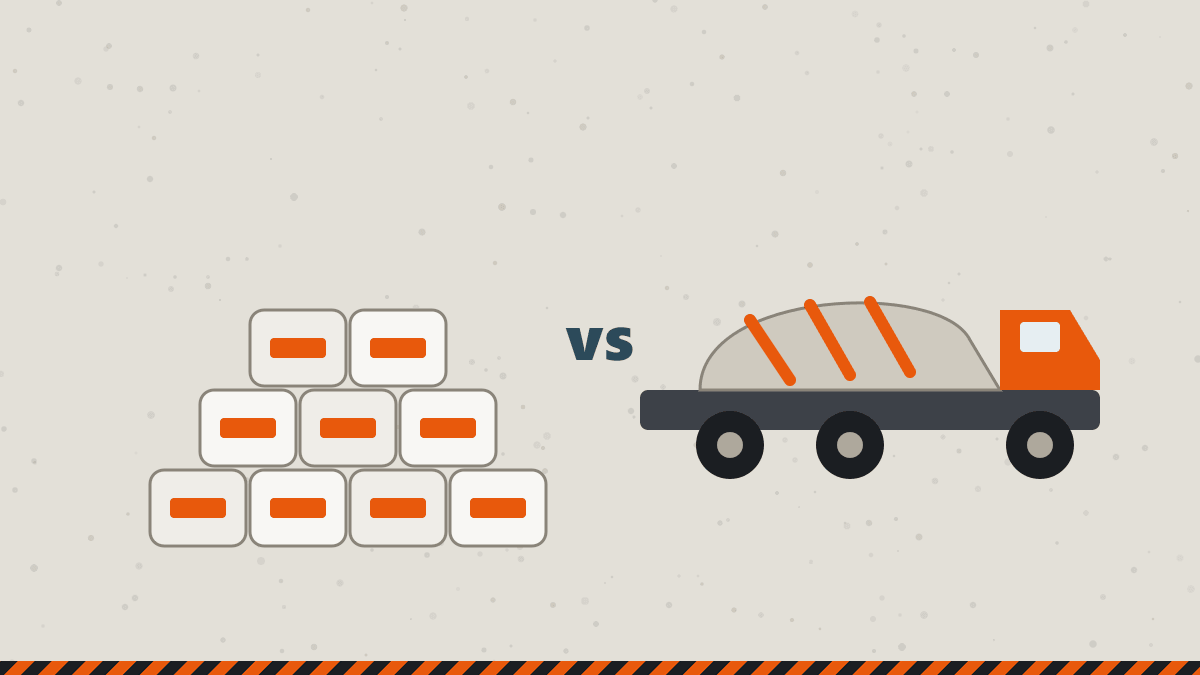
Once you know your volume, the next question is how to buy it. For small jobs, bags are convenient. For anything larger, a ready-mix truck usually wins on cost, labor and quality.
How many bags is a cubic yard?
| Bag size | Yield per bag | Bags per cubic yard |
|---|---|---|
| 40 lb | 0.30 ft³ | 90 |
| 60 lb | 0.45 ft³ | 60 |
| 80 lb | 0.60 ft³ | 45 |
Forty-five 80 lb bags weigh 3,600 lb, and every one has to be lifted, opened, mixed and placed.
The break-even point
For most homeowners the crossover is around one cubic yard (0.75 m³). Below that, bags avoid delivery minimums and short-load fees. Above it, ready-mix is usually cheaper per yard once you count your time and a mixer rental.
Beyond price
- Consistency. Every bag is mixed separately, so water content and strength vary. A truck delivers one uniform batch.
- Cold joints. Hand-mixing a large slab can take long enough that earlier concrete starts to set, leaving weak seams.
- Access. A truck needs a clear path, or a pump or wheelbarrows to reach the pour.
- Timing. Ready-mix must be placed within about 90 minutes of batching, so your crew and forms must be ready.
Quick rule of thumb
- Under 0.5 yd³: bags.
- 0.5–1 yd³: either. Compare prices and your available labor.
- Over 1 yd³: ready-mix.