
Asphalt vs Concrete Driveway Cost (2026): Which Is Cheaper Over Time?
Asphalt vs concrete driveway cost per square foot, lifespan, sealcoating and finishes, with a 24 × 24 ft example priced up front and over 30 years.


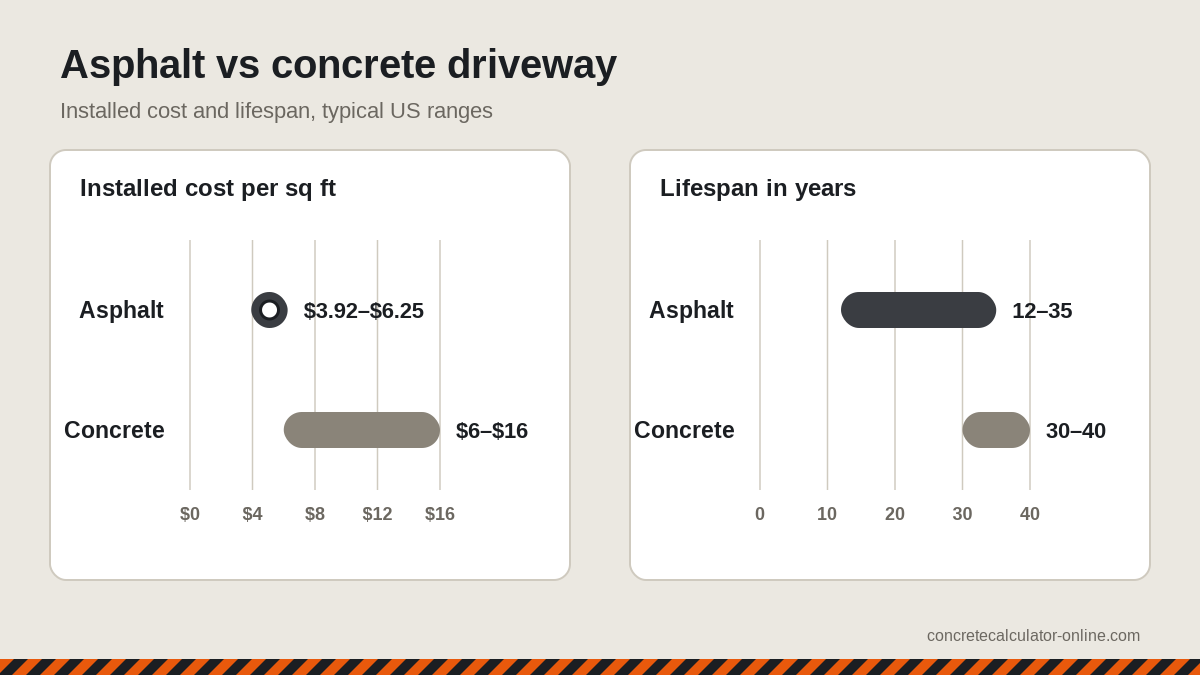
Asphalt is the cheaper driveway to install, and concrete is the longer-lasting one. Asphalt costs about $3.92–$6.25 per square foot installed, against $6–$16 for concrete, while a concrete driveway lasts about 30 to 40 years and asphalt 12 to 35 years. This guide compares asphalt vs concrete driveway cost side by side, prices a 24 × 24 ft driveway in both materials, and adds the cost of asphalt sealcoating over 30 years. Prices are typical US ranges, updated November 18, 2026.
Is Asphalt Cheaper Than Concrete for a Driveway?
Yes, asphalt is cheaper than concrete up front. LawnStarter puts an installed asphalt driveway at $3.92–$6.25 per square foot, with $5.09 as a typical price, and a concrete driveway at $6–$16 per square foot. CostInsightHub gives a similar asphalt range of $3–$6 per square foot.
In metric terms, that is about $42–$67 per m² for asphalt and $65–$172 per m² for concrete.
The two ranges barely overlap. The cheapest concrete driveway, at $6 per square foot, costs about the same as the most expensive asphalt one, at $6.25. Any upgrade on the concrete side, such as a stamped or colored finish, a thicker slab, or more reinforcement, moves the price toward $16.
Concrete costs more to install mainly because the job has more steps. The crew builds and sets forms, places rebar or wire mesh, finishes the surface by hand, and cuts control joints, and the slab then needs time to cure. An asphalt crew spreads the hot mix over the base and compacts it with a roller, usually in a single visit.
Asphalt vs Concrete Driveway Cost: Side-by-Side Comparison
The main trade-off in the asphalt vs concrete driveway choice is a lower price and regular sealcoating for asphalt, against a higher price and a longer life for concrete. The table sets out the differences.
| Asphalt (blacktop) | Concrete | |
|---|---|---|
| Installed cost per sq ft | $3.92–$6.25 | $6–$16 |
| 24 × 24 ft driveway installed | $2,258–$3,600 | $3,456–$9,216 |
| Lifespan | 12–35 years | 30–40 years |
| Routine upkeep | Sealcoat every 2–5 years at $0.17–$0.24 per sq ft | No sealcoating schedule; clean it and seal joints or the surface as the installer advises |
| Look and finish | Black, smooth surface | Gray broom finish; stamped finish at $8–$15 per sq ft |
| Repairs | Cracks can be filled, areas patched, and worn surfaces resurfaced | Cracks can be sealed, but patches rarely match; badly damaged slabs are cut out and replaced |
Asphalt is often called blacktop, and the two terms mean the same driveway surface. Its asphalt binder wears under sun, water, and oil drips, which is why it gets a protective sealcoat. Concrete does not need regular sealcoating, but road salt can damage a poorly finished surface, as the guide to why concrete scales explains.
What Does Each Driveway Cost Up Front? A 24 × 24 ft Example
A 24 × 24 ft (7.3 × 7.3 m) two-car driveway covers 576 square feet (53.5 m²). At the installed ranges, it costs:
- Asphalt: 576 × $3.92 to 576 × $6.25 = $2,258–$3,600, or about $2,932 at the typical $5.09.
- Concrete: 576 × $6 to 576 × $16 = $3,456–$9,216.
So concrete costs $1,198 more at the low ends of both ranges and $5,616 more at the high ends. At 4 inches (10 cm), the concrete version holds 7.11 yd³ (5.44 m³) of concrete, or 7.82 yd³ with 10 percent waste, which one ready-mix truck usually carries. The driveway calculator gives the volume for any size and thickness.
How Much Does Asphalt Sealcoating Add Over Time?
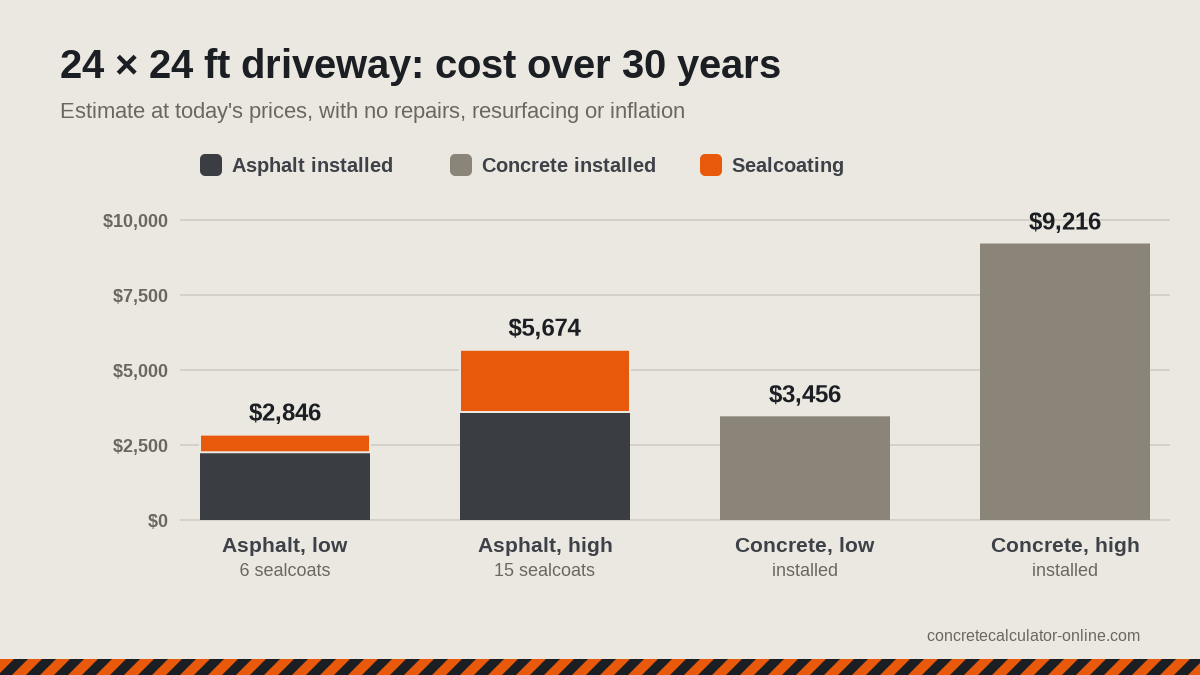
Asphalt sealcoating adds about $588–$2,074 over 30 years on a 24 × 24 ft driveway, based on LawnStarter’s price of $0.17–$0.24 per square foot, applied every 2 to 5 years. We used 30 years because it is the low end of a concrete driveway’s lifespan. Here is the arithmetic:
- Fewest coats: sealing every 5 years means 30 ÷ 5 = 6 coats. At the low price: 6 × 576 × $0.17 = $588.
- Most coats: sealing every 2 years means 30 ÷ 2 = 15 coats. At the high price: 15 × 576 × $0.24 = $2,074.
- Asphalt total: $2,258 + $588 = $2,846 at the low end, and $3,600 + $2,074 = $5,674 at the high end.
Against $3,456–$9,216 for concrete, asphalt stays cheaper in this estimate even with every sealcoat counted. The estimate uses today’s prices and leaves out inflation, crack filling, patching, and resurfacing, so treat it as a rough comparison, not a forecast.
How Long Does an Asphalt or Concrete Driveway Last?
A concrete driveway lasts about 30 to 40 years and an asphalt driveway 12 to 35 years, according to LawnStarter. The wide asphalt range reflects how much installation quality, base preparation, and upkeep matter.
The lifespan changes the long-run math more than sealcoating does. If an asphalt driveway lasts only 12 years, the low end of its range, it would be replaced twice within 30 years. Each replacement of a 24 × 24 ft driveway costs another $2,258–$3,600 at today’s prices, plus removal of the old surface. An asphalt driveway near the top of its range can last about as long as a concrete one.
Concrete has its own risks: a slab on a poor base can crack, and repairs are hard to hide. A well-compacted base and good drainage help either material reach the upper part of its range.
What Does Each Driveway Cost per Year of Use?
Spread over its lifespan, each driveway costs roughly the same per year at the ends of the ranges, so neither material is a clear long-run winner on price alone. Dividing the 24 × 24 ft installed prices by the lifespans gives:
- Asphalt: $2,258 ÷ 35 years = $65 per year at best, and $3,600 ÷ 12 years = $300 per year at worst. Sealcoating adds $20–$69 per year.
- Concrete: $3,456 ÷ 40 years = $86 per year at best, and $9,216 ÷ 30 years = $307 per year at worst.
The per-year figures overlap almost completely. What decides the real cost is where your driveway lands inside each range: a well-built asphalt driveway that reaches the top of its lifespan is a bargain, and a short-lived one is not. A plain concrete driveway near the low end of its price range is good value over 30 to 40 years.
What Moves the Price of Each Material?
The same site factors push both prices up: a soft subgrade that needs more base, a steep or long driveway, poor access for trucks, and removal of an old surface. Beyond those, each material has its own price drivers.
- Asphalt: the binder is made from petroleum, so asphalt prices can move with oil prices. The thickness of the asphalt layer and of the gravel base changes the price too.
- Concrete: ready-mix runs $130–$175 per cubic yard, according to CostInsightHub, and the finish matters most. A stamped finish costs $8–$15 per square foot, against a plain broom finish at the bottom of the installed range. A 5 or 6 inch slab and extra rebar add more.
Ask each contractor which of these factors apply to your site before comparing totals.
Which Driveway Material Fits Your Project?
Choose by budget, time horizon, and the look you want. Neither material is the better choice in every case.
Asphalt fits when:
- The up-front budget is tight.
- You are comfortable with sealcoating every few years.
- A plain black surface suits the house.
Concrete fits when:
- You plan to stay long enough to benefit from the longer lifespan.
- You want a lighter surface, or a stamped or colored finish.
- You prefer no sealcoating schedule.
Local conditions matter as well. Ask contractors in your area how each material holds up in local heat, freeze-thaw cycles, and road-salt use, and what base thickness they recommend. For concrete, pick the thickness for the heaviest vehicle: 4 inches (10 cm) for cars and 5 to 6 inches (13 to 15 cm) for trucks.
How to Price Both Options for Your Driveway
To price both options, multiply your driveway area by each range, then compare itemized quotes for the same scope. Five steps keep the comparison fair:
- Measure the area in square feet. Split curved or flared driveways into rectangles.
- Apply both ranges: area × $3.92–$6.25 for asphalt and area × $6–$16 for concrete.
- Add upkeep for asphalt: area × $0.17–$0.24 per coat, once every 2 to 5 years over the period you plan to stay.
- Get itemized quotes for each material, with removal of the old surface, grading, base, thickness, and finish listed separately.
- Compare over the same period. Add the asphalt sealcoats for the years you plan to stay, and note whether either driveway would reach the end of its lifespan inside that time.
For the concrete side, the concrete slab cost calculator adds concrete, labor, reinforcement, removal, and delivery fees with your own prices, and the guide to concrete driveway cost prices common driveway sizes and finishes in more detail.
Frequently Asked Questions
Is blacktop the same as asphalt?
How often should you sealcoat an asphalt driveway?
Does a concrete driveway need sealing?
Which driveway is easier to repair?
Sources
- LawnStarter – How Much Does an Asphalt Driveway Cost (asphalt price, sealcoating, lifespans), updated 2026-10-19
- CostInsightHub – How Much Does Asphalt Cost (asphalt price cross-check), updated 2026-04-19
- LawnStarter – How Much Does a Concrete Driveway Cost (concrete driveway price, stamped finish), updated 2025-12-27
- CostInsightHub – How Much Does Concrete Cost per Yard (ready-mix price), updated 2026-04-19
- How we calculate – formulas, constants, and sources


