Ramp & Slope Concrete Calculator
This concrete calculator ramp tool finds the volume of a solid sloped wedge: ½ × run length × rise × width. Enter feet, inches, meters, or centimeters. The results show cubic yards, cubic feet, and cubic meters, bag counts, weight, and cost, with a 10% waste allowance.
 By Muhammad AsimPublished How we calculate
Your estimate
Total volume with waste
0.98yd³
- Cubic meters
- 0.75 m³
- Cubic feet
- 26.4 ft³
Premixed bags
- 80 lb bags44
- 60 lb bags59
- 40 lb bags88
- 25 kg bags65
- 20 kg bags80
- Weight
- 3,955 lb · 1,794 kg
- Ready-mix truck loads (10 yd³ each)
- 0.10
- Concrete cost
Formula with your numbers
½ × 12 ft × 1 ft × 4 ft × 1.1 = 26.40 ft³
Includes a 10% waste allowance. Bags are rounded up. Weight uses 2,400 kg/m³ (150 lb/ft³).
Your estimate0.98 yd³ · 44 × 80 lb
Planning several pours or a cost sheet? Get the free Excel template (7 tabs, no sign-up).
How to Use the Concrete Ramp Calculator
To use the ramp calculator, follow these 4 steps.
- Enter the run: the level length of the ramp.
- Enter the rise: the ramp height at the top.
- Enter the ramp width and the number of identical ramps.
- Set the waste allowance and read the results.
Concrete Calculator Ramp Formula: ½ × Length × Height × Width
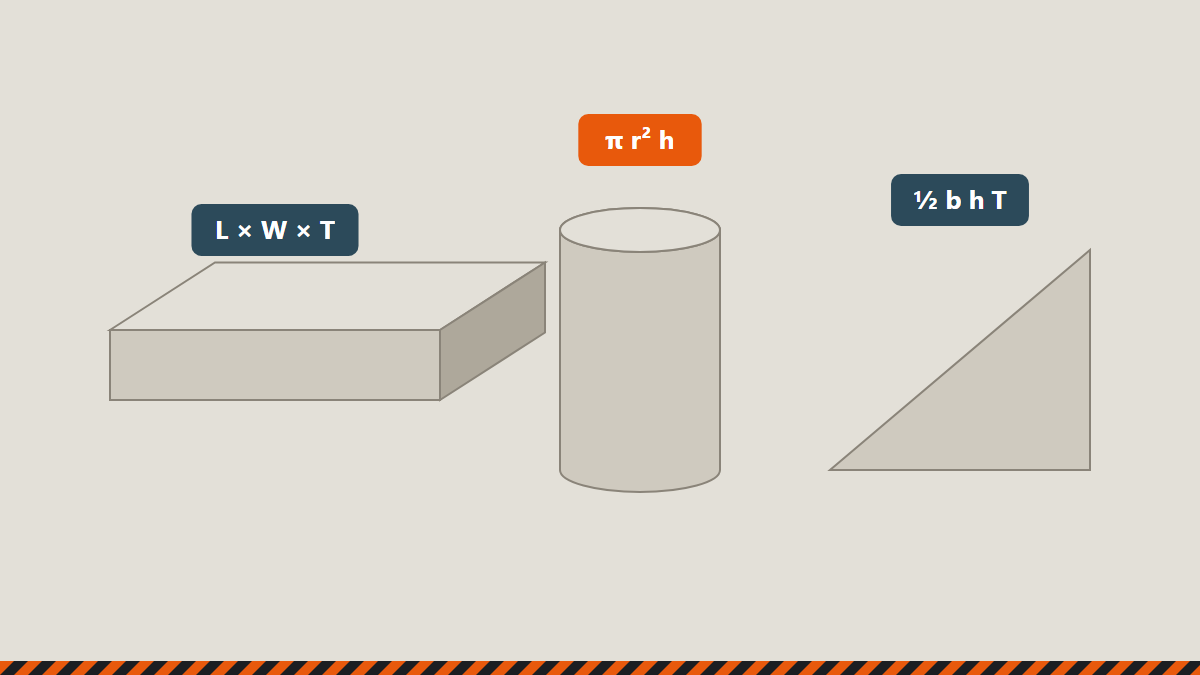
The concrete calculator with slope uses the wedge formula ½ × length × height × width. A solid ramp is half of a box cut on the diagonal. Divide cubic feet by 27 for cubic yards.
Volume (ft³) = ½ × run (ft) × rise (ft) × width (ft)
Cubic yards (yd³) = volume (ft³) ÷ 27
- Run: the level ramp length, in feet (ft).
- Rise: the height at the top, in inches (in) ÷ 12 for feet.
- Width: the ramp width side to side, in feet.
In metric, use meters to get cubic meters (m³).
Volume (m³) = ½ × run (m) × rise (m) × width (m)
1 m³ = 1.308 yd³ = 35.3 ft³
Worked Example: 12 ft Ramp with a 12 Inch Rise
A solid ramp with a 12 ft (3.66 m) run, a 12 inch (30 cm) rise, and a 4 ft (1.22 m) width holds 24.00 cubic feet, or 0.89 cubic yards (0.68 m³). The slope is 12 in over 144 in, a 1:12 ratio.
- Convert the rise to feet: 12 in ÷ 12 = 1 ft.
- Multiply run × rise × width: 12 ft × 1 ft × 4 ft = 48.00 ft³.
- Take half for the wedge: 48.00 ÷ 2 = 24.00 ft³, and 24.00 ÷ 27 = 0.89 yd³.
- Add 10% for waste: 0.98 yd³ (26.40 ft³), or 44 bags of 80 lb concrete.
Try it
Drag the sliders and the diagram redraws to scale.
Linked to the calculator above: moving a slider updates your estimate.
With your values
½ × 12 ft × 1 ft × 4 ft = 24.00 ft³
- Cubic feet
- 24.00
- Cubic yards
- 0.89
- Cubic meters
- 0.68
Where to Use the Ramp Calculator
The ramp calculator covers 3 common solid wedge pours, including wheelchair ramps and shed ramps. The sizes are sample inputs:
- Wheelchair ramps: a 12 ft run, 12 in rise, and 4 ft width at a 1:12 slope need 0.89 yd³ (0.68 m³).
- Shed ramps: a 6 ft run, 8 in rise, and 6 ft width need 12.00 ft³, or 20 bags of 80 lb concrete.
- Loading ramps: a 10 ft run, 18 in rise, and 8 ft width need 2.22 yd³ (1.70 m³).
Ramp Slope Rules and Sloped Slabs
Ramp slope is set by local codes, not by the calculator. For accessible ramps in the US, section 405.2 of the 2010 ADA Standards for Accessible Design published by the U.S. Access Board sets a running slope not steeper than 1:12, and section 405.6 limits the rise of any ramp run to 30 inches (760 mm).
A 30 ft run with a 30 in rise and a 4 ft width holds 5.56 yd³ as a solid wedge. A sloped slab of even thickness over compacted fill is a slab: 30 × 4 ft at 4 in holds 1.48 yd³. Use the slab calculator for that case.
Concrete for a 4 ft Wide Ramp at a 1:12 Slope
For a 4 ft (1.22 m) wide ramp at 1:12, find the rise below.
| Rise | Run | Cubic feet | Cubic yards | Cubic meters | 80 lb bags |
|---|---|---|---|---|---|
| 6 in (15 cm) | 6 ft (1.83 m) | 6.00 | 0.22 | 0.17 | 10 |
| 12 in (30 cm) | 12 ft (3.66 m) | 24.00 | 0.89 | 0.68 | 40 |
| 18 in (46 cm) | 18 ft (5.49 m) | 54.00 | 2.00 | 1.53 | 90 |
| 24 in (61 cm) | 24 ft (7.32 m) | 96.00 | 3.56 | 2.72 | 160 |
| 30 in (76 cm) | 30 ft (9.14 m) | 150.00 | 5.56 | 4.25 | 250 |
Common Ramp Calculation Mistakes
The 3 most common ramp mistakes involve the ½ factor, the run, and landings.
- Divide by 2 for the wedge. Run × rise × width alone gives 48.00 ft³ for the 12 ft example, double the real 24.00 ft³.
- Measure the run on the level, not along the sloped surface.
- Add level landings at the top and bottom as separate slabs, if the plan has them.
Ramp & Slope Concrete Calculator FAQ
How much concrete do I need for a ramp?
A solid ramp with a 12 ft run, 12 inch rise, and 4 ft width needs 24.00 cubic feet, or 0.89 cubic yards (0.68 m³). With a 10 percent waste allowance, plan for 0.98 yd³. Enter your own run, rise, and width above for an exact figure.
How do I calculate concrete for a slope?
To calculate concrete for a slope, multiply ½ × run × rise × width, with every measurement in feet, then divide by 27 for cubic yards. The run is the level length and the rise is the height at the top. Use meters for every measurement to get cubic meters.
Does the ramp calculator check the slope against code?
No, the ramp calculator measures concrete volume only and does not check the slope. Local codes set the maximum slope, rise, landings, and handrails. For US accessible ramps, the 2010 ADA Standards set a running slope not steeper than 1:12. Confirm the rules with your building department before forming.
How many bags of concrete do I need for a shed ramp?
A shed ramp with a 6 ft run, 8 inch rise, and 6 ft width needs 20 bags of 80 lb concrete or 27 bags of 60 lb concrete, before waste. The ramp holds 12.00 cubic feet (0.34 m³). With 10 percent added for waste, plan for 22 bags of 80 lb concrete.
Sources
Every result on this page uses plain geometry and the exact unit definitions below. The full list of formulas and constants is on the How we calculate page.
Related guides