
5 Types of Concrete and Their Uses
Learn the 5 types of concrete (ready-mix, precast, reinforced, high-strength, and lightweight), what concrete is made of, and where each type is used.


The 5 types of concrete used most in building are ready-mix, precast, reinforced, high-strength, and lightweight concrete. All 5 types start from the same basic recipe of cement, water, and aggregates. Each type changes how the concrete is made, delivered, or strengthened to suit a job, from a backyard patio to a high-rise column. This guide covers what concrete is made of, why concrete is needed, and where each type is used.
What Is Concrete Made Of?
Concrete is made of cement, water, aggregates, air, and admixtures. The National Ready Mixed Concrete Association (NRMCA) describes concrete as a mixture of paste and aggregates: cement and water form a paste that surrounds and binds each particle of sand and stone.
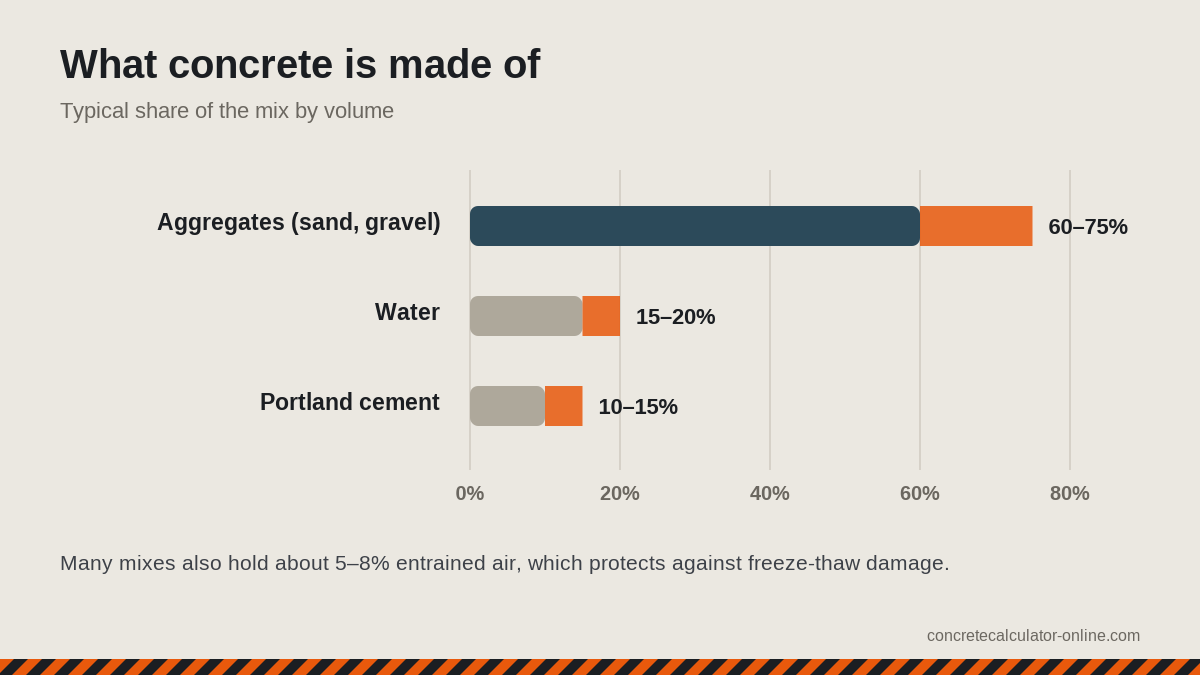
NRMCA gives these typical proportions by volume:
| Ingredient | Share of the mix by volume |
|---|---|
| Portland cement | About 10 to 15 percent |
| Aggregates (sand, gravel, crushed stone) | About 60 to 75 percent |
| Water | About 15 to 20 percent |
| Entrained air | About 5 to 8 percent more in many mixes |
The 5 ingredients each do a job:
- Cement reacts with water and binds the mix into a solid mass.
- Water starts the reaction with the cement and makes the mix workable.
- Aggregates fill most of the volume. Sand is the fine aggregate, and gravel or crushed stone is the coarse aggregate.
- Air forms small bubbles that protect concrete from freeze-thaw damage.
- Admixtures change how the mix behaves. NRMCA lists air-entraining, water-reducing, set-retarding, and high-range water-reducing admixtures.
The water-cement ratio is the weight of the mixing water divided by the weight of the cement. The strength of the paste depends on this ratio, and NRMCA notes that high-quality concrete comes from lowering the water-cement ratio as far as possible without losing workability. For a mix made on site, the mix ratio calculator and the sand, gravel, and cement calculator split a volume into each material.
What Does Concrete Do?
Concrete carries weight that pushes down on it, and it holds a shape once it hardens. The Portland Cement Association (PCA) explains that cement reacts with water and binds the aggregates into a solid, stone-like mass, and that concrete keeps gaining strength over time, mostly in the first few weeks.
Concrete is strongest in compression, so suppliers rate it by compressive strength in pounds per square inch (psi). Patios and paths use about 3,000 psi (20 MPa), and driveways use about 4,000 psi (28 MPa). The concrete psi guide explains what these numbers mean.
Why Is Concrete Needed?
Concrete is needed because fresh concrete flows into any form and then hardens into a strong, durable solid. One material makes a slab, a footing, a wall, a column, or a step.
Concrete is used in 6 common building parts:
- Foundations and footings under houses and decks
- Slabs for patios, driveways, garage floors, and sidewalks
- Walls for basements and retaining structures
- Columns and beams in larger buildings
- Pipes, poles, and barriers made in a plant
- Bridge decks, piers, and parking structures
5 Types of Concrete
The 5 types of concrete below cover most building work. Each type uses the same basic ingredients, and each type changes one thing: where the concrete is mixed, where the concrete is cast, what goes inside it, or how strong or light it is.
Ready-Mix Concrete
Ready-mix concrete is concrete batched at a plant and delivered to the site ready to place. NRMCA reports that the large majority of ready-mix concrete reaches the site in truck-mounted, rotating drum mixers. Some plants mix the concrete in a stationary mixer, and others load the materials straight into the truck drum.
Ready-mix concrete suits jobs above about 1 cubic yard (0.76 m³), such as driveways, patios, and slabs. One cubic yard takes 45 bags of 80 lb (36 kg) premixed concrete, which makes bags slow for larger pours. The ready-mix calculator gives the order in cubic yards and truck loads.
Precast Concrete
Precast concrete is concrete cast somewhere other than its final position, according to NRMCA. A plant casts the part, and trucks, rail, or barges carry the finished part to the site.
Precast concrete is used for wall panels, bridge girders, pipes, poles, crash barriers, and lift stations. A precast part arrives hardened and ready to set in place, with no formwork or curing time on site for that part.
Reinforced Concrete
Reinforced concrete is concrete with steel bars or wire mesh set inside it. Concrete resists crushing far better than bending. NRMCA states in CIP 16, Flexural Strength of Concrete that the flexural (bending) strength of concrete is about 10 to 15 percent of its compressive strength. Designers leave that flexural strength out when they size structural members, so the steel carries the tension.
Reinforced concrete is used in footings, foundation walls, columns, beams, and slabs that carry heavy loads. Local codes and the engineer’s drawings set the bar size and spacing. The rebar calculator counts the bars and their weight for a slab.
High-Strength Concrete
High-strength concrete is concrete with a specified compressive strength of about 8,000 psi (55 MPa) or more, according to NRMCA CIP 33, High Strength Concrete. NRMCA notes that strengths above 20,000 psi (140 MPa) have been used in cast-in-place buildings.
High-strength mixes use more cementitious material, in the range of 700 to 1,000 lb per cubic yard (400 to 600 kg per m³), and a low water-cementitious materials ratio of 0.23 to 0.35. High-range water-reducing admixtures keep the mix workable at that low water content. NRMCA lists 4 reasons to use high-strength concrete:
- Putting concrete into service sooner, such as opening a pavement to traffic
- Shrinking columns and other members to free up space in high-rise buildings
- Building long-span bridges and more durable bridge structures
- Reaching special properties, such as abrasion resistance, for parking garages and heavy-duty industrial floors
Lightweight Concrete
Lightweight concrete is concrete made with lighter aggregates, so the hardened concrete weighs less per cubic foot. NRMCA CIP 36, Structural Lightweight Concrete gives structural lightweight concrete a density of 90 to 120 lb/ft³ (1,440 to 1,840 kg/m³). Normal-weight concrete has a density of 140 to 150 lb/ft³ (2,240 to 2,400 kg/m³).
The lightweight aggregate is often expanded shale, clay, or slate, fired in a rotary kiln to form a porous structure. The main use is to cut the dead load on a structure, which allows smaller columns, footings, and load-bearing members. Structural lightweight concrete is used in bridge decks, parking structures, tilt-up walls, and slabs on metal deck.
Slab weight by concrete type
Weight (lb) = volume (ft³) × density (lb/ft³)
A 10 × 10 ft slab at 4 in (10 cm) holds 33.3 ft³ (0.94 m³). At 150 lb/ft³ the slab weighs 5,000 lb (2,265 kg). At 120 lb/ft³, the top of the lightweight range, the slab weighs 4,000 lb (1,814 kg).
The concrete weight calculator works out the weight of any pour.
Types of Concrete Compared
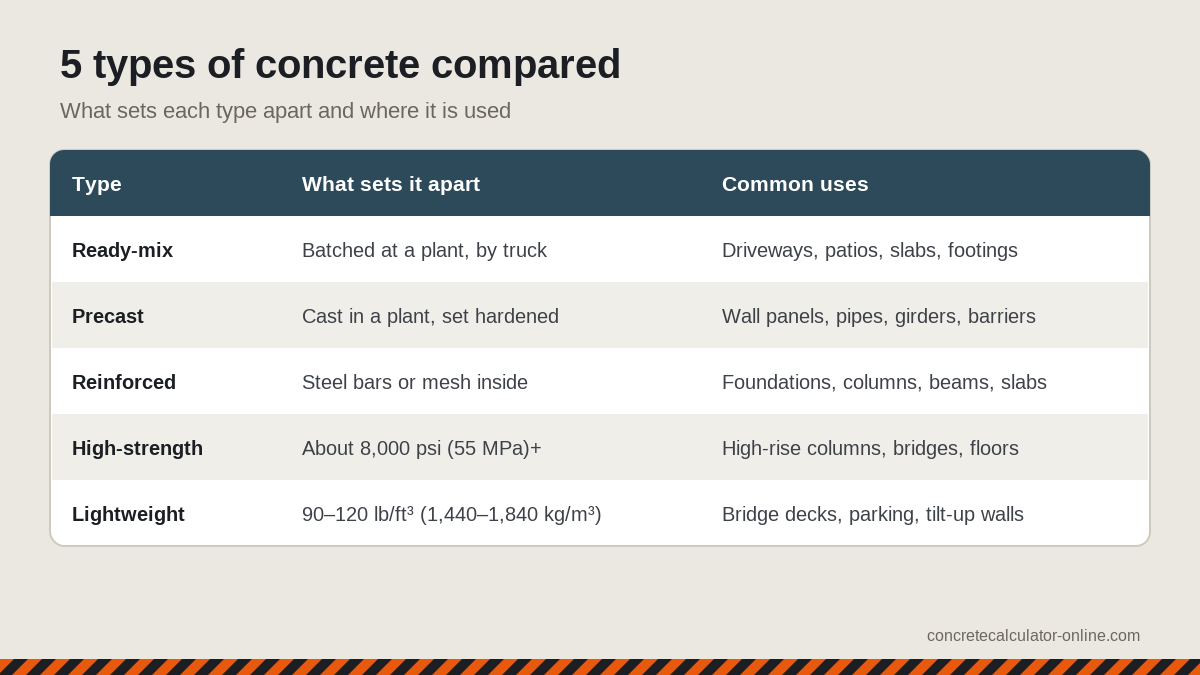
The types of concrete compared below show what sets each type apart and where each one is used.
| Type | What sets it apart | Common uses |
|---|---|---|
| Ready-mix | Batched at a plant, delivered by truck | Driveways, patios, slabs, footings |
| Precast | Cast in a plant, set in place hardened | Wall panels, pipes, girders, barriers |
| Reinforced | Steel bars or mesh inside | Foundations, columns, beams, heavy slabs |
| High-strength | About 8,000 psi (55 MPa) or more | High-rise columns, bridges, industrial floors |
| Lightweight | 90 to 120 lb/ft³ (1,440 to 1,840 kg/m³) | Bridge decks, parking structures, tilt-up walls |
The 5 types overlap. A ready-mix driveway with wire mesh is ready-mix and reinforced concrete at the same time, and a high-strength column is often reinforced.
How to Choose a Type of Concrete
To choose a type of concrete, start with the size of the job and the load it carries. Use these 4 steps:
- Work out the volume, and pick bags for small jobs or ready-mix for jobs above about 1 cubic yard.
- Match the strength to the project: about 3,000 psi (20 MPa) for patios and paths, about 4,000 psi (28 MPa) for driveways.
- Add reinforcement, if the slab carries vehicles or the plans call for steel.
- Follow local codes and the engineer’s drawings for footings, walls, and any structural member.
The concrete strength guide lists grades in psi and MPa, and the concrete calculator gives the volume for slabs, footings, columns, and stairs in one total.


