Driveway Concrete Calculator
This concrete calculator for driveway slabs multiplies length, width, and thickness to find the pour volume. Pick a 4, 5, or 6 inch thickness or type your own, in feet, inches, or meters. The results show cubic yards, cubic meters, ready-mix truck loads, bag counts, and cost.
 By Muhammad AsimPublished How we calculate
Your estimate
Total volume with waste
3.26yd³
- Cubic meters
- 2.49 m³
- Cubic feet
- 88.0 ft³
Premixed bags
- 80 lb bags147
- 60 lb bags196
- 40 lb bags294
- 25 kg bags215
- 20 kg bags267
- Weight
- 13,185 lb · 5,981 kg
- Ready-mix truck loads (10 yd³ each)
- 0.33
- Concrete cost
Formula with your numbers
20 ft × 12 ft × 0.333 ft × 1.1 = 88.00 ft³
Includes a 10% waste allowance. Bags are rounded up. Weight uses 2,400 kg/m³ (150 lb/ft³).
Your estimate3.26 yd³ · 147 × 80 lb
Planning several pours or a cost sheet? Get the free Excel template (7 tabs, no sign-up).
How to Use the Driveway Concrete Calculator
To use the driveway concrete calculator, follow these 4 steps.
- Measure the length from the garage to the street edge.
- Measure the width. Split an L-shaped driveway into rectangles, one section each.
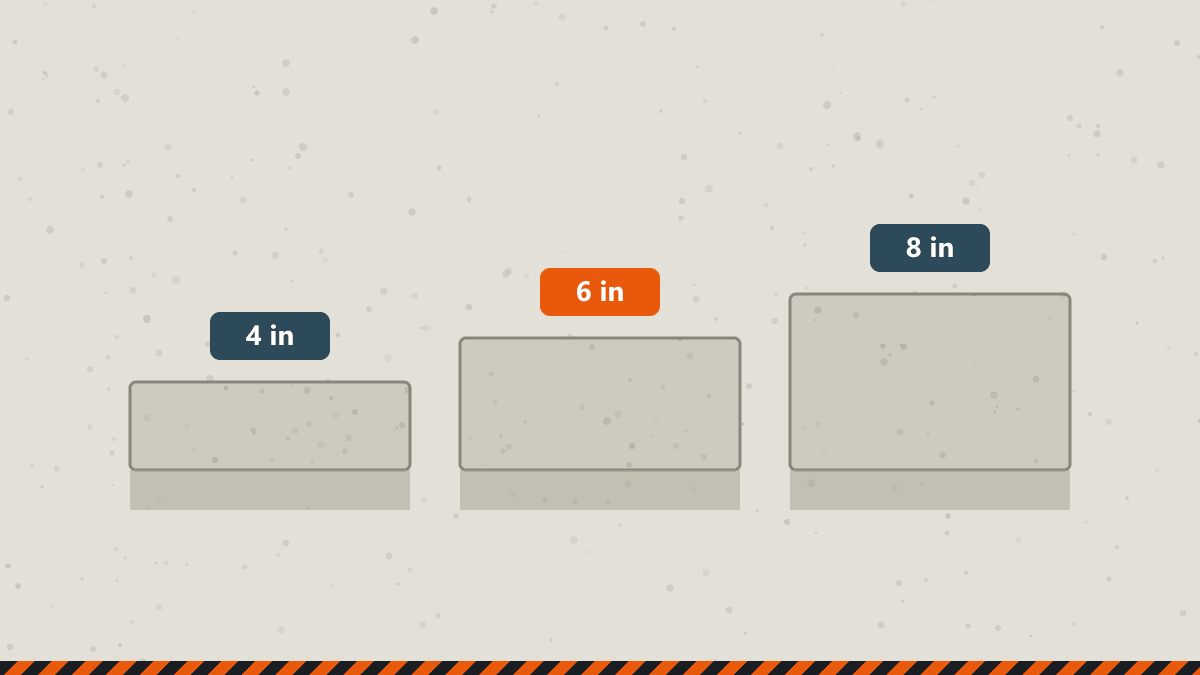
- Tap a thickness chip: 4 in for cars, 5 or 6 in for heavier vehicles.
- Read the cubic yards and truck loads, then compare the result with supplier quotes.
Driveway Concrete Formula
Driveway concrete equals length × width × thickness, converted to cubic yards. Convert the thickness from inches to feet before you multiply.
Volume (ft³) = length (ft) × width (ft) × (thickness (in) ÷ 12)
Cubic yards (yd³) = volume (ft³) ÷ 27
- Length: the driveway distance from end to end, in feet (ft).
- Width: the driveway distance from edge to edge, in feet.
- Thickness: 4, 5, or 6 inches (in), divided by 12.
The metric driveway formula uses meters for length, width, and thickness and gives cubic meters (m³).
Volume (m³) = length (m) × width (m) × thickness (m)
Cubic meters × 1.308 = cubic yards
Worked Example: 20 × 12 ft Driveway at 4 Inches
A 20 × 12 ft driveway at 4 inches (10 cm) thick takes 80 cubic feet, or 2.96 cubic yards (2.27 m³) of concrete.
- Find the surface area: 20 ft × 12 ft = 240 ft².
- Multiply by the thickness: 240 ft² × (4 ÷ 12) ft = 80 ft³.
- Divide by 27: 80 ÷ 27 = 2.96 yd³.
- Add 10% for waste: 2.96 × 1.1 = 3.26 yd³.
- Estimate the weight: 80 ft³ × 150 lb per ft³ = 12,000 lb (5,437 kg) of wet concrete.
The same driveway needs 3.70 yd³ at 5 inches and 4.44 yd³ at 6 inches. Each extra inch adds 0.74 yd³.
Try it
Drag the sliders and the diagram redraws to scale.
Linked to the calculator above: moving a slider updates your estimate.
With your values
20 ft × 12 ft × 0.333 ft = 80.00 ft³
- Cubic feet
- 80.00
- Cubic yards
- 2.96
- Cubic meters
- 2.27
Where to Use the Driveway Calculator
The driveway calculator handles 4 common vehicle pours, including single drives, double drives, and aprons:
- Single-car driveways: a 20 × 12 ft drive at 4 in needs 2.96 yd³ (2.27 m³).
- Double-car driveways: a 24 × 24 ft drive at 4 in needs 7.11 yd³ (5.44 m³).
- Long driveways: a 50 × 10 ft drive at 5 in needs 7.72 yd³ (5.90 m³).
- Driveway aprons: a 12 × 6 ft apron at 6 in needs 1.33 yd³ (1.02 m³).
Driveway Thickness, Strength, and Reinforcement
Driveway thickness depends on the heaviest vehicle that uses the slab. A 4 inch (10 cm) slab carries passenger cars. A 5 or 6 inch (13 or 15 cm) slab suits pickup trucks, delivery vans, and heavy trucks.
Driveway concrete is usually about 4,000 pounds per square inch (psi) (28 MPa). Control joints, rebar, and wire mesh are options to discuss with a contractor and the local code:
- Control joints: cut grooves that guide cracks into straight lines.
- Rebar: steel bars set in a grid on chairs.
- Wire mesh: welded steel sheets set in the slab.
How to Calculate the Cost of a Concrete Driveway
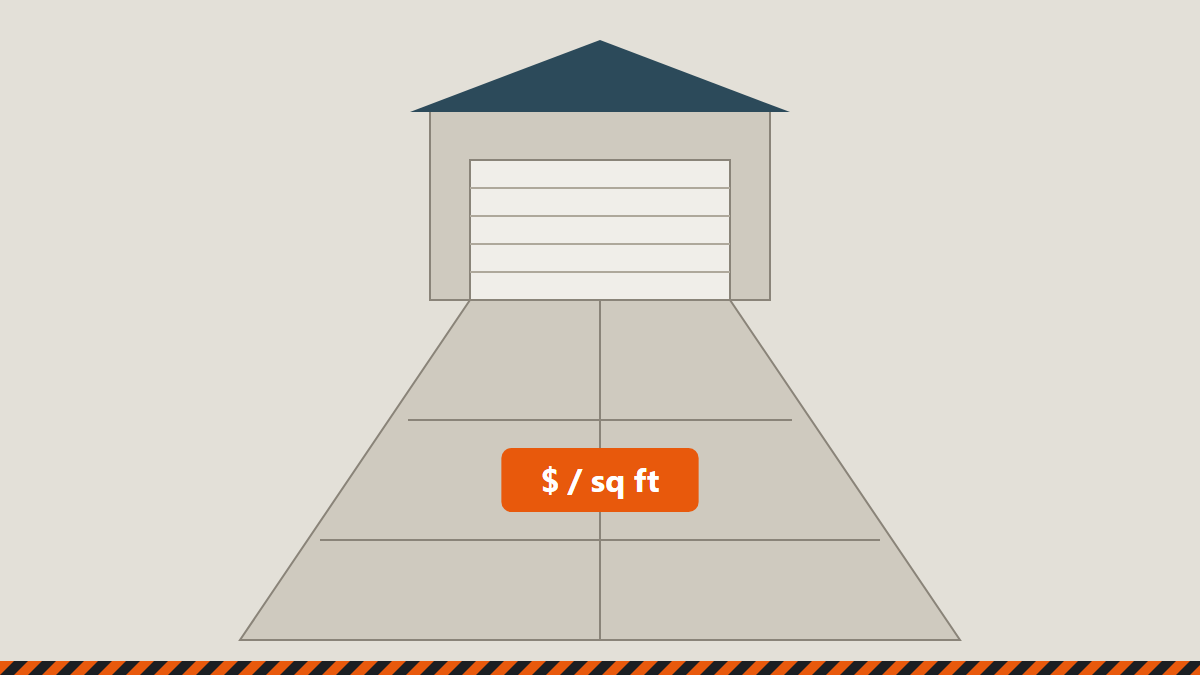
Multiply the cubic yards, with waste, by the ready-mix price, then add the area times the labor and reinforcement rates. At typical 2026 prices, the 20 × 12 ft driveway from the worked example comes to about $1,929, or $8.04 per square foot, before fees:
- Concrete: 3.26 yd³ × $150 = $489.
- Labor and finishing: 240 sq ft × $5 = $1,200.
- Rebar or wire mesh: 240 sq ft × $1 = $240.
Across the low and high prices, the same driveway costs $1,564 to $2,370, or $6.52 to $9.88 per square foot. Delivery and a short-load fee come on top, because 3.26 yd³ is under the usual 5 yd³ minimum. Removing an old driveway adds $2–$4 per square foot, or more with rebar; see the concrete removal cost guide.
In this estimate, a thicker slab changes only the concrete line: at 6 inches, the concrete for this driveway costs $733 instead of $489. The ready-mix prices are for 3,000 psi concrete, so ask the supplier to price a 4,000 psi driveway mix. Enter your own size and quotes in the concrete slab cost calculator, and see the concrete driveway cost guide for installed prices by driveway size, finish, and removal.
Cubic Yards for Common Driveway Sizes
A 24 × 24 ft double driveway at 4 inches needs 7.11 cubic yards, before waste.
| Driveway size | Area | 4 in (yd³) | 5 in (yd³) | 6 in (yd³) | 4 in (m³) |
|---|---|---|---|---|---|
| 20 × 10 ft | 200 ft² | 2.47 | 3.09 | 3.70 | 1.89 |
| 20 × 12 ft | 240 ft² | 2.96 | 3.70 | 4.44 | 2.27 |
| 24 × 12 ft | 288 ft² | 3.56 | 4.44 | 5.33 | 2.72 |
| 20 × 20 ft | 400 ft² | 4.94 | 6.17 | 7.41 | 3.78 |
| 24 × 24 ft | 576 ft² | 7.11 | 8.89 | 10.67 | 5.44 |
| 40 × 12 ft | 480 ft² | 5.93 | 7.41 | 8.89 | 4.53 |
Common Driveway Calculation Mistakes
The 3 most common driveway mistakes involve thickness, flared ends, and waste.
- Choose the thickness for the heaviest vehicle. A 20 × 12 ft drive at 6 in needs 4.44 yd³, not 2.96 yd³.
- Measure flared ends and curves as separate rectangles, and enter each one as its own section.
- Add 10 percent for waste, if the subgrade has dips.
Driveway Concrete Calculator FAQ
How many yards of concrete do I need for a 24 × 24 driveway?
A 24 × 24 ft driveway at 4 inches thick needs 7.11 cubic yards (5.44 m³) of concrete. With a 10 percent waste allowance, plan for 7.82 yd³. A standard 10 yd³ ready-mix truck carries that volume in 1 load. At 5 inches, the same driveway needs 8.89 yd³.
Is 4 inches of concrete enough for a driveway?
Yes, 4 inches (10 cm) of concrete is a common thickness for driveways that carry passenger cars. Use 5 or 6 inches (13 or 15 cm) for pickup trucks, RVs, or heavy delivery trucks. Local codes set the minimum in some areas, so check with the local building department before the pour.
What strength of concrete is used for a driveway?
Driveways usually use concrete of about 4,000 pounds per square inch (psi), or 28 MPa. Patios and paths use about 3,000 psi (20 MPa). Give the target strength to the ready-mix supplier when you order, and confirm the mix with the contractor and the local code for your area.
Should I use bags or ready-mix for a driveway?
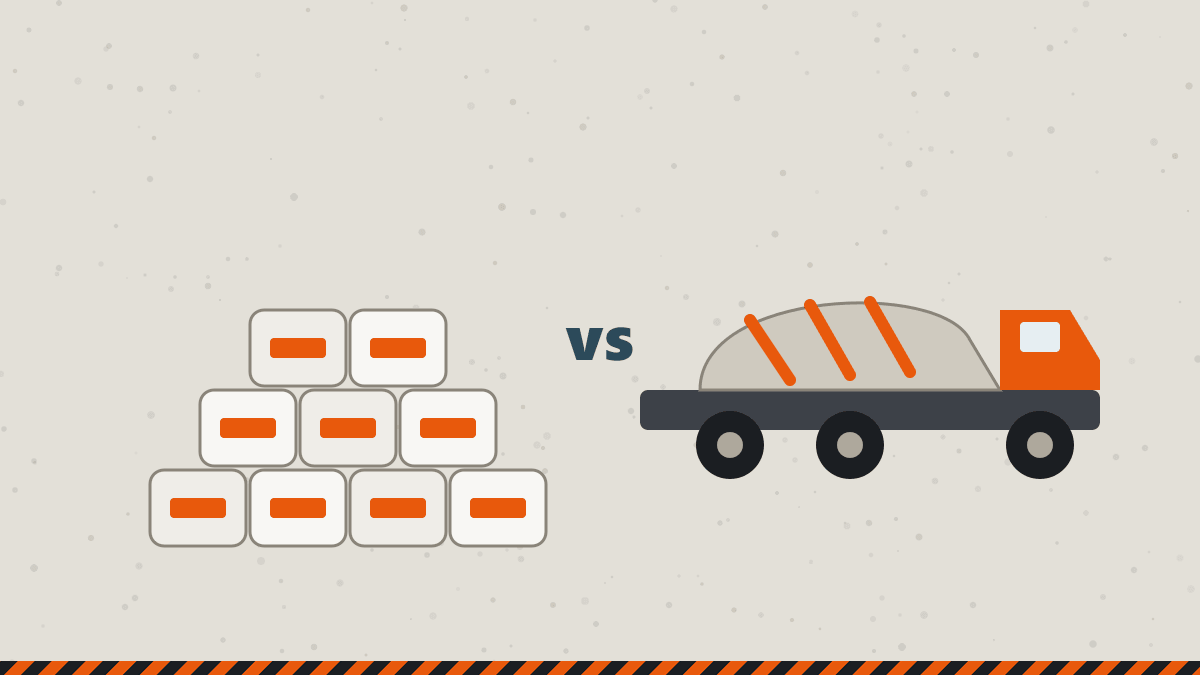
Ready-mix is the practical choice for almost every driveway. A 20 × 12 ft drive at 4 inches needs 3.26 yd³ with waste, which equals 147 bags of 80 lb concrete. Mixing that many bags by hand is slow work for a small crew. Keep bagged concrete for patches and small repairs.
Sources
Every result on this page uses plain geometry and the exact unit definitions below. The full list of formulas and constants is on the How we calculate page.
Related guides