
How Many Bags of Concrete per Post Hole? Chart by Hole Size
How many bags of concrete per post hole in 40, 50, 60 and 80 lb sizes, with a chart of common hole sizes, the post subtracted, and a full fence example.


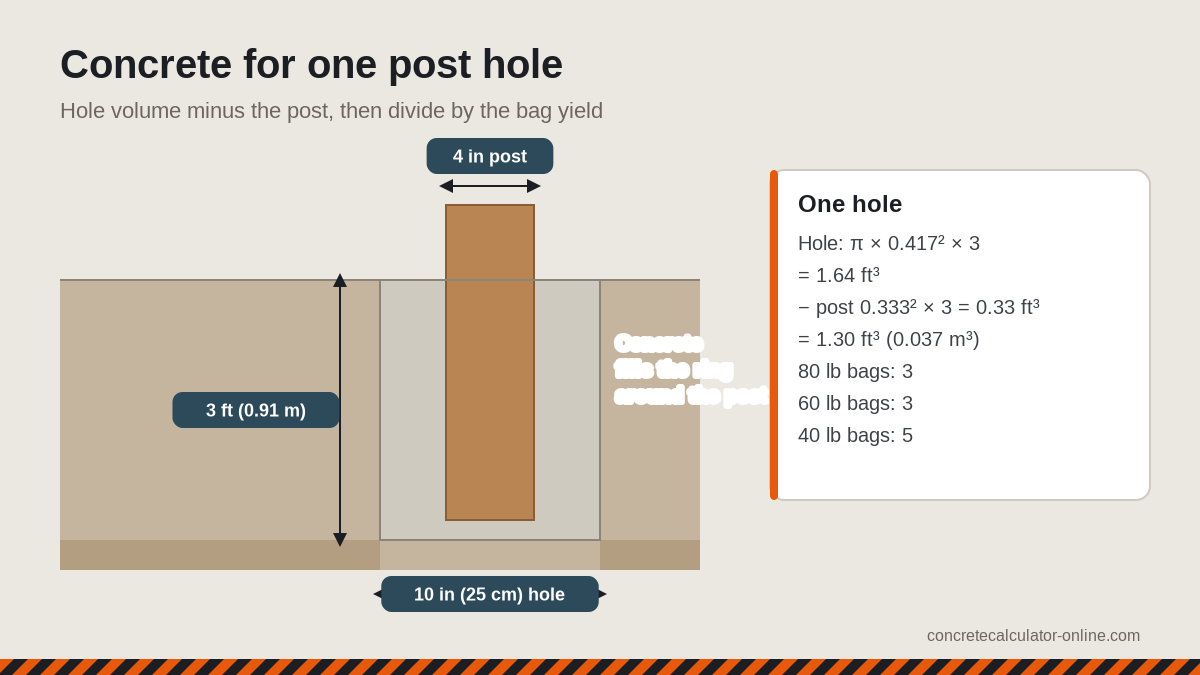
A post hole 10 inches (25 cm) wide and 3 feet (0.91 m) deep, with a 4 inch post, takes 3 bags of 80 lb concrete, 3 bags of 60 lb, 4 bags of 50 lb, or 5 bags of 40 lb. The concrete around the post fills 1.30 cubic feet (0.037 m³). This guide shows how the bag count is worked out, gives a chart for common hole sizes, and runs a full fence example so you can buy the right number of bags for every post.
How Many Bags of Concrete per Post Hole?
A standard 10 inch × 3 ft post hole with a 4 inch post takes 3 bags of 80 lb concrete, because the concrete around the post fills 1.30 ft³. Here is the same hole in each bag size:
| Bag size | Yield per bag | Bags per hole (with post) | Bags per hole (empty hole) |
|---|---|---|---|
| 80 lb | 0.60 ft³ | 3 | 3 |
| 60 lb | 0.45 ft³ | 3 | 4 |
| 50 lb | 0.375 ft³ | 4 | 5 |
| 40 lb | 0.30 ft³ | 5 | 6 |
The post takes up 0.33 ft³ of the hole, which saves a bag in some sizes and none in others. Counts are rounded up per hole, before waste. In metric, the 0.037 m³ of concrete equals 4 bags of 25 kg or 4 bags of 20 kg premix.
How Do You Calculate Concrete for a Post Hole?
To calculate concrete for a post hole, find the volume of the round hole, subtract the post, and divide by the bag yield. The hole is a cylinder, so its volume is π × radius² × depth. A square post takes up width × width × depth.
Post hole concrete
Concrete (ft³) = [π × (diameter ÷ 2)² − post width²] × depth, all in feet
A 10 in hole 3 ft deep with a 4 in post: 3.1416 × 0.417² × 3 = 1.64 ft³, minus 0.333² × 3 = 0.33 ft³ for the post, leaves 1.30 ft³. 1.30 ÷ 0.60 = 3 bags of 80 lb (rounded up).
In metric, use meters for the diameter, depth, and post width to get cubic meters. Convert inches to feet by dividing by 12, and remember that the formula uses the radius, which is half the diameter.
Bags of Concrete per Post Hole by Hole Size
A post hole needs between 1 and 4 bags of 80 lb concrete across the common sizes in this chart. A wider hole adds concrete faster than a deeper one, because the area grows with the square of the diameter.
| Hole size | Post | Concrete | 80 lb | 60 lb | 50 lb | 40 lb |
|---|---|---|---|---|---|---|
| 8 in × 2 ft (20 cm × 0.61 m) | 4 in | 0.48 ft³ | 1 | 2 | 2 | 2 |
| 8 in × 3 ft (20 cm × 0.91 m) | 4 in | 0.71 ft³ | 2 | 2 | 2 | 3 |
| 10 in × 3 ft (25 cm × 0.91 m) | 4 in | 1.30 ft³ | 3 | 3 | 4 | 5 |
| 12 in × 3 ft (30 cm × 0.91 m) | 4 in | 2.02 ft³ | 4 | 5 | 6 | 7 |
| 12 in × 3 ft (30 cm × 0.91 m) | 6 in | 1.61 ft³ | 3 | 4 | 5 | 6 |
| 12 in × 4 ft (30 cm × 1.22 m) | 6 in | 2.14 ft³ | 4 | 5 | 6 | 8 |
Bag counts are per hole, rounded up, before waste. For a single hole, round up as shown. For several holes, total the cubic feet first, as the fence example below does. The post hole concrete calculator works out any other size.
How Much Concrete Do You Need for a Fence?
A 16-post fence with 10 inch × 3 ft holes and 4 inch posts needs 20.85 cubic feet of concrete, or 39 bags of 80 lb with 10 percent waste. That fits a 120 ft (36.6 m) fence with a post every 8 ft: 15 sections and 16 posts.
- Measure one hole. Diameter 10 in (25 cm), depth 3 ft (0.91 m). Dig every hole to the same size so one figure covers them all.
- Find the hole volume. π × (10 ÷ 24)² × 3 = 1.636 ft³.
- Subtract the post. A 4 in post takes 0.333² × 3 = 0.333 ft³, leaving 1.303 ft³ per hole.
- Multiply by the number of posts. 1.303 × 16 = 20.85 ft³ (0.77 yd³, 0.59 m³).
- Add waste. 20.85 × 1.10 = 22.93 ft³.
- Divide by the bag yield and round up once. 22.93 ÷ 0.60 = 39 bags of 80 lb, or 22.93 ÷ 0.45 = 51 bags of 60 lb.
Rounding each hole up first would give 16 × 3 = 48 bags of 80 lb, which is 9 bags more than the job needs. Mix partial bags across holes and the total comes out right.
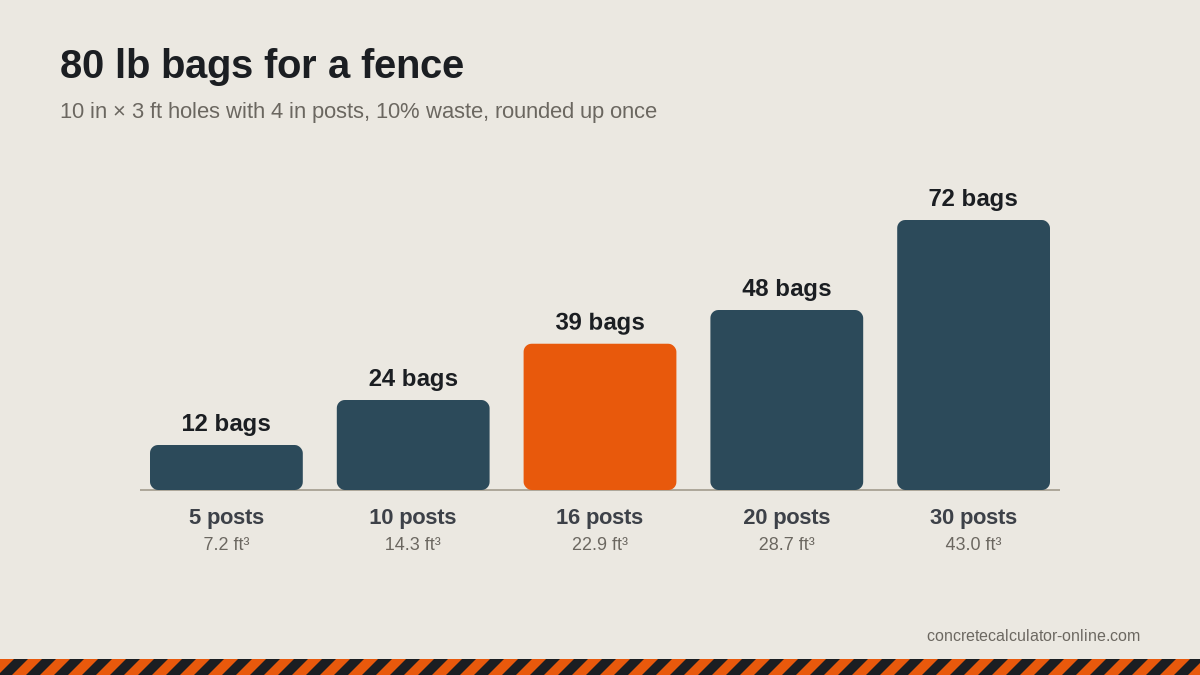
At 0.85 yd³ with waste, this fence is still a bag job: the volume is far below a ready-mix load, and each hole is filled on its own. The guide to bagged concrete vs ready-mix explains where the switch makes sense.
Which Bag Size Is Best for Post Holes?
The best bag size is the one that matches your hole without leaving a large part-bag over, and that you can lift and mix comfortably. For the 10 inch × 3 ft hole, 3 bags of 80 lb make 1.8 ft³ against the 1.30 ft³ needed, while 5 bags of 40 lb make 1.5 ft³.
Smaller bags waste less on a single hole, and they are easier to carry to the back of a yard. Larger bags mean fewer trips and fewer bags to open on a long fence. Fast-setting post mixes can list a different yield, so check the yield printed on the bag and divide by that number instead.
Does Dry-Pouring Change the Number of Bags?
No, dry-pouring premix into a post hole uses the same number of bags as mixing it first, because the bag yield already gives the finished volume. The 10 inch × 3 ft hole with a 4 inch post still takes 3 bags of 80 lb concrete. Do not apply the 1.54 dry volume factor to premixed bags; it belongs to loose cement, sand, and gravel that you mix yourself.
Whether a product supports dry-pouring at all is up to its maker, so read the bag label for the method, the water, and the wait before you load the post. Mix concrete fully for structural posts such as deck posts. The dry pour calculator counts bags for that method.
How Does Hole Depth Change the Bag Count?
Every extra 6 inches (15 cm) of depth in a 10 inch hole with a 4 inch post adds 0.22 ft³ of concrete, about 36 percent of an 80 lb bag. The volume grows in direct proportion to depth, so a hole twice as deep takes twice the concrete.
The right depth depends on the post height, the soil, and the local frost line, and the local building code sets it for structural posts such as deck footings. If you put gravel in the bottom of the hole for drainage, measure the depth from the top of the gravel, since the gravel takes the place of concrete.


