
Concrete Calculation Formula (with Examples)
The concrete calculation formula for slabs, walls, footings, columns, round slabs, and stairs, with worked examples in feet and meters and cubic yards.


The concrete calculation formula is volume = length × width × thickness, with every measurement in the same unit. Curved and stepped shapes use their own versions of that formula, and all of them end the same way: convert the result to cubic yards or cubic meters, then add a waste allowance. This guide gives the formula for 10 common shapes, with a worked example for each.
The Basic Concrete Calculation Formula
The basic concrete volume formula multiplies 3 dimensions in the same unit. Convert inches to feet by dividing by 12, multiply, and divide cubic feet by 27 to get cubic yards. In metric units, measure in meters and the result is already in cubic meters (m³).
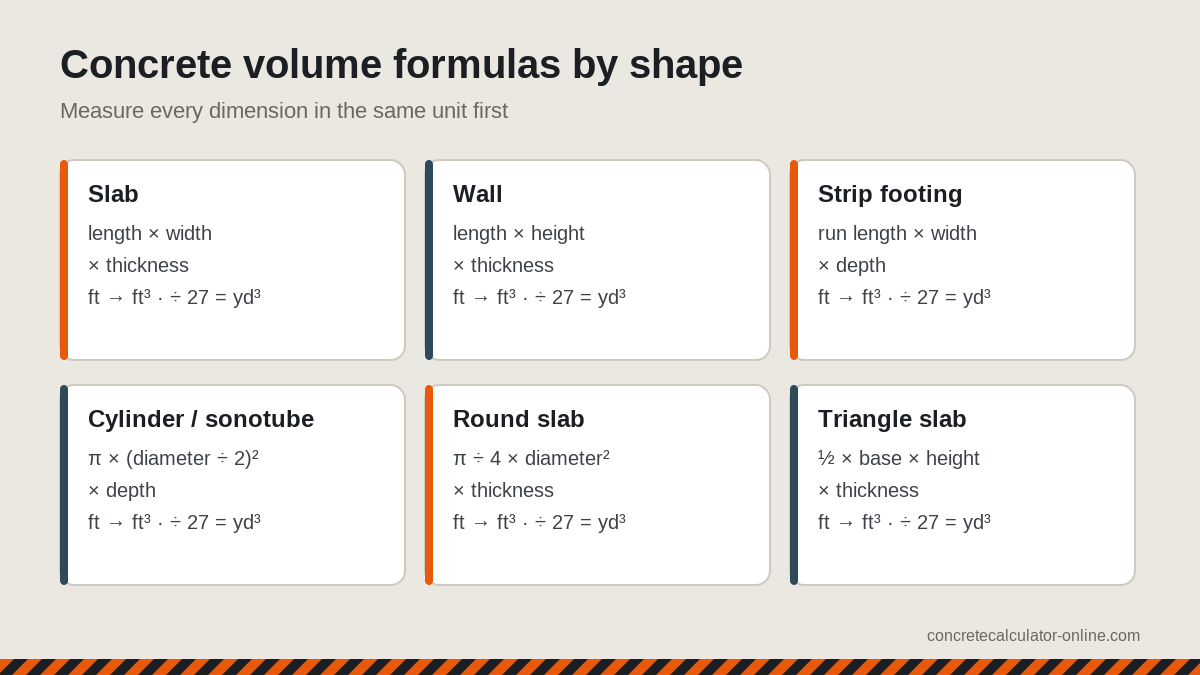
Slab
Volume (ft³) = length × width × thickness
A 12 × 10 ft slab at 4 inches (10 cm): 12 × 10 × 0.333 = 40 ft³ = 1.48 yd³ (1.13 m³).
Slabs cover patios, driveways, shed bases, sidewalks, and garage floors. Run any of them in the concrete slab calculator.
Metric Concrete Formula
The metric concrete formula uses meters for every dimension and gives cubic meters directly, with no division by 27. Divide centimeters by 100 and millimeters by 1,000 before you multiply.
Metric slab
Volume (m³) = length (m) × width (m) × thickness (m)
A 5 × 3 m slab at 10 cm: 5 × 3 × 0.10 = 1.5 m³ (1.96 yd³), or 161 bags of 20 kg concrete. A 4,000 × 2,500 mm pad at 100 mm: 4 × 2.5 × 0.1 = 1 m³.
Suppliers in the United Kingdom, Australia, and New Zealand quote ready-mix concrete per cubic meter, so the metric formula matches the number on a quote.
Wall Formula
The wall formula is the slab formula turned on its side: length × height × thickness. Enter the wall height where a slab takes its width.
Wall
Volume = length × height × thickness
A wall 20 ft long, 4 ft high, and 8 in (20 cm) thick: 20 × 4 × 0.667 = 53.3 ft³ = 1.98 yd³.
A poured wall sits on a footing, and the footing is a separate calculation. Size both with the concrete wall calculator.
Footing Formula
The footing formula uses length × width × depth. A strip footing uses the total run length around the building, and a pad footing uses the size of one pad times the number of pads.
Strip footing
Volume = run length × width × depth
A 40 ft run, 16 in wide and 8 in deep: 40 × 1.333 × 0.667 = 35.6 ft³ = 1.32 yd³.
Footing width and depth come from local codes and soil conditions, not from the formula. Estimate the concrete with the concrete footing calculator.
Cylinder Formula for Holes, Columns, and Sonotubes
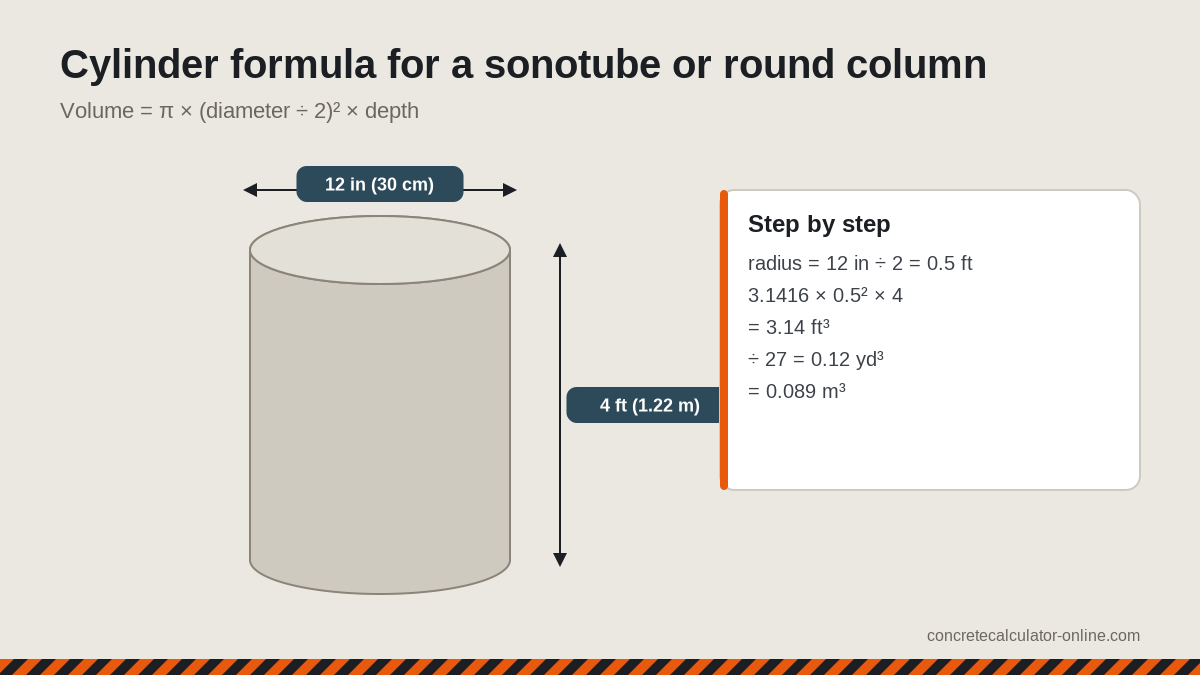
The cylinder formula is π × (diameter ÷ 2)² × depth. It covers post holes, round columns, sonotube forms, and piers.
Post hole
Volume = π × (diameter ÷ 2)² × depth
A 10 in hole, 3 ft deep: 3.1416 × (0.417)² × 3 = 1.64 ft³, or 3 bags of 80 lb concrete.
Sonotube
Volume = π × (tube diameter ÷ 2)² × depth
A 12 in tube, 4 ft deep: 3.1416 × (0.5)² × 4 = 3.14 ft³, or 6 bags of 80 lb concrete.
Multiply by the number of holes for a fence line. Subtract the post volume when the post sits in the hole before the pour. Use the post hole calculator, the sonotube calculator, or the column calculator.
Round Slab and Tube Formula
The round slab formula is π ÷ 4 × diameter² × thickness. A tube or ring subtracts the inner circle: π ÷ 4 × (outer diameter² − inner diameter²) × thickness.
Round slab
Volume = π ÷ 4 × (outer d² − inner d²) × thickness
A 10 ft round slab at 4 in: 26.2 ft³ = 0.97 yd³. With a 6 ft opening in the middle, the ring holds 16.8 ft³.
A half circle holds half the volume of the full circle. Try both in the round slab calculator.
Triangle Formula
The triangle formula is ½ × base × height × thickness. Corner pads and triangular patios use it, and an irregular slab splits into rectangles and triangles that add up.
Triangle slab
Volume = ½ × base × height × thickness
A triangle with a 10 ft base and 8 ft height at 4 in: ½ × 10 × 8 × 0.333 = 13.3 ft³.
Curb and Gutter Formula
The curb and gutter formula adds the curb and the flag: length × [curb depth × (curb height + flag thickness) + gutter width × flag thickness].
Curb and gutter
Volume = L × [cd × (ch + ft) + gw × ft]
50 ft of curb with a 6 in curb depth, 6 in curb height, 12 in gutter, and 4 in flag: 37.5 ft³ = 1.39 yd³.
Run curb sections in the full concrete calculator, which has a curb and gutter shape.
Stairs Formula
The stairs formula adds the stacked steps and the top platform: width × [run × rise × (1 + 2 + … + (risers − 1)) + platform depth × risers × rise].
Stairs
Volume = W × [run × rise × Σ(1…n−1) + platform × n × rise]
3 risers at 7 in, 11 in treads, a 36 in platform, and 4 ft wide: 27.4 ft³ = 1.02 yd³.
The concrete stairs calculator draws the steps as you type.
Adding Waste and Counting Bags
The waste step multiplies the volume by 1.05 to 1.10 for a 5 to 10 percent allowance. Bag counts divide the volume by the yield of one bag and round up.
Waste and bags
Bags = volume (ft³) × 1.10 ÷ bag yield, rounded up
The 12 × 10 ft slab with 10% waste: 40 × 1.1 = 44.0 ft³ = 74 bags of 80 lb (0.60 ft³ each) or 98 bags of 60 lb (0.45 ft³ each).
There are 4 common US bag sizes: 40, 50, 60, and 80 lb. One cubic yard takes 45 bags of 80 lb concrete or 60 bags of 60 lb concrete. Check other sizes in the concrete bag calculator.
How to Measure Before You Use a Formula
To measure for a concrete formula, take every dimension inside the formwork, since the concrete fills the space between the boards. Three habits keep the numbers accurate:
- Measure the length and width at 2 or more points, and use the largest value.
- Measure the depth at several points across the base, because a low spot takes extra concrete.
- Write each measurement with its unit, so inches never end up in a feet calculation.
Bags or Ready-Mix Concrete
Ready-mix concrete is usually the better choice above about 1 cubic yard (0.76 m³). Below that volume, premixed bags work well for post holes, small pads, and steps. The 80 lb bag calculator shows how many bags a small job takes.
Unit Conversion Table
The unit conversion table below lists the factors behind every formula on this page.
| Convert | Multiply by |
|---|---|
| inches to feet | ÷ 12 |
| cubic feet to cubic yards | ÷ 27 |
| cubic yards to cubic feet | × 27 |
| cubic yards to cubic meters | × 0.7646 |
| cubic meters to cubic yards | × 1.308 |
| cubic meters to cubic feet | × 35.3 |
| centimeters to meters | ÷ 100 |
Suppliers in the United States and Canada sell ready-mix concrete by the cubic yard, and most other countries sell by the cubic meter. Convert totals with the cubic yards calculator or the cubic meters calculator.
Common Formula Mistakes
The most common formula mistake is mixing units. A thickness of 4 entered as feet instead of inches makes the volume 12 times too large. Two more mistakes come up often:
- Forgetting to divide by 27, which leaves the answer in cubic feet.
- Using the radius in place of the diameter in π ÷ 4 × d², which makes a round slab 4 times too large.
All of these formulas run in the concrete calculator, which combines several shapes into one estimate. The full list of constants and sources is on the how we calculate page.


