Concrete Slab Calculator
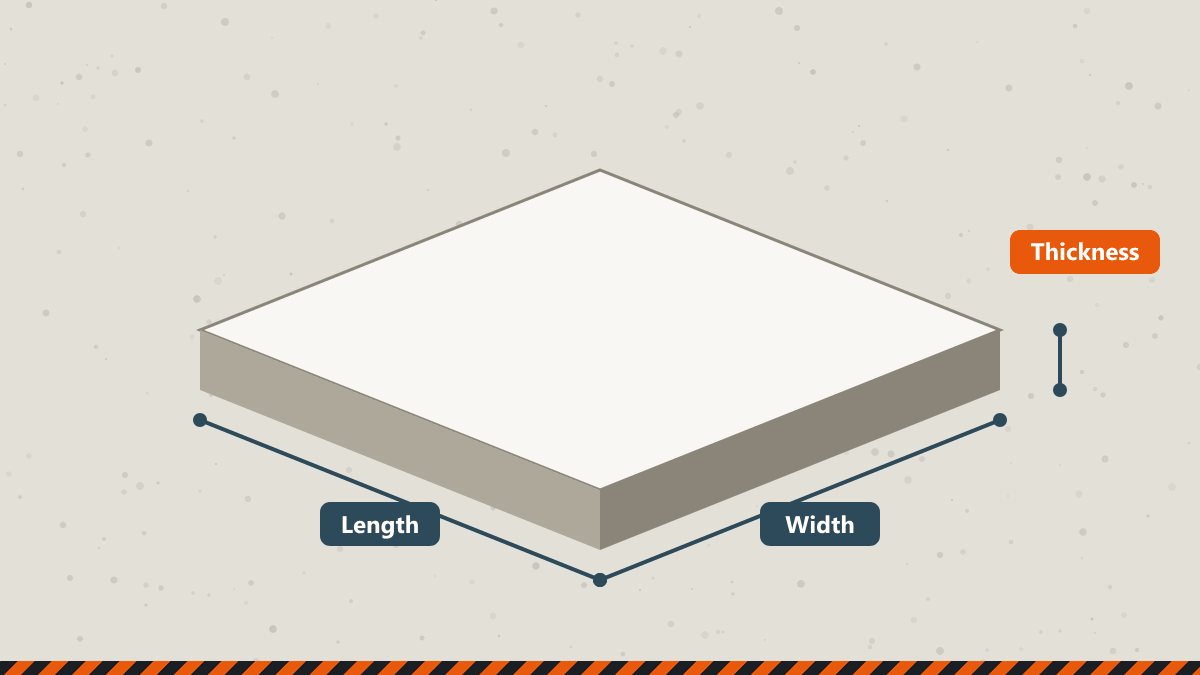
This concrete calculator for slab pours multiplies length, width, and thickness to find the volume of a rectangular slab. Enter feet, inches, meters, or centimeters. The results show cubic yards, cubic feet, and cubic meters, bag counts for 5 bag sizes, weight, ready-mix truck loads, and cost, with a 10% waste allowance.
 By Muhammad AsimPublished Updated How we calculate
Your estimate
Total volume with waste
1.63yd³
- Cubic meters
- 1.25 m³
- Cubic feet
- 44.0 ft³
Premixed bags
- 80 lb bags74
- 60 lb bags98
- 40 lb bags147
- 25 kg bags108
- 20 kg bags134
- Weight
- 6,592 lb · 2,990 kg
- Ready-mix truck loads (10 yd³ each)
- 0.16
- Concrete cost
Whole slab
- Ready-mix order
- –
- Reinforcement
- –
- Gravel base
- –
- Thickened edge
- –
- Vapour barrier
- –
- Soil pressure
- –
- Forms and stakes
- –
- Control joints
- –
Formula with your numbers
12 ft × 10 ft × 0.333 ft × 1.1 = 44.00 ft³
Includes a 10% waste allowance. Bags are rounded up. Weight uses 2,400 kg/m³ (150 lb/ft³).
Your estimate1.63 yd³ · 74 × 80 lb
Planning several pours or a cost sheet? Get the free Excel template (7 tabs, no sign-up).
How to Use the Concrete Calculator for a Slab
To use the concrete calculator for a slab, follow these 4 steps.
- Enter the length and width, and pick the unit next to each field.
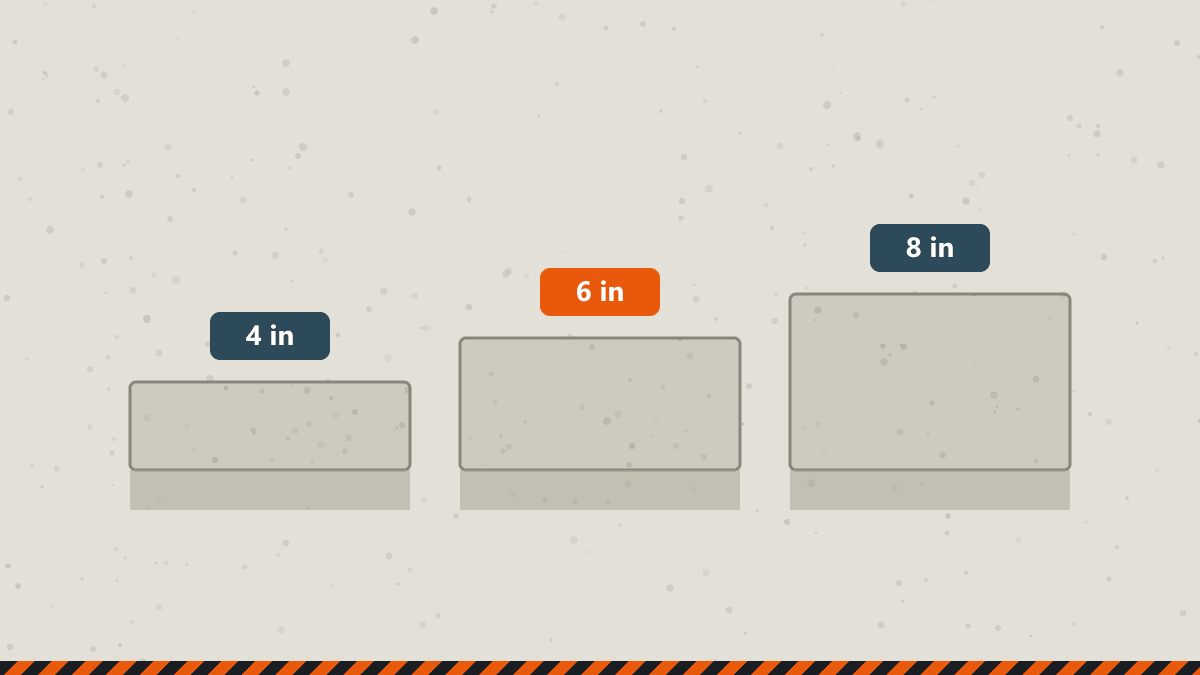
- Enter the slab thickness. Patios and walkways are usually 4 inches (10 cm) thick.
- Set the number of slabs for identical pads.
- Keep the 10% waste allowance or change it, then read the results panel.
Concrete Slab Formula
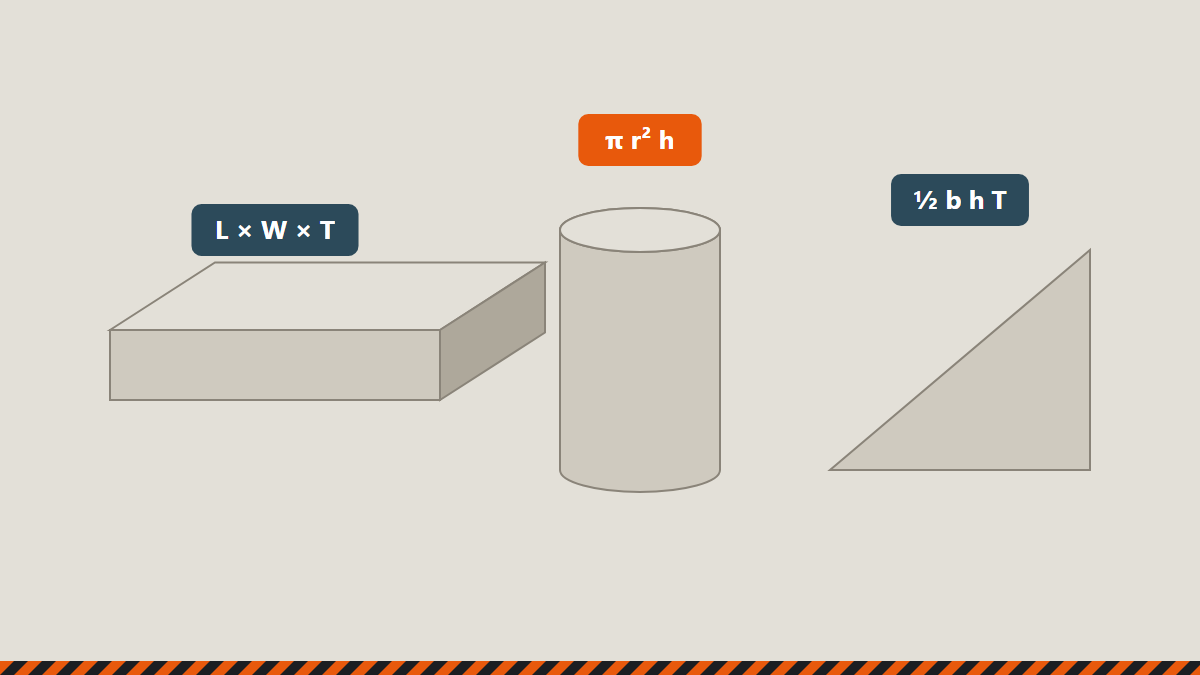
The concrete slab formula multiplies length × width × thickness, with all 3 measurements in the same unit. Divide cubic feet by 27 to get cubic yards.
Volume (ft³) = length (ft) × width (ft) × thickness (ft)
Cubic yards (yd³) = volume (ft³) ÷ 27
- Length: the long side, in feet (ft).
- Width: the short side, in feet.
- Thickness: the depth in inches (in) ÷ 12.
- 27: cubic feet in 1 cubic yard.
The metric slab formula uses meters for every dimension and gives cubic meters (m³) directly. Divide a thickness in centimeters (cm) by 100 before you multiply.
Volume (m³) = length (m) × width (m) × thickness (m)
1 m³ = 1.308 yd³ = 35.3 ft³
Worked Example: 12 × 10 ft Slab at 4 Inches
A 12 × 10 ft slab at 4 inches (10 cm) thick holds 40 cubic feet, or 1.48 cubic yards (1.13 m³). The 5 steps below show the math.
- Convert the thickness to feet: 4 in ÷ 12 = 0.333 ft.
- Multiply the dimensions: 12 ft × 10 ft × 0.333 ft = 40 ft³.
- Convert to cubic yards: 40 ÷ 27 = 1.48 yd³.
- Add 10% for waste: 1.48 × 1.1 = 1.63 yd³ (44.0 ft³).
- Count the bags: 44.0 ft³ fills 74 bags of 80 lb concrete or 98 bags of 60 lb concrete.
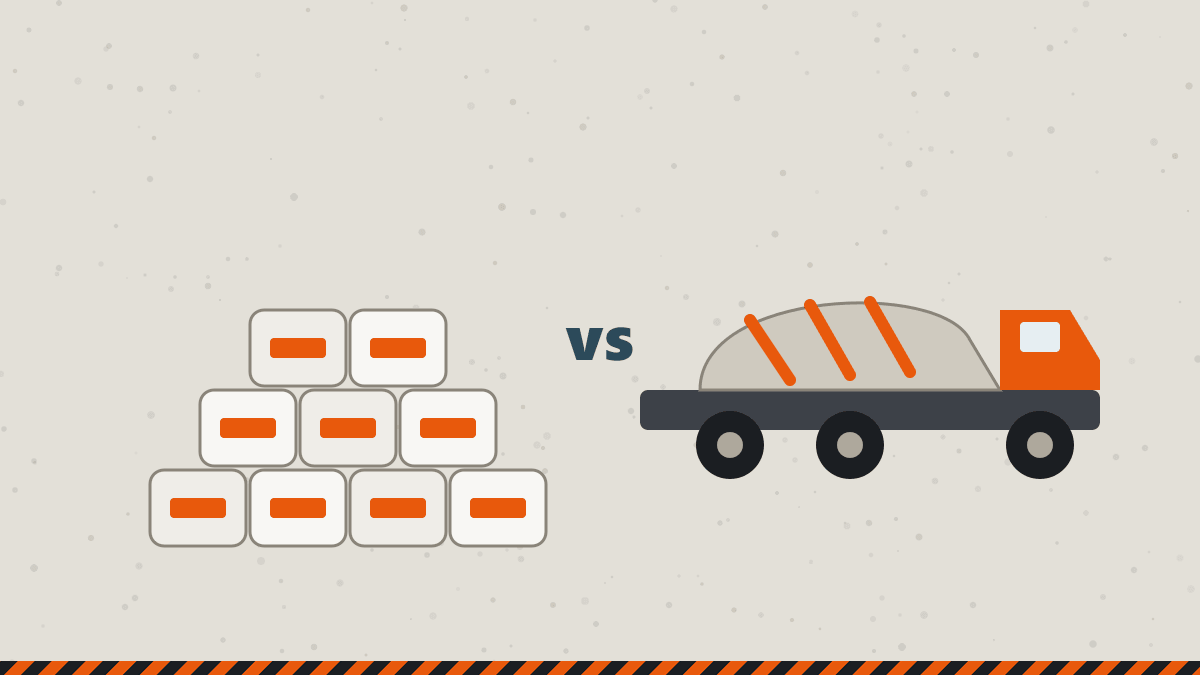
Ready-mix concrete is usually the better choice above about 1 cubic yard. Move the sliders to see how each dimension changes the volume.
To price the same slab with labor, reinforcement, and delivery fees, use the concrete slab cost calculator.
Try it
Drag the sliders and the diagram redraws to scale.
Linked to the calculator above: moving a slider updates your estimate.
With your values
12 ft × 10 ft × 0.333 ft = 40.00 ft³
- Cubic feet
- 40.00
- Cubic yards
- 1.48
- Cubic meters
- 1.13
Where to Use the Slab Calculator
The slab calculator fits any flat, rectangular pour. These 5 projects use the same formula at 4 inches (10 cm) thick:
- Patios: a 12 × 12 ft patio needs 1.78 yd³ (1.36 m³).
- Driveways: a 20 × 12 ft driveway needs 2.96 yd³ (2.27 m³).
- Shed bases: an 8 × 10 ft shed base needs 0.99 yd³ (0.76 m³).
- Garage floors: a 20 × 20 ft garage floor needs 4.94 yd³ (3.78 m³).
- Sidewalks: a 30 × 4 ft sidewalk needs 1.48 yd³ (1.13 m³).
Bags or Ready-Mix: Concrete for Common Slab Sizes
A 16 × 20 ft slab at 4 inches needs 4.35 cubic yards with waste, a 4.5 yd³ ready-mix order or 196 bags of 80 lb concrete. To compare thicknesses side by side, use the concrete slab thickness calculator.
| Slab size | Area | Cubic yards | With 10% waste | Ready-mix order | 80 lb bags with waste |
|---|---|---|---|---|---|
| 12 × 10 ft | 120 sq ft | 1.48 | 1.63 | 1.75 yd³ | 74 |
| 12 × 16 ft | 192 sq ft | 2.37 | 2.61 | 2.75 yd³ | 118 |
| 16 × 20 ft | 320 sq ft | 3.95 | 4.35 | 4.5 yd³ | 196 |
| 20 × 30 ft | 600 sq ft | 7.41 | 8.15 | 8.25 yd³ | 367 |
| 30 × 40 ft | 1,200 sq ft | 14.81 | 16.30 | 16.5 yd³ | 734 |
| 40 × 60 ft | 2,400 sq ft | 29.63 | 32.59 | 32.75 yd³ | 1,467 |
Whole Slab: Rebar, Gravel Base, Edge and Vapour Barrier
Open Whole slab in the calculator to count the rest of the job from the same length and width. Every item is optional, and the concrete volume, bags and weight stay exactly as above unless you add a thickened edge.
- Reinforcement: pick a rebar grid or 5 × 10 ft wire mesh sheets lapped 6 in. Rebar counts bars each way as the dimension ÷ spacing, rounded up, plus 1, the same method as the rebar calculator. A 12 × 10 ft slab with #4 bars at 12 in takes 11 bars × 12 ft + 13 bars × 10 ft, 288 ft and 193 lb with 10% waste. Bar size and spacing come from your drawings, local code, or engineer.
- Gravel base: IRC R506.2.2 calls for a 4 in base of clean graded sand, gravel or crushed stone under slabs below grade, except on well-drained soils. Under a 12 × 10 ft slab that is 1.48 yd³ compacted (2.07 tons at 1.4 tons per yd³); order about 20% more loose stone, 1.78 yd³.
- Thickened edge: the extra concrete is (edge depth − slab thickness) × edge width × (perimeter − 4 × edge width), corners counted once. A 24 × 20 ft slab at 4 in with a 12 × 12 in edge adds 56 ft³ (2.07 yd³) and needs 8.8 yd³ with waste, so the order rounds up to 9 yd³.
- Vapour barrier: the 2021 IRC (R506.2.3) requires a 10-mil retarder meeting ASTM E1745 Class A, joints lapped at least 6 in, under heated floors; garages, carports, driveways, walks and patios are exempt. The calculator counts 20 × 100 ft rolls.
- Soil pressure: slab weight plus any building load, divided by the slab area, compared with the presumptive values in IRC Table R401.4.1: 3,000 psf for gravel, 2,000 psf for sand and 1,500 psf for clay or silt. A uniform check does not replace footing design for point loads or wall lines.
- Forms, stakes and joints: forms equal the perimeter (a 2×6 for a 4 in slab), with a stake every 3 ft plus one per corner. NRMCA recommends control joints every 24 to 36 times the slab thickness, about 10 ft for a 4 in slab and no more than 15 ft.
The ready-mix order rounds up to the next ¼ yd³ and shows whole trucks, and the IRC (R506.1) sets a minimum floor slab of 3½ in.
Common Slab Calculation Mistakes
The 4 most common slab mistakes involve thickness, waste, the subgrade, and the base.
- Enter the thickness with the right unit. A thickness of 4 entered as feet instead of inches gives a volume 12 times too large.
- Add 5 to 10 percent for waste and spillage. Use the top of that range, if the ground is soft or uneven.
- Check the depth at several points before the pour. A subgrade that sits 1 inch (2.5 cm) low across a 12 × 10 ft slab takes 10.0 ft³ (0.37 yd³) of extra concrete.
- Order the gravel base separately. The calculator counts concrete only, and a 4 in gravel base under a 12 × 10 ft slab is another 1.48 yd³ of gravel; the sand, gravel & cement calculator counts the materials.
Concrete Slab Calculator FAQ
How much concrete do I need for a 12 × 12 slab?
A 12 × 12 ft slab at 4 inches (10 cm) thick needs 48 cubic feet, or 1.78 cubic yards (1.36 m³). With a 10 percent waste allowance, plan for 1.96 yd³. That volume equals 88 bags of 80 lb concrete, so ready-mix concrete is usually the easier option at this size.
How thick should a concrete slab be?
A concrete slab for a patio or walkway is usually 4 inches (10 cm) thick. Driveways use 5 to 6 inches (13 to 15 cm) to carry vehicle loads. Follow local codes for structural slabs. See how thick a concrete slab should be for patios, driveways and garages.
Does the slab calculator include waste?
Yes, the slab calculator adds a 10 percent waste allowance by default. Change the waste field to any value from 0 to 100 percent. A range of 5 to 10 percent covers spillage, uneven ground, and form movement on most home projects. Set the field to 0 to see the exact geometric volume.
How much concrete do I need for a 10 × 10 slab?
A 10 × 10 ft slab at 4 inches (10 cm) needs 1.23 cubic yards (0.94 m³) of concrete, or 33.3 cubic feet, before waste. With 10 percent added for waste, order 1.36 yd³. For a bag count by size, use the concrete bag calculator.
Sources
Slab volume uses plain geometry and exact unit definitions. The whole-slab items follow the references below.
- International Residential Code 2021, R506 and Table R401.4.1 (Seattle Residential Code 2021, Chapters 4 and 5)
- NRMCA – CIP 6, Joints in concrete slabs on grade
- Rebar weights per foot (CRSI table, Weyerhaeuser SBP-4100)
- ASCC – Welded wire reinforcement lap splices and slabs on ground
- CalcMyProject – gravel base, forms and stakes method
- NIST – Unit conversion: SI to U.S. customary units
- How we calculate – formulas, constants, and sources
Related guides