Cubic Meters (m³) Concrete Calculator
This concrete calculator gives the volume in m3 (cubic meters) from metric measurements. Enter length, width, and thickness in meters, centimeters, or millimeters, or switch to an area in m². The results show cubic meters first, then cubic yards and cubic feet, plus 20, 25, and 30 kg bag counts.
 By Muhammad AsimPublished Updated How we calculate
Your estimate
Total volume with waste
1.65m³
- Cubic yards
- 2.16 yd³
- Cubic feet
- 58.3 ft³
Premixed bags
- 20 kg bags177
- 25 kg bags142
- 30 kg bags118
- 80 lb bags98
- 60 lb bags130
- Weight
- 3,960 kg · 8,730 lb
- Ready-mix truck loads (10 yd³ each)
- 0.22
- Concrete cost
Formula with your numbers
16.404 ft × 9.843 ft × 0.328 ft × 1.1 = 58.27 ft³
Includes a 10% waste allowance. Bags are rounded up. Weight uses 2,400 kg/m³ (150 lb/ft³).
Your estimate1.65 m³ · 177 × 20 kg
Planning several pours or a cost sheet? Get the free Excel template (7 tabs, no sign-up).
How to Use the Concrete Calculator in Cubic Meters
To use the concrete calculator in cubic meters, follow these 4 steps.
- Choose Length × width for a rectangle, or Area (m²) when you know the floor area.
- Enter each measurement and pick m, cm, or mm next to the field.
- Keep or change the 10 percent waste allowance.
- Read the cubic meters at the top of the results and the kg bag counts below.
Concrete Calculator M3 Formula
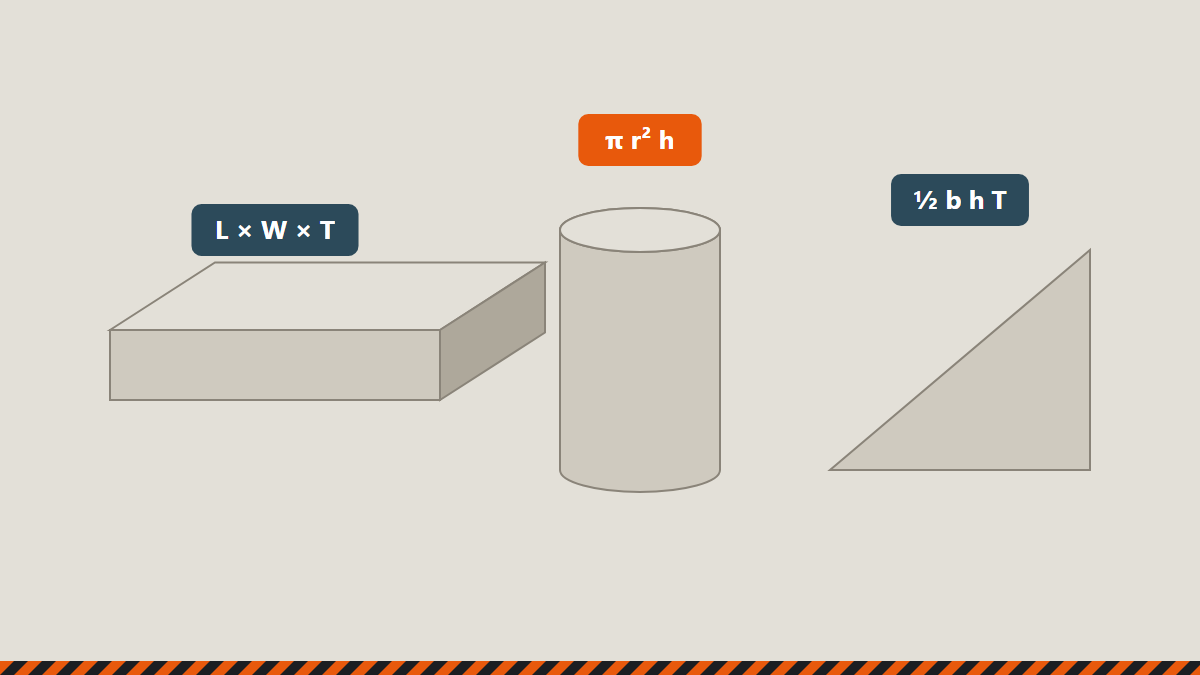
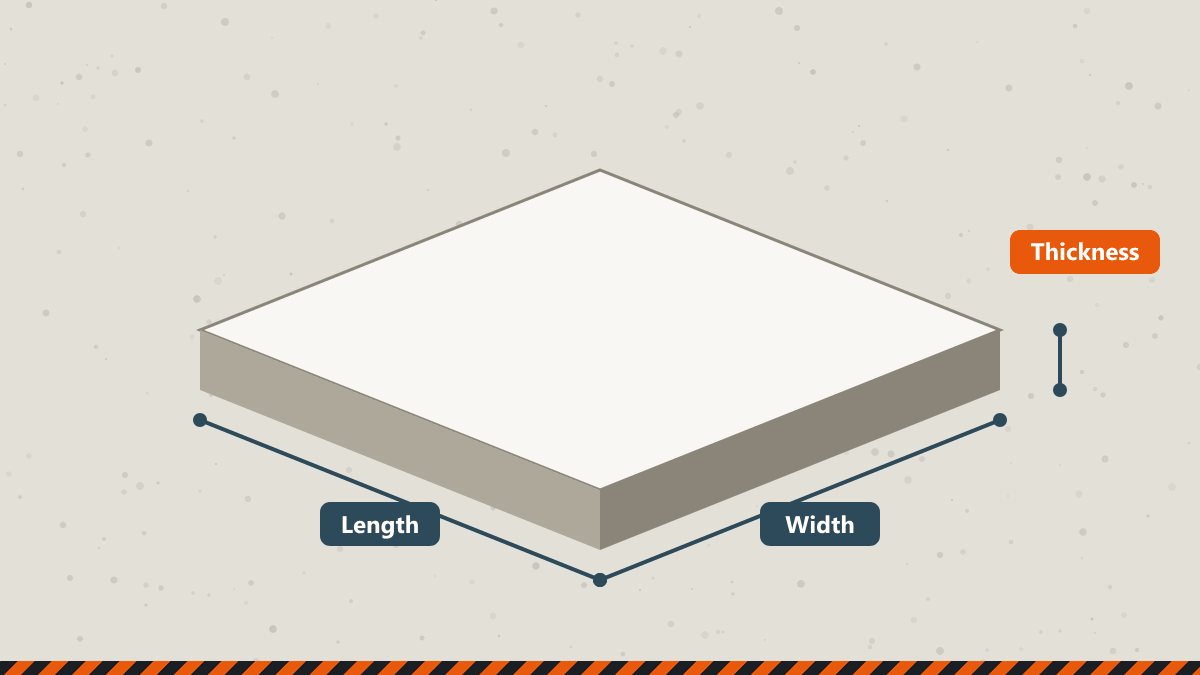
The m³ formula multiplies length × width × thickness, with every measurement in meters. Divide centimeters by 100 and millimeters by 1,000 before you multiply.
Volume (m³) = length (m) × width (m) × thickness (m)
Thickness (m) = cm ÷ 100 = mm ÷ 1,000
- Length: the long side in meters (m).
- Width: the short side in meters.
- Thickness: the depth in meters, converted from cm or mm.
The imperial conversion multiplies cubic meters by 1.308 to get cubic yards (yd³).
Cubic yards (yd³) = m³ × 1.308
Cubic meters (m³) = yd³ × 0.7646
Worked Example: 5 × 3 m Slab at 10 cm
A 5 × 3 m slab, 10 cm (4 in) thick, holds 1.5 m³ (1.96 yd³) of concrete. The 4 steps below show the math.
- Convert the thickness to meters: 10 cm ÷ 100 = 0.1 m.
- Multiply the dimensions: 5 m × 3 m × 0.1 m = 1.5 m³.
- Add 10 percent for waste: 1.5 × 1.1 = 1.65 m³ (2.16 yd³).
- Count the bags: 1.65 m³ fills 177 bags of 20 kg or 142 bags of 25 kg.
Ready-mix suppliers in the UK, Australia, New Zealand, and most other countries sell concrete by the cubic meter. Use the converter to check any m³ figure in cubic yards.
Volume converter
- Cubic yards
- 1.96
- Cubic feet
- 52.97
- Cubic meters
- 1.50
Ready-mix trucks at 10 yd³ each0.20
Each cube is drawn to scale: your volume next to 1 cubic yard and 1 cubic meter.
Where to Use Cubic Meters
Cubic meters are the ordering unit for concrete in metric countries. These 4 jobs show typical volumes:
- Garden paths: a 10 × 1 m path at 10 cm needs 1.00 m³ (1.31 yd³).
- Shed bases: a 3 × 2.4 m shed base at 10 cm needs 0.72 m³ (0.94 yd³).
- Driveways: a 6 × 3 m driveway at 15 cm needs 2.70 m³ (3.53 yd³).
- Garage floors: a 6 × 6 m garage floor at 15 cm needs 5.40 m³ (7.06 yd³).
Square Meters to Cubic Meters
To convert square meters to cubic meters, multiply the area in m² by the thickness in meters.
Volume (m³) = area (m²) × thickness (m)
A 15 m² floor at 10 cm (4 in) thick needs 15 × 0.1 = 1.5 m³.
Millimeter Input Example
A slab measured as 4,000 × 2,500 × 150 mm holds 1.50 m³ (1.96 yd³). Divide each millimeter value by 1,000 first.
4 m × 2.5 m × 0.15 m = 1.50 m³
Cubic Meters, Litres, and Wheelbarrow Loads
One cubic meter is 1,000 litres. Wheelbarrows and mixer drums are sold by litres, so the litre figure tells you how many loads a pour takes. The 5 × 3 m slab with waste needs 1.65 m³, which is 1,650 litres, or 20 level loads of an 85 litre barrow.
| Cubic meters | Litres | 60 L loads | 85 L loads | 100 L loads |
|---|---|---|---|---|
| 0.25 m³ | 250 | 5 | 3 | 3 |
| 0.50 m³ | 500 | 9 | 6 | 5 |
| 1.00 m³ | 1,000 | 17 | 12 | 10 |
| 1.50 m³ | 1,500 | 25 | 18 | 15 |
| 2.00 m³ | 2,000 | 34 | 24 | 20 |
| 3.00 m³ | 3,000 | 50 | 36 | 30 |
Cubic Meters per 10 m² by Slab Thickness
A 100 mm slab uses 1 m³ per 10 m² (108 sq ft).
| Thickness | Cubic meters | Cubic yards | 20 kg bags | 25 kg bags | 30 kg bags |
|---|---|---|---|---|---|
| 75 mm (3 in) | 0.75 | 0.98 | 81 | 65 | 54 |
| 100 mm (3.9 in) | 1.00 | 1.31 | 107 | 86 | 71 |
| 125 mm (4.9 in) | 1.25 | 1.63 | 134 | 108 | 89 |
| 150 mm (5.9 in) | 1.50 | 1.96 | 161 | 129 | 107 |
| 200 mm (7.9 in) | 2.00 | 2.62 | 214 | 172 | 142 |
Common Metric Volume Mistakes
The 4 most common metric mistakes involve centimeters, millimeters, area units, and the waste allowance.
- Convert centimeters to meters before you multiply. A thickness of 10 entered as meters gives a volume 100 times too large.
- Watch the millimeter fields. A 150 mm slab is 0.15 m, and a missing zero changes the order by a factor of 10.
- Check the base level before the pour. A sub-base 1 cm low across a 5 × 3 m slab takes another 0.15 m³.
- Add 5 to 10 percent for waste. Order the higher figure, if the ground is soft or the forms are long.
Cubic Meters (m³) Concrete Calculator FAQ
How much is 5 meters of concrete?
Five meters of concrete means 5 cubic meters (6.54 yd³). Suppliers shorten cubic meters to meters on quotes. Five cubic meters fills a slab 10 × 5 m at 10 cm thick, or 535 bags of 20 kg concrete, so a ready-mix truck is the practical choice.
How many 20 kg bags do I need for 2 m³?
A volume of 2 m³ needs 214 bags of 20 kg concrete or 172 bags of 25 kg concrete, before waste. With 10 percent added, the counts rise to 236 and 190 bags. At that size, ready-mix concrete delivered by the cubic meter saves mixing 214 bags by hand.
How do I convert cubic meters to cubic yards?
To convert cubic meters to cubic yards, multiply by 1.308. A 2 m³ pour equals 2.62 yd³, and a 5 m³ pour equals 6.54 yd³. Going the other way, multiply cubic yards by 0.7646, so 5 yd³ equals 3.82 m³. The results panel shows both units for every job.
Can I enter millimeters in the calculator?
Yes, every length field accepts millimeters, centimeters, and meters. Pick mm from the unit menu next to the field. A slab of 4,000 × 2,500 × 150 mm returns 1.50 m³. Mixed units work too, such as meters for length and millimeters for thickness.
How many litres are in a cubic meter of concrete?
A cubic meter of concrete is 1,000 litres. A 5 × 3 m slab 10 cm thick holds 1.50 m³, or 1,500 litres, before waste. That fills about 18 level loads of an 85 litre wheelbarrow, so plan the mixing and the carrying around that number.
Sources
Every result on this page uses plain geometry and the exact unit definitions below. The full list of formulas and constants is on the How we calculate page.
Related guides