Concrete Weight Calculator
This concrete calculator finds weight from volume. Enter a volume, or switch to dimensions and measure the slab, and the tool multiplies by a density of 2,400 kg per m³ (about 150 lb per ft³). The results show pounds, kilograms, short tons, and tonnes, next to the volume and bag counts.
 By Muhammad AsimPublished How we calculate
Your estimate
Total volume with waste
1.10yd³
- Cubic meters
- 0.84 m³
- Cubic feet
- 29.7 ft³
Premixed bags
- 80 lb bags50
- 60 lb bags66
- 40 lb bags99
- 25 kg bags73
- 20 kg bags90
- Weight
- 4,450 lb · 2,018 kg
- Ready-mix truck loads (10 yd³ each)
- 0.11
- Concrete cost
- Pounds
- 4,450 lb
- Kilograms
- 2,018 kg
- Short tons (2,000 lb)
- 2.22
- Tonnes (1,000 kg)
- 2.02
Formula with your numbers
27 ft³ × 1.1 = 29.70 ft³
Includes a 10% waste allowance. Bags are rounded up. Weight uses 2,400 kg/m³ (150 lb/ft³).
Your estimate1.10 yd³ · 50 × 80 lb
Planning several pours or a cost sheet? Get the free Excel template (7 tabs, no sign-up).
How to Use the Concrete Weight Calculator
To use the concrete weight calculator, follow these 4 steps.
- Choose Volume for a known amount or Dimensions for a slab you can measure.
- Enter the value with its unit: cubic yards, cubic feet, cubic meters, feet, or inches.
- Set the waste field to 0 to weigh existing concrete, such as a slab you plan to remove.
- Read the weight in pounds, kilograms, short tons, and tonnes.
Concrete Calculator Weight Formula
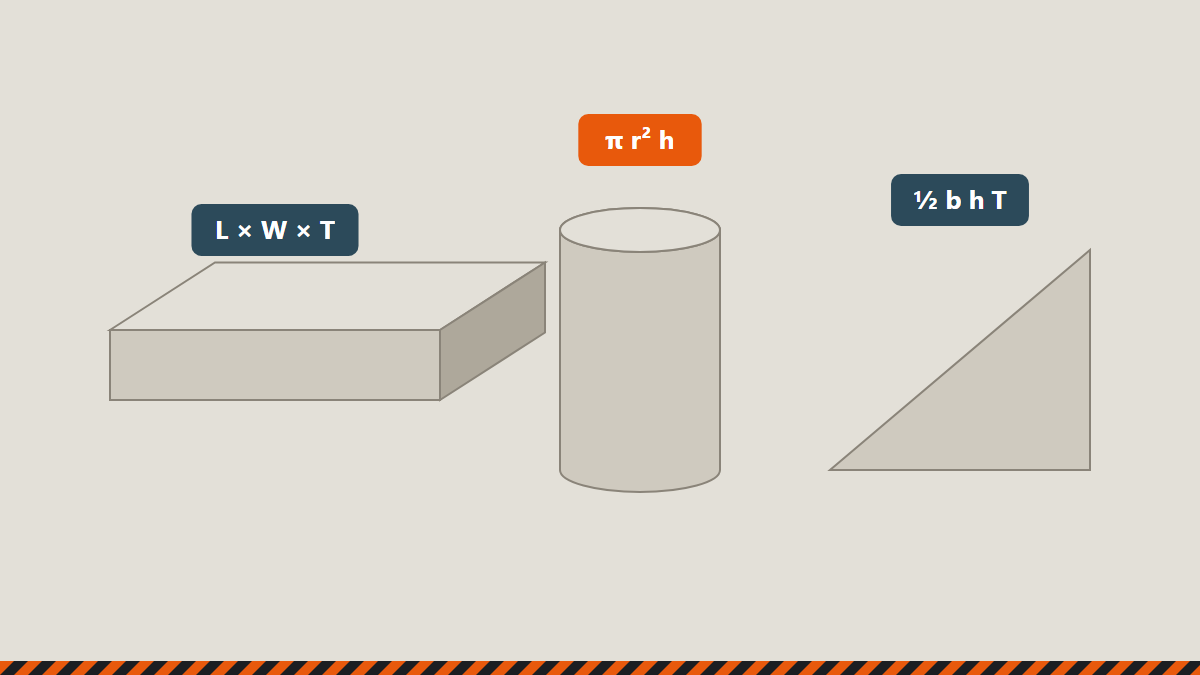
The concrete weight formula multiplies volume × density. The calculator uses 150 lb per cubic foot, the typical density of normal-weight concrete. How we calculate lists every constant.
Weight (lb) = volume (ft³) × 150 lb/ft³
Short tons = weight (lb) ÷ 2,000
- Volume: the concrete in cubic feet (ft³); multiply cubic yards by 27 first.
- Density: the unit weight of concrete, about 150 lb per ft³.
- 2,000: pounds in 1 short ton.
The metric formula multiplies cubic meters by 2,400 kg per m³. Divide kilograms by 1,000 to get tonnes.
Weight (kg) = volume (m³) × 2,400 kg/m³
Tonnes = weight (kg) ÷ 1,000
Worked Example: Weight of 1 Cubic Yard of Concrete
One cubic yard (0.76 m³) of concrete weighs about 4,045 lb (1,835 kg), or 1.83 tonnes. The 3 steps below show the math with the engine density.
- Convert the volume: 1 yd³ = 27 ft³ = 0.7646 m³.
- Multiply by the density: 0.7646 m³ × 2,400 kg/m³ = 1,835 kg.
- Convert the units: 1,835 kg = 4,045 lb = 2.02 short tons = 1.83 tonnes.
At a round 150 lb per ft³, the yard weighs 27 × 150 = 4,050 lb; the engine density equals 149.8 lb per ft³. The calculator adds 10% waste by default, so it shows 4,450 lb.
Where to Use the Weight Calculator
The weight calculator answers 4 common questions, including truck loads, demolition, and lifting:
- Truck loads: check a load against the payload rating of your truck or trailer. Half a cubic yard weighs 2,023 lb.
- Demolition: a 12 × 10 ft patio, 4 in thick, weighs 5,993 lb (2.72 tonnes) to haul away.
- Driveway removal: a 20 × 12 ft driveway at 5 in weighs 7.49 short tons.
- Lifting: a 2 ft concrete cube weighs 1,199 lb (544 kg), so plan the lift before you cast it.
Why Concrete Density Varies
Concrete density varies with the mix. Normal-weight concrete weighs about 140 to 150 lb per cubic foot, according to the Pennsylvania Aggregates and Concrete Association. Lightweight aggregate gives a lower unit weight, and steel reinforcement adds weight. Ask the supplier for the unit weight of a specific mix.
How to Calculate the Weight of a Concrete Slab
Find the slab volume in cubic feet, then multiply by about 150 lb per cubic foot. Follow these 3 steps:
- Multiply length × width × thickness in feet. Divide the thickness in inches by 12 first.
- Multiply the cubic feet by the density. The calculator uses 2,400 kg per m³, which equals 149.8 lb per ft³.
- Divide the pounds by 2,000 for short tons.
A 20 × 20 ft garage slab at 4 inches holds 133.3 ft³. At 149.8 lb per ft³, it weighs 19,977 lb, or 9.99 short tons.
In metric, multiply cubic meters by 2,400. The same slab is 3.78 m³, so it weighs 9,061 kg, or 9.06 tonnes.
Set the waste field to 0 when you weigh an existing slab for removal, then check the result against the weight limit of the trailer, truck, or dumpster. Rebar and heavy aggregate add weight, and lightweight mixes weigh less.
Concrete Weight by Volume in Pounds, Kilograms, and Tons
One cubic foot of concrete weighs about 150 lb (68 kg), and 1 cubic meter weighs 2,400 kg. The table scales those figures by volume.
| Volume | Pounds | Kilograms | Short tons | Tonnes |
|---|---|---|---|---|
| 0.25 yd³ (0.19 m³) | 1,011 | 459 | 0.51 | 0.46 |
| 0.5 yd³ (0.38 m³) | 2,023 | 917 | 1.01 | 0.92 |
| 1 yd³ (0.76 m³) | 4,045 | 1,835 | 2.02 | 1.83 |
| 2 yd³ (1.53 m³) | 8,091 | 3,670 | 4.05 | 3.67 |
| 3 yd³ (2.29 m³) | 12,136 | 5,505 | 6.07 | 5.50 |
| 5 yd³ (3.82 m³) | 20,227 | 9,175 | 10.11 | 9.17 |
| 10 yd³ (7.65 m³) | 40,453 | 18,349 | 20.23 | 18.35 |
Common Concrete Weight Mistakes
The 4 most common weight mistakes involve rubble, tons, density, and extra loads.
- Weigh the solid volume, not the rubble pile. Broken concrete takes more room, but the weight matches the slab before demolition.
- Tell short tons (2,000 lb) from tonnes (1,000 kg). One cubic yard is 2.02 short tons but 1.83 tonnes.
- Use the unit weight from the supplier for lightweight or heavily reinforced concrete.
- Add the weight of forms, rebar, and tools, if you check a trailer or floor load.
Concrete Weight Calculator FAQ
How much does a cubic yard of concrete weigh?
A cubic yard of concrete weighs about 4,045 lb (1,835 kg), which equals 2.02 short tons or 1.83 tonnes. The figure assumes normal-weight concrete at about 150 lb per cubic foot. Lightweight mixes weigh less, so check the unit weight on the supplier ticket for a special mix.
How many kg is 1 m³ of concrete?
One cubic meter of concrete weighs about 2,400 kg (2.40 tonnes). That figure is the density of normal-weight concrete, 2,400 kg per m³. To convert m³ to kg, multiply the volume by 2,400. For 0.5 m³, the result is 1,200 kg.
How do I calculate the unit weight of concrete?
To calculate the unit weight of concrete, divide the weight of a sample by its volume. A lab fills a container of known volume, weighs it, and reports pounds per cubic foot or kilograms per cubic meter. Normal-weight concrete lands near 150 lb per ft³ (2,400 kg per m³).
How many tons is a 12 × 10 ft slab?
A 12 × 10 ft slab, 4 inches thick, weighs 3.00 short tons (2.72 tonnes). The slab holds 40 cubic feet, or 1.48 cubic yards. Multiply the cubic feet by about 150 lb per ft³ to get 5,993 lb, then divide by 2,000 for short tons.
Sources
Every result on this page uses plain geometry and the exact unit definitions below. The full list of formulas and constants is on the How we calculate page.
Related guides