Concrete Slab Thickness Calculator
Set this concrete calculator to 6 inches thick for a driveway, 4 inches for a walk, or any depth from 2 to 8 inches. The tool multiplies length × width × thickness and shows cubic yards, cubic feet, and cubic meters, plus 80 lb and 60 lb bag counts, weight, and cost.
 By Muhammad AsimPublished How we calculate
Your estimate
Total volume with waste
2.04yd³
- Cubic meters
- 1.56 m³
- Cubic feet
- 55.0 ft³
Premixed bags
- 80 lb bags92
- 60 lb bags123
- 40 lb bags184
- 25 kg bags134
- 20 kg bags167
- Weight
- 8,240 lb · 3,738 kg
- Ready-mix truck loads (10 yd³ each)
- 0.20
- Concrete cost
Formula with your numbers
10 ft × 10 ft × 0.5 ft × 1.1 = 55.00 ft³
Includes a 10% waste allowance. Bags are rounded up. Weight uses 2,400 kg/m³ (150 lb/ft³).
Your estimate2.04 yd³ · 92 × 80 lb
Planning several pours or a cost sheet? Get the free Excel template (7 tabs, no sign-up).
How to Use the Concrete Calculator (6 Inches Thick or Any Depth)
The thickness calculator gives a result in 4 steps.
- Measure the slab length and width in feet, inches, or meters.
- Tap a thickness chip, or type a depth such as 5.5 in.
- Set the waste allowance. The default is 10%.
- Tap a different chip to compare volumes.
Slab Thickness Formula
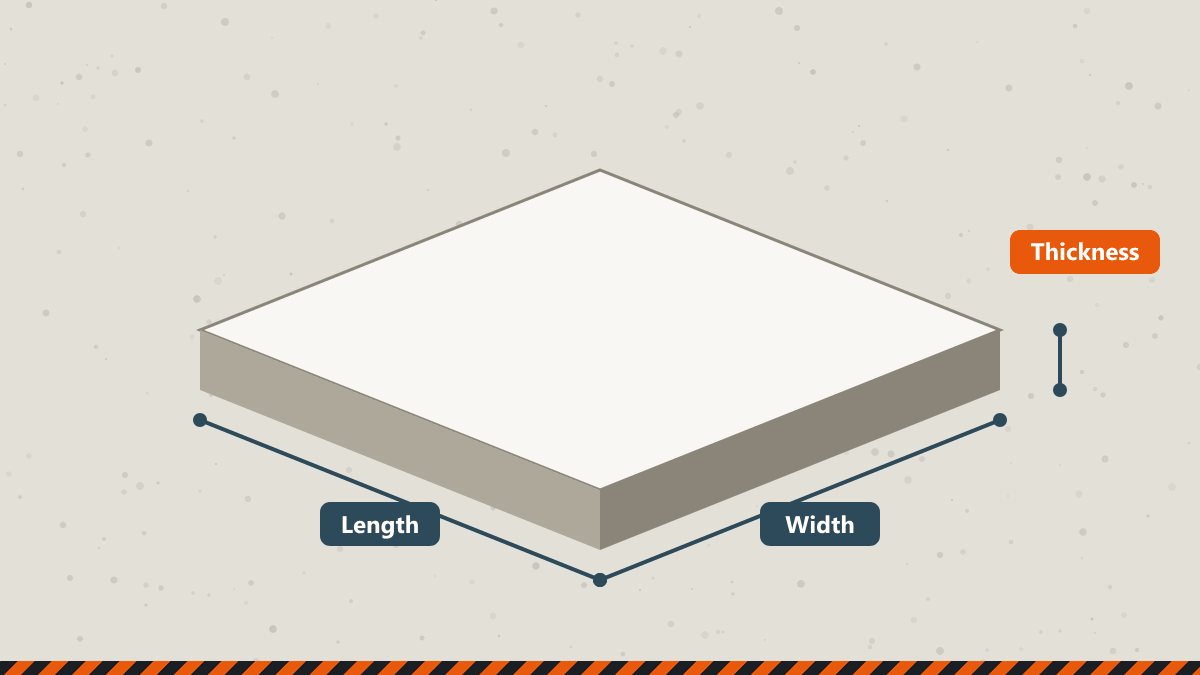
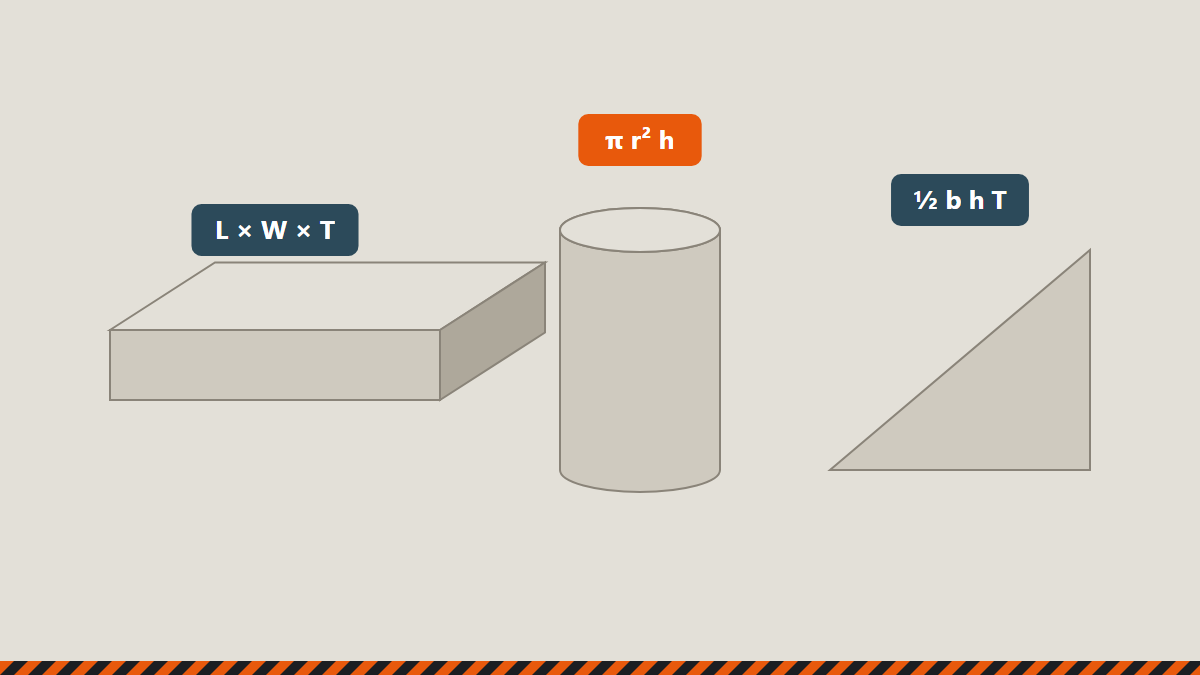
Slab volume equals length × width × thickness, with the thickness turned from inches into feet by dividing by 12.
Volume (ft³) = length (ft) × width (ft) × thickness (in) ÷ 12
Cubic yards = volume (ft³) ÷ 27
- Length and width: the slab sides, in feet (ft).
- Thickness: the slab depth in inches (in).
- 27: cubic feet in 1 cubic yard (yd³).
The metric version uses meters for the sides and millimeters for the thickness, and gives cubic meters (m³).
Volume (m³) = length (m) × width (m) × thickness (mm) ÷ 1,000
Worked Example: 6 Inch Concrete for a 10 × 10 ft Slab
A 10 × 10 ft slab poured 6 inches (15 cm) thick holds 50 cubic feet, or 1.85 cubic yards (1.42 m³). To figure 6 inch concrete, follow these 5 steps.
- Find the area: 10 ft × 10 ft = 100 ft² (9.29 m²).
- Turn the thickness into feet: 6 in ÷ 12 = 0.5 ft.
- Multiply area by thickness: 100 × 0.5 = 50 ft³.
- Divide by 27: 50 ÷ 27 = 1.85 yd³.
- Add 10% for waste: 2.04 yd³, or 92 bags of 80 lb (123 bags of 60 lb).
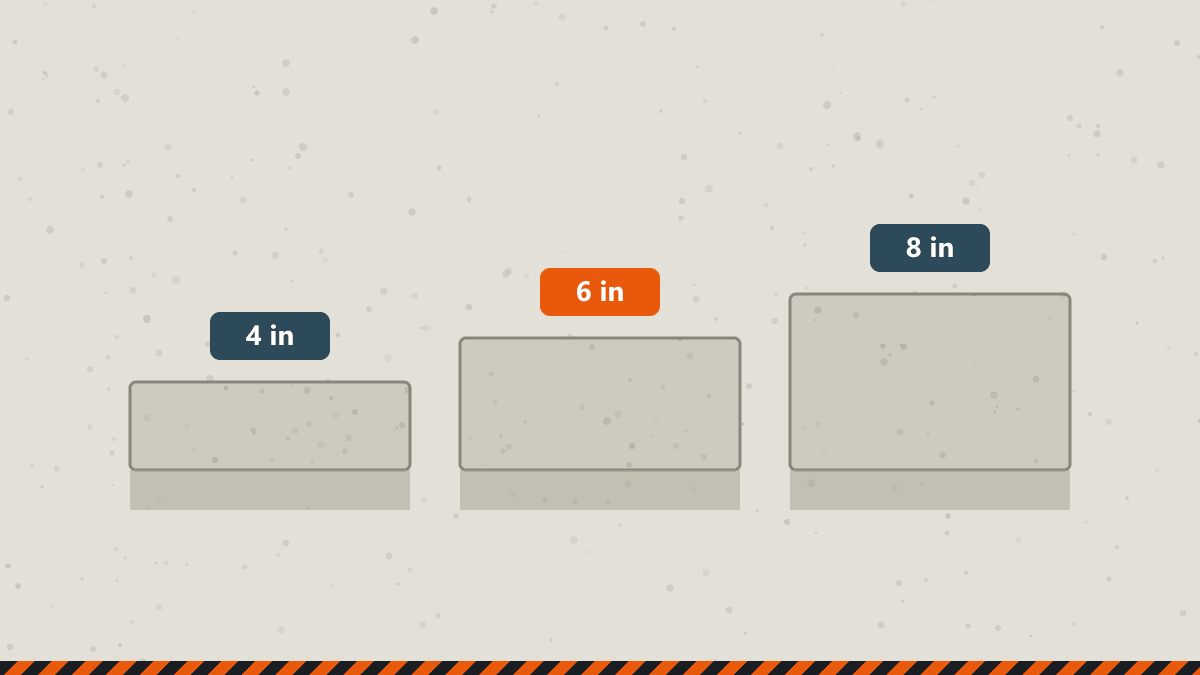
The same slab at 4 inches needs 1.23 yd³, so the 6 inch pour takes 50% more concrete.
Try it
Drag the sliders and the diagram redraws to scale.
Linked to the calculator above: moving a slider updates your estimate.
With your values
10 ft × 10 ft × 0.5 ft = 50.00 ft³
- Cubic feet
- 50.00
- Cubic yards
- 1.85
- Cubic meters
- 1.42
Where to Use Each Slab Thickness
Slab thickness follows the load. These 4 sample pours use typical depths:
- Walkways at 4 in (10 cm): a 30 × 4 ft walk needs 1.48 yd³ (1.13 m³).
- Patios at 4 in: a 14 × 12 ft patio needs 2.07 yd³ (1.59 m³).
- Single driveways at 5 in (13 cm): a 20 × 12 ft drive needs 3.70 yd³ (2.83 m³).
- Double driveways at 6 in (15 cm): a 24 × 24 ft drive needs 10.67 yd³ (8.16 m³).
How Thickness Changes Volume
Volume grows in direct proportion to thickness. Each added inch puts 0.31 yd³ (0.24 m³) into every 100 sq ft of slab.
Doubling the thickness doubles the concrete: 100 sq ft at 8 in (20 cm) needs 2.47 yd³.
Cubic Yards and Bags per 100 Square Feet by Thickness
At 6 inches, every 100 sq ft (9.29 m²) of slab takes 1.85 cubic yards, against 1.23 yd³ at 4 inches.
| Thickness | Cubic feet | Cubic yards | Cubic meters | 80 lb bags | 60 lb bags |
|---|---|---|---|---|---|
| 2 in (5 cm) | 16.7 | 0.62 | 0.47 | 28 | 38 |
| 3 in (8 cm) | 25.0 | 0.93 | 0.71 | 42 | 56 |
| 4 in (10 cm) | 33.3 | 1.23 | 0.94 | 56 | 75 |
| 5 in (13 cm) | 41.7 | 1.54 | 1.18 | 70 | 93 |
| 6 in (15 cm) | 50.0 | 1.85 | 1.42 | 84 | 112 |
| 8 in (20 cm) | 66.7 | 2.47 | 1.89 | 112 | 149 |
Common Slab Thickness Mistakes
The 3 most common thickness mistakes involve the unit, uneven depth, and waste.
- Check the unit beside the thickness field. Six feet in place of 6 inches multiplies the order by 12.
- Measure the depth at several points. A 10 × 10 ft slab that averages 6.5 in instead of 6 in uses 4.2 ft³ more concrete.
- Keep a 5 to 10 percent waste allowance at every thickness, and use the top of that range if the subgrade is uneven.
Concrete Slab Thickness Calculator FAQ
How much concrete do I need for a 6 inch slab?
A 6 inch slab needs 1.85 cubic yards (1.42 m³) per 100 square feet, before waste. A 10 × 10 ft slab at 6 inches holds 50 cubic feet. With 10 percent added for waste, plan for 2.04 yd³, or 92 bags of 80 lb concrete.
How do I calculate 6 inch concrete?
To calculate 6 inch concrete, multiply the area in square feet by 0.5, then divide by 27 for cubic yards. Six inches is half a foot, so 200 square feet at 6 inches holds 100 cubic feet, or 3.70 cubic yards. With 10 percent for waste, order 4.07 yd³.
How many bags of concrete do I need for a 2 inch slab?
A 2 inch slab needs 28 bags of 80 lb concrete per 100 square feet, or 38 bags of 60 lb concrete, before waste. That area at 2 inches (5 cm) holds 16.7 cubic feet (0.47 m³). Enter your length and width above, then tap the 2 in chip.
How do I calculate concrete slab thickness from a volume?
To calculate concrete slab thickness from a volume, divide the cubic feet by the area in square feet, then multiply by 12 for inches. One cubic yard (27 ft³) spread over 100 square feet makes a slab 3.24 inches (8.2 cm) thick. Use it to check how far a delivered load will go.
What thickness is typical for patios and driveways?
Patios and walkways are typically 4 inches (10 cm) thick, and driveways 5 to 6 inches (13 to 15 cm). The deeper driveway slab carries vehicle loads. Local codes and soil conditions set the final thickness, so confirm the depth with your building department before you pour a driveway.
Sources
Every result on this page uses plain geometry and the exact unit definitions below. The full list of formulas and constants is on the How we calculate page.
Related guides