Sonotube Concrete Calculator
This concrete calculator sonotube tool finds the volume of a round tube form from its inside diameter and filled height. Pick a 6 to 24 inch tube, enter the depth and number of tubes, and read cubic feet, cubic yards, cubic meters, and bag counts for 80, 60, and 40 lb bags and 25 and 20 kg bags, with 10% waste.
 By Muhammad AsimPublished Updated How we calculate
Your estimate
Total volume with waste
0.13yd³
- Cubic meters
- 0.10 m³
- Cubic feet
- 3.5 ft³
Premixed bags
- 80 lb bags6
- 60 lb bags8
- 40 lb bags12
- 25 kg bags9
- 20 kg bags11
- Weight
- 518 lb · 235 kg
- Ready-mix truck loads (10 yd³ each)
- 0.01
- Concrete cost
- Net volume (before waste)
- 3.14 ft³ · 0.12 yd³ · 0.089 m³
- With 10% waste
- 3.46 ft³ · 0.13 yd³ · 0.098 m³
- Shaft volume
- –
- Pad volume
- –
- Total volume
- –
All tubes, before waste.
Bags if you buy for all tubes together (pooled): 6 × 80 lb · 8 × 60 lb
Bags if each tube is bought separately (per-tube rounding): 6 × 80 lb · 8 × 60 lb
Both use the same concrete. The difference is rounding: a part-bag left over from one tube can go into the next tube only if you pour them together.
Ready-mix, rounded up to the nearest ¼ yd³: 0.25 yd³
Bagged concrete is usually practical at this size.
- Bagged total
- Ready-mix total (before delivery and short-load fees)
Formula with your numbers
π × (1 ft ÷ 2)² × 4 ft × 1.1 = 3.46 ft³
Includes a 10% waste allowance. Bags are rounded up. Weight uses 2,400 kg/m³ (150 lb/ft³).
Your estimate0.13 yd³ · 6 × 80 lb
Planning several pours or a cost sheet? Get the free Excel template (7 tabs, no sign-up).
Pour ticket (preview of what prints)
How to Use the Sonotube Calculator
To use the sonotube calculator, follow these 4 steps.
- Tap a tube size, or type any inside diameter.
- Enter the filled height of the tube and the number of tubes.
- Open Add a footing pad if your plans show a pad under each tube.
- Read the bag counts, pooled or per tube, and print the pour ticket.
Sonotube Concrete Formula
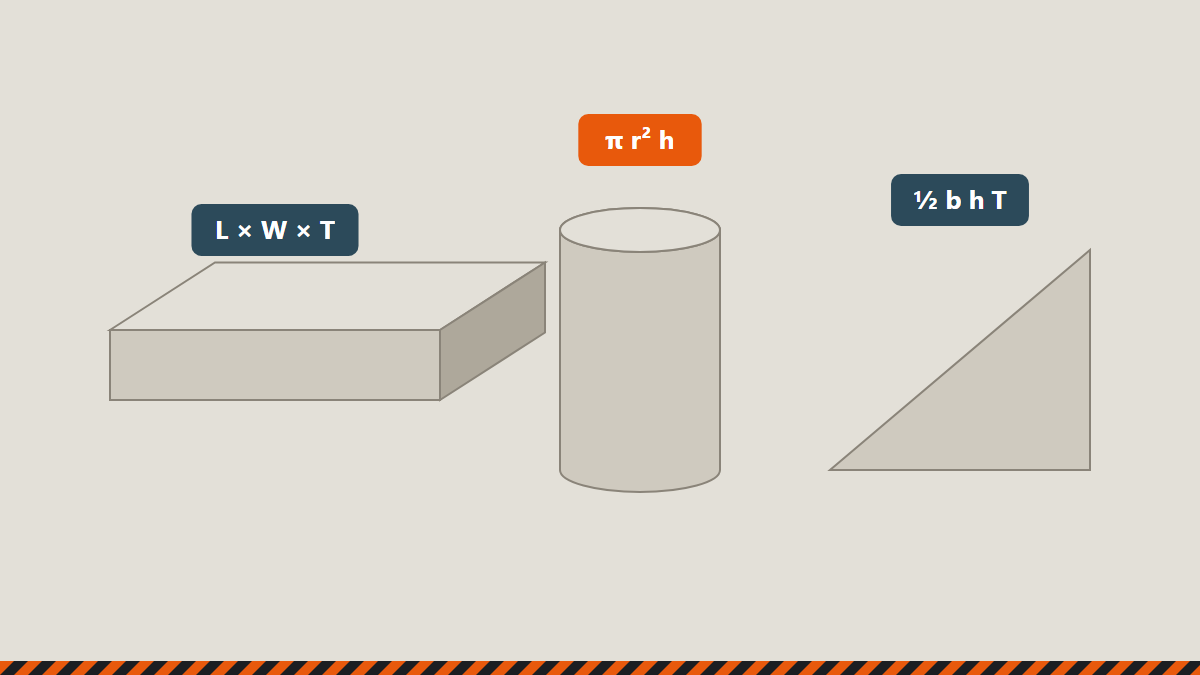
The sonotube concrete formula multiplies π × (diameter ÷ 2)² × depth. Multiply by the number of tubes for the full job.
Volume (ft³) = π × (diameter (ft) ÷ 2)² × depth (ft) × tubes
Pad volume (ft³) = π × (pad diameter (ft) ÷ 2)² × pad thickness (ft), once per tube
Cubic yards (yd³) = volume (ft³) ÷ 27
- Diameter: the inside tube size in inches (in) ÷ 12, in feet (ft).
- Depth: the full height of concrete in the tube, in feet.
- 27: cubic feet in 1 cubic yard.
The metric sonotube formula uses meters for the diameter and depth and gives cubic meters (m³).
Volume (m³) = π × (diameter (m) ÷ 2)² × depth (m) × tubes
1 m³ = 1.308 yd³ = 35.3 ft³
How to Measure a Sonotube Correctly
Use the inside diameter: measure straight across the opening inside the paper form. Enter the full concrete-filled height, from the bottom of the shaft to the finished top, including the part above grade. A tube that sticks 6 in above grade on a 12 in form adds 0.39 ft³.
Count identical tubes together, and estimate deeper, wider, or padded tubes as a separate group. Concrete volume is not the same as the length of paper tube you buy.
Worked Example: 12 Inch Sonotube, 4 Feet Deep
A 12 inch (30 cm) sonotube 4 feet (1.22 m) deep holds 3.14 cubic feet (0.089 m³), or 6 bags of 80 lb concrete with 10% waste. The 4 steps below show the math.
- Convert the diameter to feet: 12 in ÷ 12 = 1 ft, so the radius is 0.5 ft.
- Find the tube area: π × 0.5² = 0.785 ft².
- Multiply by the depth: 0.785 ft² × 4 ft = 3.14 ft³ (0.12 yd³).
- Count the bags: 3.14 ft³ ÷ 0.60 = 5.24, rounded up to 6 bags before waste. With 10% waste, 3.14 × 1.1 = 3.46 ft³ ÷ 0.60 = 5.76, rounded up to 6 bags.
Try it
Drag the sliders and the diagram redraws to scale.
Linked to the calculator above: moving a slider updates your estimate.
With your values
π × (1 ft ÷ 2)² × 4 ft = 3.14 ft³
- Cubic feet
- 3.14
- Cubic yards
- 0.12
- Cubic meters
- 0.09
Where to Use the Sonotube Calculator
The sonotube calculator fits any round tube form. Sample jobs, before waste:
- Deck piers: 6 tubes at 10 in × 4 ft need 13.09 ft³. Without tubes, use the pier calculator.
- Porch columns: 2 tubes at 12 in × 8 ft need 12.57 ft³ (0.36 m³). Square columns: column calculator.
- Pole barn footings: 8 tubes at 18 in × 4 ft need 2.09 yd³ (1.60 m³).
- Lamp posts: 1 tube at 8 in × 3 ft needs 1.05 ft³.
- For an open hole with no tube, use the post hole calculator.
8 Inch Sonotube Concrete
Each foot of 8 inch (20 cm) sonotube holds 0.35 cubic feet of concrete. A 4 ft tube needs 1.40 ft³, or 3 bags of 80 lb concrete.
10 Inch Sonotube Concrete
Each foot of 10 inch (25 cm) sonotube holds 0.55 cubic feet of concrete. A 4 ft tube needs 2.18 ft³, or 4 bags of 80 lb concrete.
12 Inch Sonotube Concrete
Each foot of 12 inch (30 cm) sonotube holds 0.79 cubic feet of concrete. A 4 ft tube needs 3.14 ft³, or 6 bags of 80 lb concrete.
16 Inch Sonotube Concrete
Each foot of 16 inch (41 cm) sonotube holds 1.40 cubic feet of concrete. A 4 ft tube needs 5.59 ft³, or 10 bags of 80 lb concrete.
18 Inch Sonotube Concrete
Each foot of 18 inch (46 cm) sonotube holds 1.77 cubic feet of concrete. A 4 ft tube needs 7.07 ft³, or 12 bags of 80 lb concrete.
Sonotube Concrete per Foot of Depth
Each foot of an 18 inch tube takes 2.25 times the concrete of a 12 inch tube. Doubling the diameter multiplies the volume by four; doubling only the height doubles it.
| Tube size | Cubic feet per ft | Cubic yards per ft | Cubic meters per ft | 80 lb bags per ft | 60 lb bags per ft |
|---|---|---|---|---|---|
| 6 in (15 cm) | 0.20 | 0.007 | 0.006 | 1 | 1 |
| 8 in (20 cm) | 0.35 | 0.013 | 0.010 | 1 | 1 |
| 10 in (25 cm) | 0.55 | 0.020 | 0.015 | 1 | 2 |
| 12 in (30 cm) | 0.79 | 0.029 | 0.022 | 2 | 2 |
| 14 in (36 cm) | 1.07 | 0.040 | 0.030 | 2 | 3 |
| 16 in (41 cm) | 1.40 | 0.052 | 0.040 | 3 | 4 |
| 18 in (46 cm) | 1.77 | 0.065 | 0.050 | 3 | 4 |
| 20 in (51 cm) | 2.18 | 0.081 | 0.062 | 4 | 5 |
| 24 in (61 cm) | 3.14 | 0.116 | 0.089 | 6 | 7 |
Bags of Concrete by Sonotube Diameter and Depth
| Diameter | 2 ft deep | 3 ft deep | 4 ft deep | 5 ft deep | 6 ft deep |
|---|---|---|---|---|---|
| 8 in | 2 (0.03 yd³) | 2 (0.04 yd³) | 3 (0.06 yd³) | 4 (0.07 yd³) | 4 (0.09 yd³) |
| 10 in | 2 (0.04 yd³) | 3 (0.07 yd³) | 4 (0.09 yd³) | 5 (0.11 yd³) | 6 (0.13 yd³) |
| 12 in | 3 (0.06 yd³) | 5 (0.10 yd³) | 6 (0.13 yd³) | 8 (0.16 yd³) | 9 (0.19 yd³) |
| 14 in | 4 (0.09 yd³) | 6 (0.13 yd³) | 8 (0.17 yd³) | 10 (0.22 yd³) | 12 (0.26 yd³) |
| 16 in | 6 (0.11 yd³) | 8 (0.17 yd³) | 11 (0.23 yd³) | 13 (0.28 yd³) | 16 (0.34 yd³) |
| 18 in | 7 (0.14 yd³) | 10 (0.22 yd³) | 13 (0.29 yd³) | 17 (0.36 yd³) | 20 (0.43 yd³) |
| 24 in | 12 (0.26 yd³) | 18 (0.38 yd³) | 24 (0.51 yd³) | 29 (0.64 yd³) | 35 (0.77 yd³) |
| Diameter | 2 ft deep | 3 ft deep | 4 ft deep | 5 ft deep | 6 ft deep |
|---|---|---|---|---|---|
| 8 in | 2 | 3 | 4 | 5 | 6 |
| 10 in | 3 | 4 | 6 | 7 | 8 |
| 12 in | 4 | 6 | 8 | 10 | 12 |
| 14 in | 6 | 8 | 11 | 14 | 16 |
| 16 in | 7 | 11 | 14 | 18 | 21 |
| 18 in | 9 | 13 | 18 | 22 | 26 |
| 24 in | 16 | 24 | 31 | 39 | 47 |
For other bag sizes or a volume you already know, use the concrete bag calculator.
Pooled vs Per-Pier Bag Rounding
Total all tubes before you round up, if you pour them together. Ten 12 in tubes at 4 ft need 58 bags of 80 lb concrete with 10% waste when pooled (34.56 ft³ ÷ 0.60 = 57.6, rounded up to 58), not 60 if each tube is rounded separately.
Six 12 in tubes at 3 ft need 26 bags pooled, or 30 if each pier is bought separately. Both use the same concrete: the difference is whether a part-bag from one tube can go into the next. The calculator shows both counts.
Footing Pad or Flared Base Under a Sonotube
For higher loads or weaker soil, plans often call for a wider footing under the tube: a bell-shaped form poured with the pier (Bigfoot Systems lists a 28 in base for 10 and 12 in tubes), or a round pad poured first with the tube set on top.
Use Add a footing pad above. The pad volume is added once per tube; enter the shaft height above the pad as the tube depth, so nothing is counted twice. A 20 in pad 8 in thick holds 1.45 ft³ (0.054 yd³), or 3 bags of 80 lb with 10% waste. A 28 in pad 10 in thick holds 3.56 ft³ (0.132 yd³), or 7 bags. For a square pad, use the footing calculator.
Pad size comes from your plans, local code, the soil, or a structural engineer. The calculator gives volume, not structural advice.
Bagged Concrete vs Ready-Mix for Sonotubes
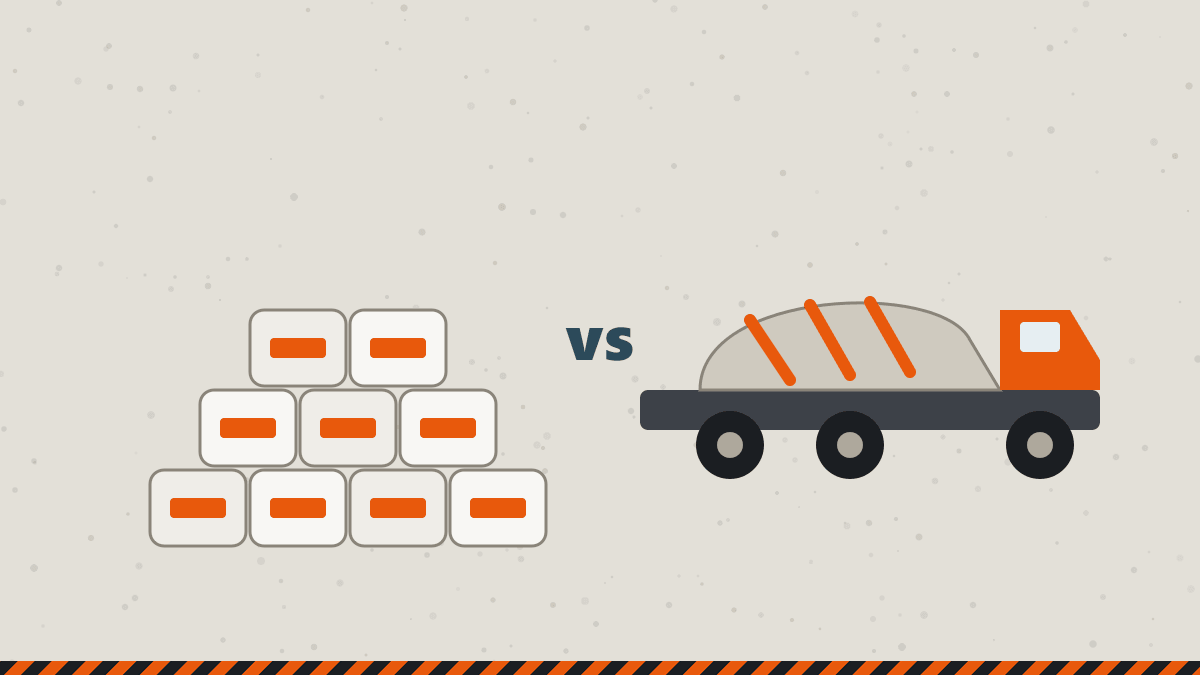
For a few small tubes, bagged mix is simplest. The bag count climbs fast across several piers:
| Tubes | Total volume | 80 lb bags | Practical choice |
|---|---|---|---|
| 1–2 tubes | 0.13–0.26 yd³ | 6–12 | Bagged |
| 3–6 tubes | 0.38–0.77 yd³ | 18–35 | Bagged, or rent a mixer |
| 7–12 tubes | 0.90–1.54 yd³ | 41–70 | Compare both |
| 13+ tubes | 1.66+ yd³ | 75+ | Ready-mix |
The usual crossover is about 1 cubic yard, which is 45 bags of 80 lb mix. Above that, get ready-mix quotes too. The calculator rounds the order up to the next ¼ yd³ (0.58 yd³ becomes 0.75 yd³), and many suppliers charge a short-load fee on small orders. Compare both with the concrete cost calculator.
Frost Depth, Rebar and Bracing
Set the footing deep enough. IRC 2021 R403.1.4 places exterior footings at least 12 in below undisturbed ground, and R403.1.4.1 requires frost protection, usually by extending below the local frost line. Get the frost depth from your building department.
Reinforce structural piers as your plans show. The plans, local code, or an engineer set the rebar; the calculator does not size it.
Brace and level before you pour. Sonoco rates Builder's Tube for pours up to 3 ft above ground, with bracing above 2 ft. Set anchor bolts or post bases while the concrete is workable.
Common Sonotube Calculation Mistakes
The 4 most common sonotube mistakes involve depth, flared bases, rounding, and pier size.
- Measure the full tube depth, including the part above grade. An extra 6 in of tube on a 12 in form adds 0.39 ft³.
- Add a flared base with the footing pad inputs, not by adding its thickness to the tube depth.
- Total all tubes before you round up. Ten 12 in tubes at 4 ft need 58 bags of 80 lb concrete with 10% waste, not 10 × 6 = 60.
- Take pier diameter and depth from local codes, the soil, or a structural engineer. The calculator gives volume, not structural advice.
Sonotube Concrete Calculator FAQ
How many bags of concrete do I need for a sonotube?
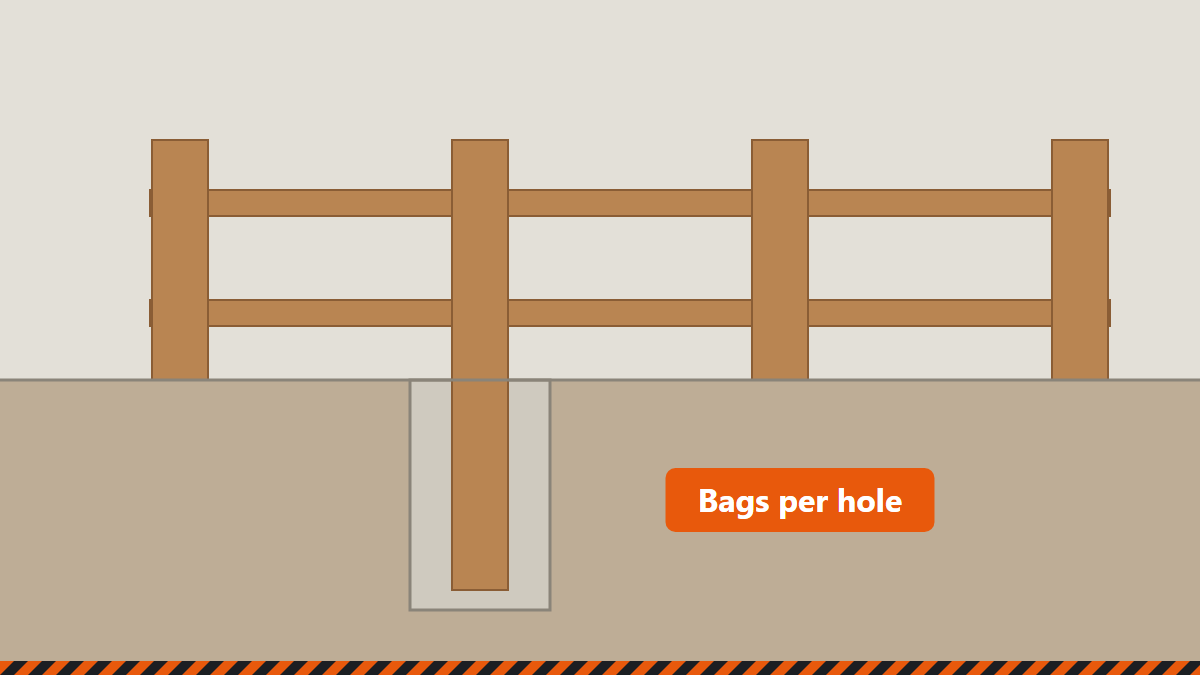
A 12 inch sonotube 4 feet deep holds 3.14 cubic feet, which is 6 bags of 80 lb or 7 bags of 60 lb concrete before waste. With the default 10% waste, plan for 6 bags of 80 lb or 8 bags of 60 lb.
How much concrete fits in an 18 inch sonotube?
An 18 inch sonotube holds 1.77 cubic feet of concrete per foot of depth (0.065 yd³). A 4 ft tube holds 7.07 ft³, or 12 bags of 80 lb concrete before waste. With the default 10% waste, plan for 13 bags. Compare bags with ready-mix in the concrete cost calculator.
What size sonotube do I need?
The sonotube size comes from local codes, the load on the pier, and the soil, so check with your building department or a structural engineer. The calculator does not size piers. Once you know the diameter and depth, tap the tube size above to count the bags.
Does the sonotube calculator include waste?
Yes, the sonotube calculator adds a 10 percent waste allowance by default. Change the waste field to any value from 0 to 100 percent. A range of 5 to 10 percent covers spillage and holes dug wider than the tube. Set the field to 0 for the exact tube volume.
How many bags of concrete for 6 sonotubes?
Six 12 inch tubes, 4 feet deep, need 35 bags of 80 lb concrete with 10% waste (0.77 yd³) when you pour them together. Bought tube by tube, that is 6 bags each, or 36 in total, because each tube is rounded up on its own.
How deep should a sonotube footing be?
Deep enough for your plans and local code. IRC R403.1.4 puts exterior footings at least 12 inches below undisturbed ground, and R403.1.4.1 calls for frost protection, usually by going below the local frost line. Ask your building department for the frost depth before you dig.
Do I need rebar in a sonotube pier?
Structural piers that carry deck, porch, or column loads are usually reinforced, and your plans, local code, or engineer set the bar size and count. Small non-structural posts may not need it, but check your plans. The calculator counts concrete only and does not size rebar.
Can I use a 6×6 post in a 10 inch sonotube?
It fits, but the cover is thin. A 6×6 post measures about 5.5 × 5.5 in, leaving 2.25 in of concrete on the flat sides of a 10 in tube and 1.1 in at the corners (2.1 in with a 12 in tube). The post fills about 39% of the tube.
Do I need to remove sonotubes after concrete sets?
Below ground, no: Sonoco designs Builder's Tube to stay in place and says it is not made to be stripped. For a clean column above ground, Sonoco advises a release agent before the pour and stripping the tube once the concrete has set.
Sources
Tube volumes use plain geometry. Bag yields, tube guidance and footing depths come from these references.
- QUIKRETE – Concrete Mix No. 1101 data sheet – bag yields
- QUIKRETE – QUIK-TUBE building form data sheet – bags per 12 in × 4 ft tube
- Sonoco – Sonotube Builder's Tube concrete forms – use and bracing
- International Residential Code 2021, R403.1.4 and R403.1.4.1 (UpCodes) – footing depth
- Bigfoot Systems – footing form sizes
- NIST – Unit conversion: SI to U.S. customary units
- How we calculate – formulas, constants, and sources
Sonotube® and Builder's Tube® are Sonoco trademarks. This site is independent and not affiliated with Sonoco.
Related guides