60 lb Concrete Bag Calculator
This concrete calculator for 60 lb bags finds your concrete volume and divides it by 0.45 cubic feet, the yield of one 60 lb (27 kg) bag. Enter a slab size or a volume in cubic yards, cubic feet, or cubic meters. The result shows 60 lb bags first, with 80 lb and metric counts below.
 By Muhammad AsimPublished Updated How we calculate
Your estimate
Total volume with waste
0.33yd³
- Cubic meters
- 0.25 m³
- Cubic feet
- 8.8 ft³
Premixed bags
- 60 lb bags20
- 80 lb bags15
- 40 lb bags30
- 25 kg bags22
- 20 kg bags27
- Weight
- 1,318 lb · 598 kg
- Ready-mix truck loads (10 yd³ each)
- 0.03
- Concrete cost
Formula with your numbers
6 ft × 4 ft × 0.333 ft × 1.1 = 8.80 ft³
Includes a 10% waste allowance. Bags are rounded up. Weight uses 2,400 kg/m³ (150 lb/ft³).
Your estimate0.33 yd³ · 20 × 60 lb
Planning several pours or a cost sheet? Get the free Excel template (7 tabs, no sign-up).
How to Use the 60 lb Bag Calculator
To use the 60 lb bag calculator, work through these 3 steps.
- Choose Slab size for a rectangle, or Volume for a known volume.
- Enter the numbers with their units, and set how many identical slabs you need.
- Keep or change the 10% waste field, then compare the 60 lb count with the 80 lb count below it.
60 lb Concrete Bag Formula
The 60 lb concrete bag formula divides the volume in cubic feet by 0.45 and rounds the answer up. A cubic yard takes 60 bags of 60 lb concrete.
60 lb bags = volume (ft³) ÷ 0.45, rounded up
60 lb bags = volume (yd³) × 60, rounded up
- Volume: the concrete for the job, in cubic feet (ft³) or cubic yards (yd³).
- 0.45: cubic feet of mixed concrete from one 60 lb bag.
- 60: 60 lb bags in 1 cubic yard (27 ft³ ÷ 0.45).
The metric 60 lb bag formula divides cubic meters (m³) by the bag yield in cubic meters. One cubic meter takes 79 bags.
60 lb bags = volume (m³) ÷ 0.0127, rounded up
1 yd³ = 0.7646 m³
Worked Example: 60 lb Bags for a 4 × 6 ft Pad
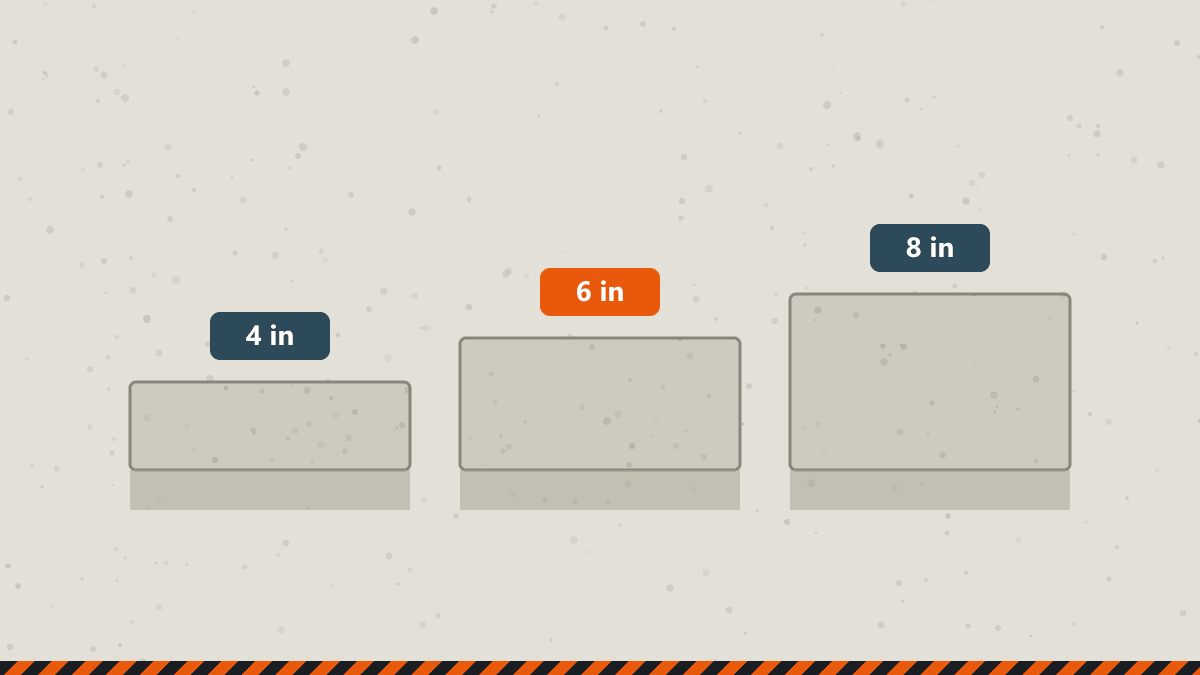
A 4 × 6 ft pad, 4 inches (10 cm) thick, is a typical small job for 60 lb bags. It takes 18 bags of 60 lb concrete before waste. Here is the math in 4 steps.
- Find the volume: 6 ft × 4 ft × (4 in ÷ 12) = 8 ft³ (0.23 m³).
- Divide by the 60 lb yield: 8 ÷ 0.45 = 17.8.
- Round up to a whole bag: 18 bags, or 1,080 lb to carry.
- Add 10% for waste: 8.8 ft³ ÷ 0.45 rounds up to 20 bags. The same pad takes 15 bags of 80 lb with waste.
Try it
Drag the sliders and the diagram redraws to scale.
Linked to the calculator above: moving a slider updates your estimate.
With your values
6 ft × 4 ft × 0.333 ft = 8.00 ft³
- Cubic feet
- 8.00
- Cubic yards
- 0.30
- Cubic meters
- 0.23
Where to Use 60 lb Bags
60 lb bags fit jobs where a lighter lift matters more than the bag count. These 4 pads, 4 inches (10 cm) thick, suit 60 lb bags:
- Air conditioner pads: a 3 × 3 ft pad takes 7 bags.
- Step landings: a 3 × 4 ft landing takes 9 bags.
- Equipment pads: a 6 × 6 ft pad takes 27 bags.
- Shed floors: an 8 × 10 ft shed base takes 60 bags.
60 lb vs 80 lb Bags
60 lb and 80 lb bags give the same concrete per pound, and a cubic yard takes 3,600 lb of either. The differences are:
- Weight per lift: 60 lb (27 kg) against 80 lb (36 kg).
- Bags per cubic yard: 60 against 45.
- Water per bag: about 4 pints (1.9 L), up to 7 pints (3.3 L), against 6 to 9 pints for an 80 lb bag (Quikrete data sheet).
Both sizes are above the 51 lb (23 kg) that the NIOSH lifting equation treats as the most to lift even in ideal conditions, so move bags in a wheelbarrow and share long carries. Pick 60 lb bags when one person lifts every bag, and the 80 lb bag calculator for larger pours with help.
60 lb Bags for Common Slab Sizes
A 10 × 20 ft slab at 4 inches takes 149 bags of 60 lb concrete. The weight column shows what the crew lifts in total, which is the real limit on a bagged pour.
| Slab size | Cubic feet | 60 lb bags | 60 lb with 10% waste | Weight to carry | 80 lb bags with waste |
|---|---|---|---|---|---|
| 3 × 3 ft | 3.0 | 7 | 8 | 480 lb | 6 |
| 4 × 6 ft | 8.0 | 18 | 20 | 1,200 lb | 15 |
| 6 × 6 ft | 12.0 | 27 | 30 | 1,800 lb | 22 |
| 8 × 10 ft | 26.7 | 60 | 66 | 3,960 lb | 49 |
| 10 × 10 ft | 33.3 | 75 | 82 | 4,920 lb | 62 |
| 10 × 20 ft | 66.7 | 149 | 163 | 9,780 lb | 123 |
Common 60 lb Bag Counting Mistakes
The 3 most common 60 lb bag mistakes involve yield, waste, and thickness.
- Use 0.45 ft³ for a 60 lb bag. Dividing by the 80 lb yield of 0.60 ft³ leaves the job a quarter short.
- Add waste before you buy. The 4 × 6 ft pad needs 18 bags on paper and 20 bags with 10 percent waste.
- Check the form depth. A 4 × 6 ft pad at 3 inches needs 14 bags, not 18.
60 lb Concrete Bag Calculator FAQ
How many 60 lb bags of concrete make a cubic yard?
A cubic yard (0.76 m³) of concrete takes 60 bags of 60 lb concrete. Each bag yields 0.45 cubic feet, and 27 cubic feet divided by 0.45 equals 60. Add 5 to 10 percent for waste, which brings the purchase to 63 to 66 bags per cubic yard.
How many square feet does a 60 lb bag of concrete cover?
A 60 lb bag of concrete covers 1.35 square feet at 4 inches thick (10 cm). At 3 inches the same bag covers 1.80 square feet, and at 2 inches it covers 2.70 square feet. Divide the 0.45 cubic foot yield by the thickness in feet to get the coverage.
Should I buy 60 lb or 80 lb bags?
Buy 60 lb bags when the lift matters more than the bag count, and 80 lb bags when the job is larger. Both sizes give the same concrete per pound. A 60 lb (27 kg) bag is easier to carry, but a cubic yard takes 60 bags instead of 45.
How many 60 lb bags do I need for a 10 × 20 slab?
A 10 × 20 ft slab at 4 inches (10 cm) thick needs 149 bags of 60 lb concrete before waste and 163 bags with 10 percent waste. The slab holds 2.47 cubic yards, so ready-mix concrete is usually the easier choice at this size.
Sources
The 0.45 cubic foot yield of a 60 lb bag is the figure both Quikrete and Sakrete print. The water figures come from the Quikrete data sheet, and the lifting figure from NIOSH.
- Quikrete – Concrete Mix No. 1101 data sheet (yields, water per bag, mixer capacity)
- Sakrete – High-Strength Concrete Mix (yields 0.30, 0.45, and 0.6 ft³)
- NIOSH – Revised lifting equation (Waters et al., 1993), 51 lb load constant
- NIST – Unit conversion: SI to U.S. customary units
- How we calculate – formulas, constants, and sources
Related guides