Concrete Sand, Gravel & Cement Calculator
This concrete calculator for sand, gravel, and cement turns a pour into a site-mix shopping list. It multiplies the wet volume by 1.54, splits the dry total by a 1:2:3 or 1:2:4 ratio, and shows 94 lb cement bags, sand, and gravel in cubic feet and cubic meters.
 By Muhammad AsimPublished Updated How we calculate
Your estimate
Total volume with waste
1.10yd³
- Cubic meters
- 0.84 m³
- Cubic feet
- 29.7 ft³
Premixed bags
- 80 lb bags50
- 60 lb bags66
- 40 lb bags99
- 25 kg bags73
- 20 kg bags90
- Weight
- 4,450 lb · 2,018 kg
- Ready-mix truck loads (10 yd³ each)
- 0.11
- Concrete cost
Dry materials (1:2:3 general, × 1.54 dry volume)
- Cement
- 0.22 m³
- 7.6 ft³
- Sand
- 0.43 m³
- 15.2 ft³
- Gravel
- 0.65 m³
- 22.9 ft³
Cement: 8 bags of 94 lb (1 ft³ each)
Formula with your numbers
27 ft³ × 1.1 = 29.70 ft³
Includes a 10% waste allowance. Bags are rounded up. Weight uses 2,400 kg/m³ (150 lb/ft³).
Your estimate1.10 yd³ · 50 × 80 lb
Planning several pours or a cost sheet? Get the free Excel template (7 tabs, no sign-up).
How to Use the Sand, Gravel, and Cement Calculator
To use the sand, gravel, and cement calculator, follow these 4 steps.
- Type the finished volume, or pick Dimensions and measure the slab.
- Choose 1:2:3 for patios and slabs or 1:2:4 for footings.
- Keep the 10% waste allowance.
- Read the cement bag count, then the sand and gravel volumes.
Concrete Calculator Sand Gravel Cement Formula
The sand, gravel, and cement formula starts from the dry volume: wet volume × 1.54. Each material gets its ratio share, and each cubic foot of cement is one 94 lb bag.
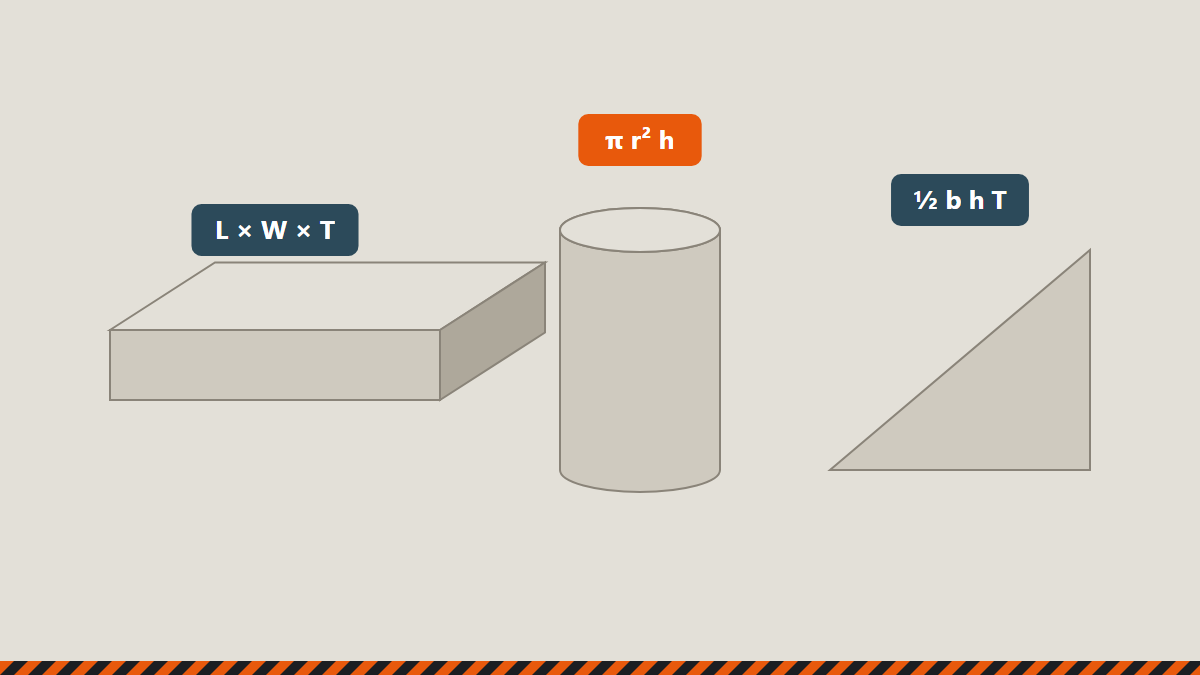
Dry volume (ft³) = wet volume (ft³) × 1.54
Material (ft³) = dry volume × its part ÷ total parts
94 lb cement bags = cement (ft³) ÷ 1, rounded up
- Wet volume: the finished concrete, in cubic feet (ft³).
- 1.54: the dry volume factor for loose, unmixed materials.
- 1 ft³: the volume of one 94 lb (42.6 kg) bag of portland cement.
The metric version uses cubic meters. One 94 lb cement bag holds 0.028 m³.
Dry volume (m³) = wet volume (m³) × 1.54
Cement bags = cement (m³) ÷ 0.028
Worked Example: Materials for 1 Cubic Yard at 1:2:3
One cubic yard (0.76 m³) of 1:2:3 concrete takes 7 bags of 94 lb cement, 13.9 ft³ of sand, and 20.8 ft³ of gravel, before waste. The 4 steps below show the math.
- Find the dry volume: 27 ft³ × 1.54 = 41.58 ft³.
- Cement takes 1 of 6 parts: 41.58 ÷ 6 = 6.93 ft³, rounded up to 7 bags.
- Sand takes 2 parts: 13.9 ft³ (0.39 m³).
- Gravel takes 3 parts: 20.8 ft³ (0.59 m³).
At 1:2:4 the same yard takes 6 bags of cement, 11.9 ft³ of sand, and 23.8 ft³ of gravel. The figure of 1 ft³ per 94 lb bag comes from CMHA TEK 04-02A.
Mix ratio splitter
- Cement0.26 m³
- Sand0.51 m³
- Gravel or crushed stone0.77 m³
Where to Use Site-Mixed Concrete
Site-mixed concrete fits 3 small jobs, including patios, footings, and slabs:
- Patios: an 8 × 8 ft patio at 4 in needs 6 cement bags, 11.0 ft³ of sand, and 16.4 ft³ of gravel.
- Footings: use 1:2:4, and take the footing size from local code or a structural engineer.
- Small slabs: site mixing suits pours under about 1 cubic yard (0.76 m³); get a ready-mix quote above that.
Hand Mixing Concrete on Site
To hand mix concrete on site, measure every material with one bucket and mix it dry first. The job needs 5 tools:
- Wheelbarrow or mixing tub
- Square shovel or mortar hoe
- Bucket for measuring
- Hose or water can
- Gloves and eye protection
Turn the dry materials until the color is even. Add water gradually until the mix is workable, and follow the cement bag instructions.
Cement Bags, Sand, and Gravel for Common Jobs
An 8 × 8 ft patio at 4 inches takes 6 bags of 94 lb cement.
| Job and ratio | Wet volume (ft³) | 94 lb cement bags | Sand (ft³) | Gravel (ft³) |
|---|---|---|---|---|
| 8 × 8 ft patio, 4 in, 1:2:3 | 21.3 | 6 | 11.0 | 16.4 |
| 10 × 10 ft slab, 4 in, 1:2:3 | 33.3 | 9 | 17.1 | 25.7 |
| 4 × 3 ft step landing, 6 in, 1:2:3 | 6.0 | 2 | 3.1 | 4.6 |
| 20 ft footing, 16 × 8 in, 1:2:4 | 17.8 | 4 | 7.8 | 15.6 |
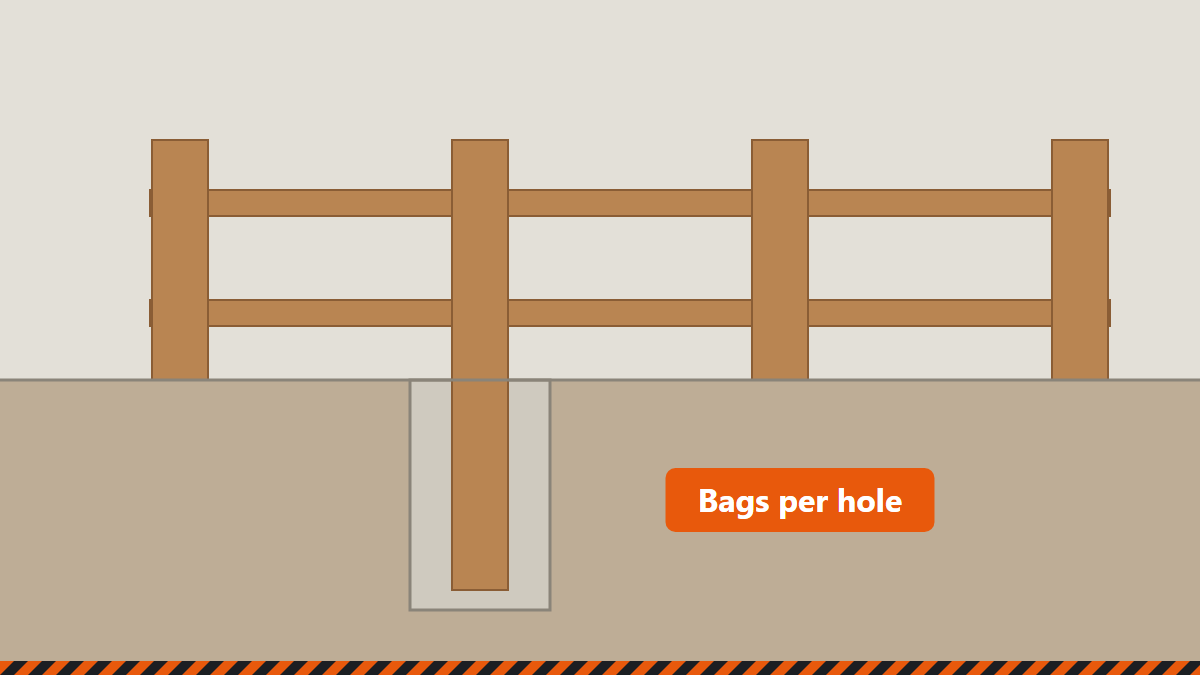
| 6 post holes, 10 in × 3 ft, 1:2:3 | 9.8 | 3 | 5.0 | 7.6 |
Buying Sand and Gravel by the Ton
Yards and landscape suppliers often sell sand and gravel by weight. Loose sand weighs about 1.45 tons per cubic yard and gravel about 1.42 tons, so multiply each volume in cubic yards by its factor. One cubic yard of 1:2:3 concrete needs 0.51 yd³ of sand and 0.77 yd³ of gravel: about 0.74 tons of sand and 1.09 tons of gravel.
| Job | Sand (tons) | Gravel (tons) | Cement (94 lb bags) |
|---|---|---|---|
| 8 × 8 ft patio, 4 in, 1:2:3 | 0.59 | 0.86 | 6 |
| 10 × 10 ft slab, 4 in, 1:2:3 | 0.92 | 1.35 | 9 |
| 4 × 3 ft step landing, 6 in, 1:2:3 | 0.17 | 0.24 | 2 |
| 20 ft footing, 16 × 8 in, 1:2:4 | 0.42 | 0.82 | 4 |
| 6 post holes, 10 in × 3 ft, 1:2:3 | 0.27 | 0.40 | 3 |
Common Site-Mixing Mistakes
The 3 most common site-mixing mistakes involve bags, water, and ballast.
- Round cement up to whole bags. A cement share of 6.93 ft³ means 7 bags of 94 lb.
- Add water in small amounts and follow the mixing instructions on the cement bag.
- Skip the separate sand and gravel lines, if you buy all-in ballast.
Concrete Sand, Gravel & Cement Calculator FAQ
How many bags of cement do I need for 1 cubic yard of concrete?
One cubic yard of 1:2:3 concrete needs 7 bags of 94 lb portland cement, before waste. The dry volume is 27 × 1.54 = 41.58 ft³, and cement takes one sixth, or 6.93 ft³. Each 94 lb bag holds 1 ft³, so round up to whole bags.
How much sand and gravel do I need for a cubic yard?
A cubic yard of 1:2:3 concrete needs 13.9 ft³ of sand and 20.8 ft³ of gravel before waste. In cubic yards, that is 0.51 yd³ of sand and 0.77 yd³ of gravel. Order a little extra, since loose piles leave some material on the ground.
How much water goes into hand-mixed concrete?
Add water gradually until the mix is workable, and follow the instructions on the cement bag. The calculator gives no water figure, since the right amount depends on how damp the sand and gravel are. Mix the dry materials to an even color before any water goes in.
What is ballast in concrete?
Ballast is the UK word for a sand and gravel blend, often sold as all-in ballast. Sand and gravel or crushed stone form the aggregate in concrete, and ballast supplies both. Use the cement bag count from the calculator, and buy ballast in place of the separate sand and gravel lines.
How many tons of sand and gravel do I need for a yard of concrete?
One cubic yard of 1:2:3 concrete needs about 0.74 tons of sand and 1.09 tons of gravel, using 1.45 and 1.42 tons per cubic yard of loose material. Add 10 percent for waste, and ask the supplier whether their weights are for wet or dry material.
Sources
Material splits use the 1.54 dry volume factor and the ratio parts. The bag and weight figures come from the references below.
Related guides