Triangle Concrete Calculator
This concrete calculator for a triangle slab multiplies ½ × base × height × thickness. Enter the base, the height measured square to the base, and the thickness in feet, inches, or meters. The results show cubic feet, cubic yards, and cubic meters, bags of concrete, weight, and cost.
 By Muhammad AsimPublished How we calculate
Your estimate
Total volume with waste
0.54yd³
- Cubic meters
- 0.42 m³
- Cubic feet
- 14.7 ft³
Premixed bags
- 80 lb bags25
- 60 lb bags33
- 40 lb bags49
- 25 kg bags36
- 20 kg bags45
- Weight
- 2,197 lb · 997 kg
- Ready-mix truck loads (10 yd³ each)
- 0.05
- Concrete cost
Formula with your numbers
½ × 10 ft × 8 ft × 0.333 ft × 1.1 = 14.67 ft³
Includes a 10% waste allowance. Bags are rounded up. Weight uses 2,400 kg/m³ (150 lb/ft³).
Your estimate0.54 yd³ · 25 × 80 lb
Planning several pours or a cost sheet? Get the free Excel template (7 tabs, no sign-up).
How to Use the Concrete Triangle Calculator
The triangle calculator works in 4 steps.
- Pick one side as the base and measure the base length.
- Measure the height at a right angle from the base to the far corner.
- Enter the slab thickness, usually 4 inches (10 cm) for a pad or patio.
- Read the cubic feet for a bag pour or the cubic yards for ready-mix.
Triangle Concrete Formula
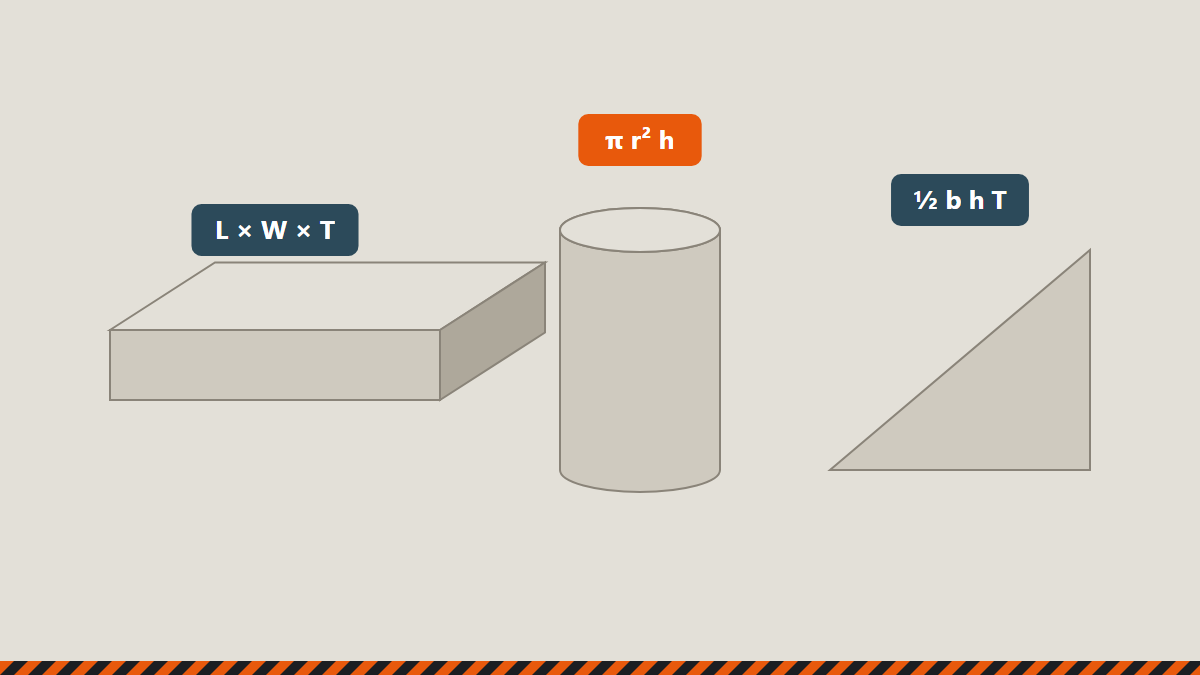
Triangle concrete volume equals ½ × base × height × thickness, all in feet. A triangle covers half of the rectangle with the same base and height, so the ½ cuts the rectangle volume in half.
Volume (ft³) = ½ × base (ft) × height (ft) × thickness (in) ÷ 12
Cubic yards = volume (ft³) ÷ 27
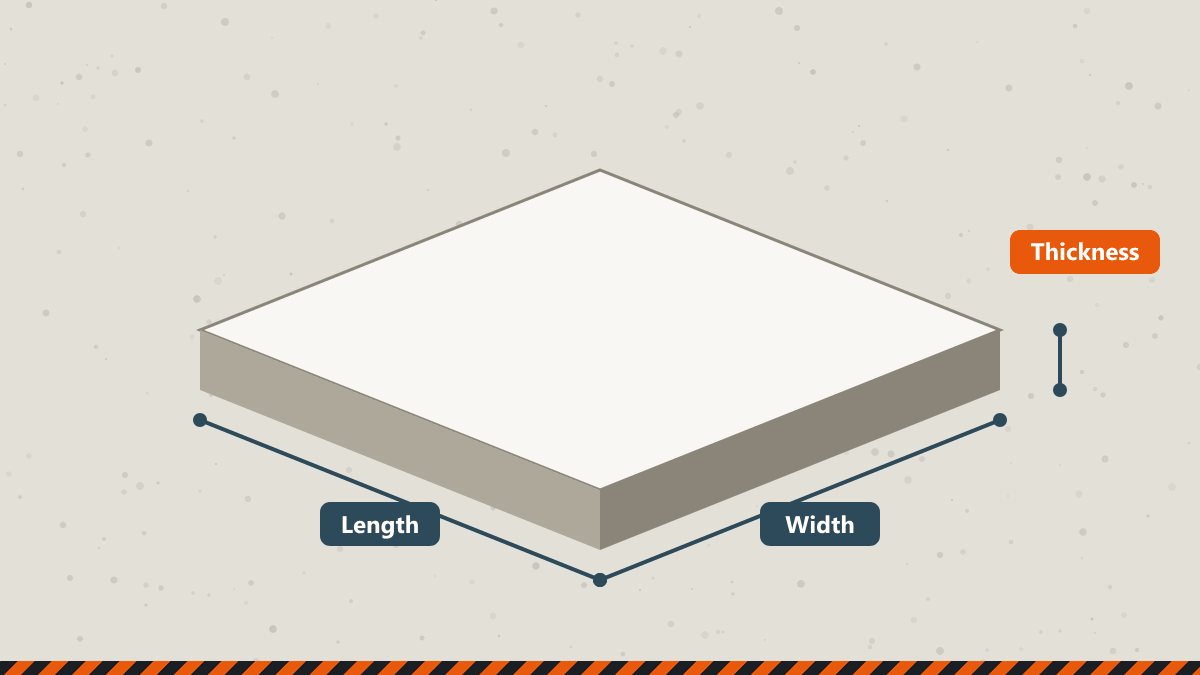
- Base: any one side of the triangle, in feet (ft).
- Height: the distance from the base to the opposite corner, measured at 90°, in feet.
- Thickness: the slab depth in inches (in) ÷ 12.
The metric triangle formula uses meters for base, height, and thickness and gives cubic meters (m³).
Volume (m³) = 0.5 × base (m) × height (m) × thickness (m)
Worked Example: Triangle Slab, 10 ft Base and 8 ft Height
A triangle slab with a 10 ft (3.05 m) base, an 8 ft (2.44 m) height, and a 4 inch (10 cm) thickness holds 13.3 cubic feet, or 0.49 cubic yards (0.38 m³). The 4 steps below show the math.
- Find the area: ½ × 10 ft × 8 ft = 40 ft² (3.72 m²).
- Multiply by the thickness in feet: 40 × (4 ÷ 12) = 13.3 ft³.
- Divide by 27: 13.3 ÷ 27 = 0.49 yd³.
- Add 10% for waste: 14.7 ft³, or 25 bags of 80 lb (33 bags of 60 lb).
A 10 × 8 ft rectangle at the same thickness holds 26.7 ft³, exactly twice the triangle.
Try it
Drag the sliders and the diagram redraws to scale.
Linked to the calculator above: moving a slider updates your estimate.
With your values
½ × 10 ft × 8 ft × 0.333 ft = 13.33 ft³
- Cubic feet
- 13.33
- Cubic yards
- 0.49
- Cubic meters
- 0.38
Where to Use the Triangle Calculator
The triangle calculator fits 4 kinds of angled pours, including corner pads, patios, and fill-in sections:
- Corner pads: a 6 × 6 ft right-angle pad at 4 in needs 6 ft³, or 10 bags of 80 lb concrete.
- Triangular patios: a 16 ft base with a 12 ft height at 4 in needs 1.19 yd³ (0.91 m³).
- Fill-in sections: a 12 ft base with a 4 ft height between a walk and a drive needs 8 ft³.
- Angled slab ends: add the triangle to the rectangle result from the slab calculator, or use the irregular shape calculator.
Concrete for Common Triangle Sizes
A triangle with a 12 ft base and a 12 ft height at 4 inches needs 40 bags of 80 lb concrete, before waste.
| Base × height | Cubic feet | Cubic yards | Cubic meters | 80 lb bags | 60 lb bags |
|---|---|---|---|---|---|
| 4 × 4 ft | 2.7 | 0.10 | 0.08 | 5 | 6 |
| 6 × 6 ft | 6.0 | 0.22 | 0.17 | 10 | 14 |
| 8 × 8 ft | 10.7 | 0.40 | 0.30 | 18 | 24 |
| 10 × 8 ft | 13.3 | 0.49 | 0.38 | 23 | 30 |
| 12 × 12 ft | 24.0 | 0.89 | 0.68 | 40 | 54 |
| 16 × 12 ft | 32.0 | 1.19 | 0.91 | 54 | 72 |
| 20 × 20 ft | 66.7 | 2.47 | 1.89 | 112 | 149 |
Common Triangle Calculation Mistakes
The 3 most common triangle mistakes involve the height, the ½ factor, and the thickness unit.
- Measure the height square to the base, not along a slanted side. Using a 9 ft slanted side in place of an 8 ft height adds 1.7 ft³ to the 10 ft base example.
- Keep the ½ in the formula. Leaving it out doubles the order.
- Enter the thickness in inches, if the field shows inches, and convert to feet when working by hand.
Triangle Concrete Calculator FAQ
How do I calculate concrete for a triangle?
To calculate concrete for a triangle, multiply ½ × base × height × thickness, with every measurement in feet. The result is cubic feet. Divide by 27 for cubic yards, or by 0.60 for 80 lb bags. Measure the height at a right angle from the base to the opposite corner.
How much concrete is in a triangle slab with a 10 ft base and 8 ft height?
A triangle slab with a 10 ft base and 8 ft height at 4 inches thick holds 13.3 cubic feet, or 0.49 cubic yards (0.38 m³). That fills 23 bags of 80 lb concrete before waste. With 10 percent extra, plan for 25 bags.
Can I use the triangle calculator for a right-angle corner?
Yes, enter the 2 sides that meet at the square corner as the base and the height. In a right triangle, each of those sides is square to the other, so no extra measurement is needed. The long sloping side plays no part in the volume calculation.
How many cubic yards does a triangular patio need?
A triangular patio with a 16 ft base and 12 ft height at 4 inches needs 1.19 cubic yards (0.91 m³), before waste. With 10 percent extra, order 1.30 yd³. Enter your own base, height, and thickness above to get a figure for a different patio.
Sources
Every result on this page uses plain geometry and the exact unit definitions below. The full list of formulas and constants is on the How we calculate page.
Related guides