Curb & Gutter Concrete Calculator
This concrete calculator curb and gutter tool finds the volume of an L-shaped curb with an attached gutter flag. Enter 5 measurements: curb depth, curb height, gutter width, flag thickness, and run length. The results show cubic feet, cubic yards, cubic meters, and bag counts, with a 10% waste allowance.
 By Muhammad AsimPublished How we calculate
Your estimate
Total volume with waste
1.53yd³
- Cubic meters
- 1.17 m³
- Cubic feet
- 41.3 ft³
Premixed bags
- 80 lb bags69
- 60 lb bags92
- 40 lb bags138
- 25 kg bags101
- 20 kg bags125
- Weight
- 6,180 lb · 2,803 kg
- Ready-mix truck loads (10 yd³ each)
- 0.15
- Concrete cost
Formula with your numbers
50 ft × [0.5 ft × (0.5 ft + 0.333 ft) + 1 ft × 0.333 ft] × 1.1 = 41.25 ft³
Includes a 10% waste allowance. Bags are rounded up. Weight uses 2,400 kg/m³ (150 lb/ft³).
Your estimate1.53 yd³ · 69 × 80 lb
Planning several pours or a cost sheet? Get the free Excel template (7 tabs, no sign-up).
How to Use the Concrete Curb and Gutter Calculator
To use the concrete calculator for curb and gutter, follow these 4 steps.
- Enter the curb depth, which is the width of the upright curb from front to back.
- Enter the curb height above the flag and the flag thickness.
- Enter the gutter width and the total run length in feet.
- Read the cubic yards and bag counts.
Curb and Gutter Concrete Formula
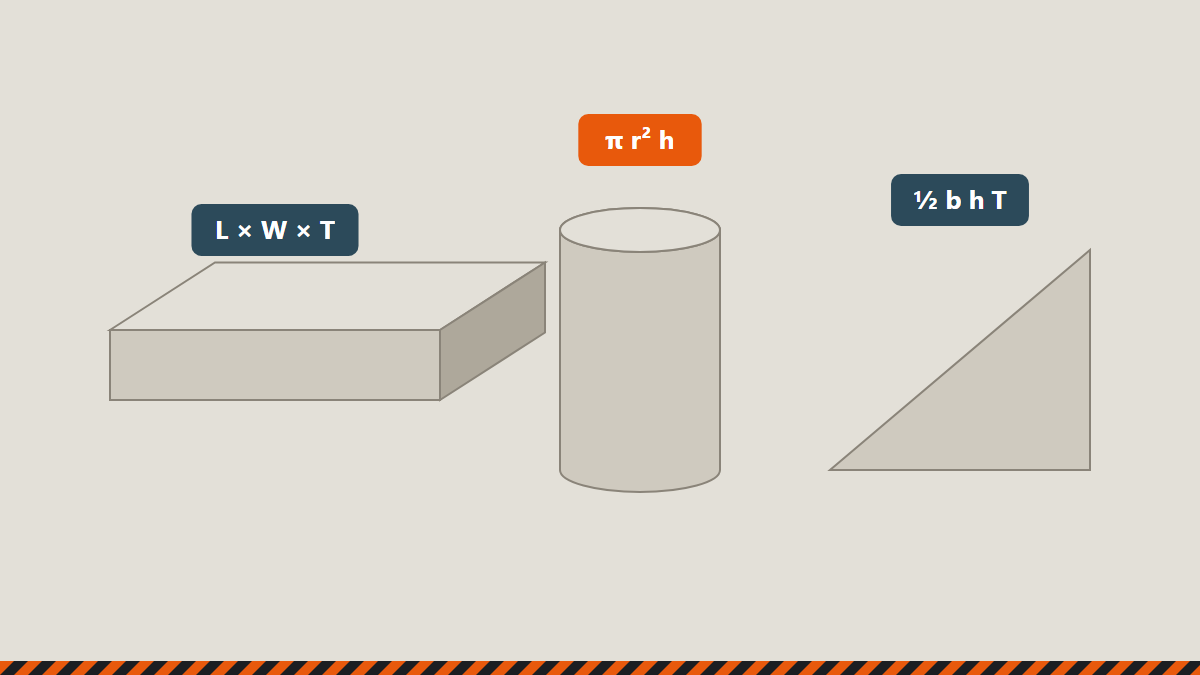
The curb and gutter formula adds 2 rectangles in cross-section, curb depth × (curb height + flag thickness) + gutter width × flag thickness, then multiplies by the length.
Volume (ft³) = length × [curb depth × (curb height + flag thickness) + gutter width × flag thickness]
Cubic yards (yd³) = volume (ft³) ÷ 27
- Length: the run of curb, in feet (ft).
- Curb depth: the front-to-back width of the curb, in inches (in) ÷ 12.
- Curb height: the curb face above the flag, in inches ÷ 12.
- Gutter width: the flat flag in front of the curb, in inches ÷ 12.
- Flag thickness: the depth of the gutter flag, in inches ÷ 12.
The metric curb formula uses meters (m) for all 5 measurements and returns cubic meters (m³).
Volume (m³) = length × [curb depth × (curb height + flag thickness) + gutter width × flag thickness]
1 m³ = 1.308 yd³ = 35.3 ft³
Worked Example: 50 Feet of 6 Inch Curb With a 12 Inch Gutter
A 50 ft (15.24 m) run with a 6 in curb depth, 6 in curb height, 12 in gutter, and 4 in flag holds 37.5 cubic feet, or 1.39 cubic yards (1.06 m³). The 4 steps below show the math.
- Find the curb block: 0.5 ft × (0.5 ft + 0.333 ft) × 50 ft = 20.8 ft³.
- Find the gutter flag: 1 ft × 0.333 ft × 50 ft = 16.7 ft³.
- Add the parts and convert: 37.5 ft³ ÷ 27 = 1.39 yd³.
- Add 10% waste: 1.53 yd³, or 69 bags of 80 lb concrete.
Try it
Drag the sliders and the diagram redraws to scale.
Linked to the calculator above: moving a slider updates your estimate.
With your values
50 ft × [0.5 ft × (0.5 ft + 0.333 ft) + 1 ft × 0.333 ft] = 37.50 ft³
- Cubic feet
- 37.50
- Cubic yards
- 1.39
- Cubic meters
- 1.06
Where to Use the Curb and Gutter Calculator
The calculator covers any curb with a flat gutter flag in front. Sample runs, before waste:
- Parking islands: 80 ft of the example profile takes 2.22 yd³ (1.70 m³).
- Subdivision streets: 300 ft with a 24 in gutter and 6 in flag takes 16.67 yd³.
- Concrete edging: a raised edge with a flat lip fits the same 5 inputs.
Concrete per 100 Feet of Curb and Gutter
A 24 in gutter with a 6 in flag takes 2 times the concrete of a 12 in gutter with a 4 in flag.
| Sample profile (depth × height, gutter, flag) | Cubic feet | Cubic yards | Cubic meters | 80 lb bags |
|---|---|---|---|---|
| 6 × 6 in, 12 in (30 cm), 4 in | 75.0 | 2.78 | 2.12 | 125 |
| 6 × 6 in, 18 in (46 cm), 4 in | 91.7 | 3.40 | 2.60 | 153 |
| 6 × 6 in, 24 in (61 cm), 6 in | 150.0 | 5.56 | 4.25 | 250 |
| 8 × 6 in, 24 in (61 cm), 6 in | 166.7 | 6.17 | 4.72 | 278 |
Common Curb and Gutter Calculation Mistakes
The 3 most common curb and gutter mistakes involve the curb height, the flag, and the base.
- Measure the curb height from the top of the flag, not from the ground.
- Check the flag thickness on the drawings. A 5 in flag instead of 4 in raises 50 ft of the example from 1.39 to 1.62 yd³.
- Price the gravel bed under the curb as its own material, because the result covers concrete alone.
Curb & Gutter Concrete Calculator FAQ
How much concrete do I need for 50 feet of curb and gutter?
Fifty feet of curb and gutter with a 6 by 6 inch curb, 12 inch gutter, and 4 inch flag needs 37.5 cubic feet, or 1.39 cubic yards. Adding 10 percent for waste brings the order to 1.53 yd³. Change any of the 5 inputs above to match your own profile.
Is a concrete kerb calculator the same as a curb calculator?
Yes, a concrete kerb calculator uses the same formula as a curb calculator. Kerb is the UK spelling, and kerb and channel is the matching term for curb and gutter. Enter the kerb sizes in millimeters (mm) and meters, and the results show cubic meters (m³) next to cubic yards.
Can I use the concrete gutter calculator for a curb without a gutter?
No, the curb and gutter inputs need a gutter width and flag thickness above zero. For a plain upright curb or a flat edging strip, use the footing calculator, which multiplies length × width × depth. Enter the curb depth as the width and the full curb height as the depth.
Does the curb and gutter calculator include waste?
Yes, the curb and gutter calculator adds 10 percent for waste by default. Form leaks, low spots in the base, and spillage at the chute all take extra concrete. Keep the allowance between 5 and 10 percent, or set the waste field to 0 to see the exact section volume.
Sources
Every result on this page uses plain geometry and the exact unit definitions below. The full list of formulas and constants is on the How we calculate page.
Related guides