Dry Pour Concrete Calculator
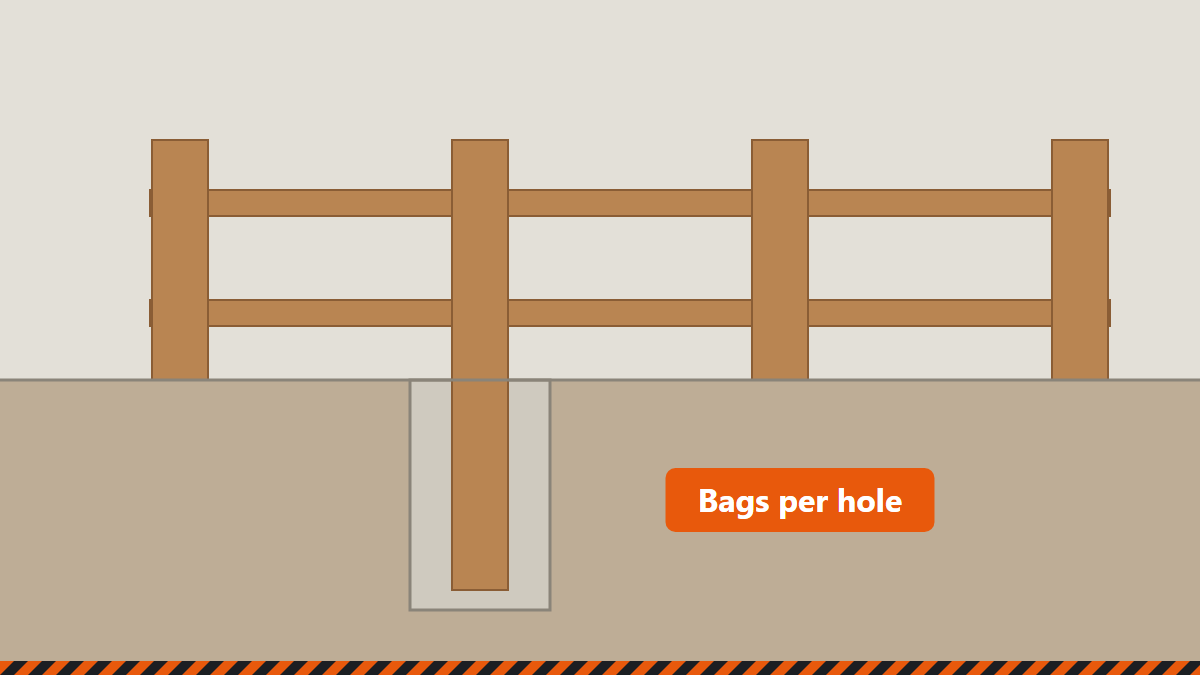
This concrete calculator for dry pour post setting counts bags of dry premix for each hole. Enter the hole size, subtract the post if you like, and set the number of holes. The tool divides the volume by each bag yield and shows bags of 80, 60, 50, and 40 lb, with 10% waste.
 By Muhammad AsimPublished Updated How we calculate
Your estimate
Total volume with waste
0.07yd³
- Cubic meters
- 0.05 m³
- Cubic feet
- 1.8 ft³
Premixed bags
- 80 lb bags3
- 60 lb bags4
- 50 lb bags5
- 40 lb bags6
- Weight
- 270 lb · 122 kg
- Ready-mix truck loads (10 yd³ each)
- 0.01
- Concrete cost
Formula with your numbers
π × (0.833 ft ÷ 2)² × 3 ft × 1.1 = 1.80 ft³
Includes a 10% waste allowance. Bags are rounded up. Weight uses 2,400 kg/m³ (150 lb/ft³).
Your estimate0.07 yd³ · 3 × 80 lb
Planning several pours or a cost sheet? Get the free Excel template (7 tabs, no sign-up).
How to Use the Dry Pour Calculator
To use the dry pour calculator, follow these 4 steps.
- Choose Hole only or Subtract the post.
- Enter the hole diameter, hole depth, and post width.
- Type the number of holes.
- Read the bag count for each bag size.
Concrete Calculator Dry Pour Formula
The dry pour formula finds the hole volume, subtracts the post, and divides by the bag yield.
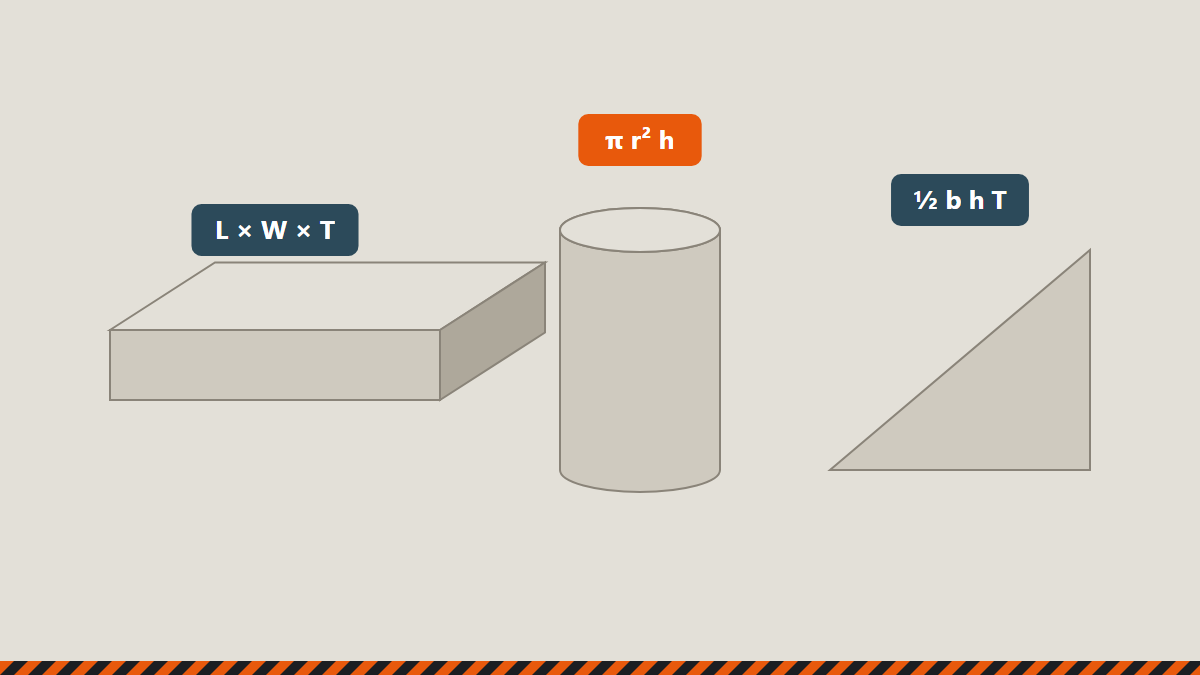
Hole (ft³) = π × (diameter ÷ 2)² × depth
Fill (ft³) = hole − post width² × depth
Bags = fill × holes ÷ bag yield, rounded up
- Diameter and depth: the hole size, in feet (ft).
- Post width: the real width of one side of a square post, in feet.
- Bag yield: 0.60 ft³ (80 lb), 0.45 ft³ (60 lb), 0.375 ft³ (50 lb), or 0.30 ft³ (40 lb).
The metric formula uses meters and gives cubic meters (m³).
Fill (m³) = [π × (diameter (m) ÷ 2)² − post (m)²] × depth (m)
1 ft³ = 0.0283 m³
Worked Example: 10 Inch Hole, 3 Feet Deep
A 10 inch (25.4 cm) hole dug 3 feet (0.91 m) deep holds 1.64 ft³ and takes 3 bags of 80 lb dry mix or 4 bags of 60 lb. The 3 steps below show the math.
- Find the hole volume with a radius of 10 ÷ 24 = 0.417 ft: π × 0.417² × 3 = 1.64 ft³ (0.046 m³).
- Subtract a 4 in square post: 1.64 − 0.333² × 3 = 1.30 ft³.
- Divide by the bag yield and round up: 3 bags of 80 lb or 3 bags of 60 lb with the post in place.
Try it
Drag the sliders and the diagram redraws to scale.
Linked to the calculator above: moving a slider updates your estimate.
With your values
π × (0.833 ft ÷ 2)² × 3 ft = 1.64 ft³
- Cubic feet
- 1.64
- Cubic yards
- 0.06
- Cubic meters
- 0.05
Where to Use the Dry Mix Calculator
The dry mix calculator fits 3 light post jobs:
- Fence lines: 10 holes at 10 in × 3 ft with 4 in posts take 22 bags of 80 lb, or 24 with waste.
- Mailbox posts: an 8 in hole, 2 ft deep, around a 4 in post takes 2 bags of 50 lb.
- Gate posts: a 12 in hole, 3 ft deep, around a 6 in post takes 3 bags of 80 lb.
What Is 1.54 in Concrete Calculation?
The 1.54 in concrete calculation is the dry volume factor: 1.54 volumes of loose cement, sand, and gravel make 1 volume of wet concrete. Premixed bags skip the factor, since an 80 lb bag yield of 0.60 ft³ is already finished volume. Applying it to the example hole gives 5 bags, more than the hole holds.
Dry Mix for a Whole Fence Run
Count the posts before the bags. A straight fence needs one post per bay plus one at the end, so posts = fence length ÷ post spacing + 1, rounded up. Gate and corner posts are extra.
A 100 ft fence with posts every 8 ft needs 14 posts. In 10 in holes 3 ft deep around 4 × 4 posts, that is 18.2 ft³, or 34 bags of 80 lb mix with 10% waste, bought as one batch.
| Fence length | Posts at 6 ft | 80 lb bags at 6 ft | Posts at 8 ft | 80 lb bags at 8 ft |
|---|---|---|---|---|
| 50 ft | 10 | 24 | 8 | 20 |
| 100 ft | 18 | 43 | 14 | 34 |
| 150 ft | 26 | 63 | 20 | 48 |
| 200 ft | 35 | 84 | 26 | 63 |
Dry Mix Bags per Hole With a 4 Inch Post
A 10 in hole 3 ft deep around a 4 in post takes 3 bags of 80 lb dry mix.
| Hole | Fill (ft³) | 80 lb bags | 60 lb bags | 50 lb bags | 40 lb bags |
|---|---|---|---|---|---|
| 8 in × 2 ft | 0.48 | 1 | 2 | 2 | 2 |
| 8 in × 3 ft | 0.71 | 2 | 2 | 2 | 3 |
| 8 in × 4 ft | 0.95 | 2 | 3 | 3 | 4 |
| 10 in × 2 ft | 0.87 | 2 | 2 | 3 | 3 |
| 10 in × 3 ft | 1.30 | 3 | 3 | 4 | 5 |
| 10 in × 4 ft | 1.74 | 3 | 4 | 5 | 6 |
| 12 in × 2 ft | 1.35 | 3 | 3 | 4 | 5 |
| 12 in × 3 ft | 2.02 | 4 | 5 | 6 | 7 |
| 12 in × 4 ft | 2.70 | 5 | 6 | 8 | 9 |
Common Dry Pour Mistakes
The 4 most common dry pour mistakes involve the factor, the post, the label, and structural posts.
- Leave out the 1.54 factor for premixed bags. The factor belongs to separate cement, sand, and gravel only.
- Measure the post itself and type its real width, not the label size.
- Read the bag label before you start. Strength and water amounts come from the maker.
- Mix concrete fully for structural posts, such as deck posts.
Dry Pour Concrete Calculator FAQ
How many bags of dry concrete do I need per post hole?
A 10 inch hole 3 feet deep takes 3 bags of 80 lb concrete or 4 bags of 60 lb. The open hole holds 1.64 cubic feet, and a 4 inch post cuts the fill to 1.30 ft³. Enter your hole size above to count the whole fence.
What is 1.54 in concrete calculation?
The number 1.54 is the dry volume factor for separate materials: 1.54 m³ of loose cement, sand, and gravel makes 1 m³ of wet concrete. Use it when you mix those materials yourself. Do not apply it to premixed bags, since the bag yield already gives the finished volume.
Does dry-poured concrete reach full strength?
No, this page makes no claim about the strength of dry-poured concrete. Strength depends on the product, water, and curing. Follow the bag label, which states whether the maker supports the dry-pour method, how much water to add, and how long to wait before loading the post.
Can I dry pour concrete for deck posts?
No, dry pour is not suitable for structural posts such as deck posts or posts that carry a roof. Mix those footings fully and follow the plans, local code, or a structural engineer. Dry pour suits light posts, such as fences and mailboxes, when the bag label allows the method.
How many bags of concrete do I need for a 100 foot fence?
A 100 ft fence with posts every 8 feet has 14 posts. In 10 inch holes 3 feet deep around 4 × 4 posts, it takes 34 bags of 80 lb concrete with 10 percent waste. Posts every 6 feet raise the count to 43 bags.
Sources
Every result on this page uses plain geometry and the exact unit definitions below. The full list of formulas and constants is on the How we calculate page.
Related guides