Concrete Overlay & Topping Calculator
This concrete overlay calculator finds the volume of a thin topping layer from area × thickness. Enter feet, inches, meters, or centimeters, or tap a ½, 1, or 2 inch preset. The results show cubic feet, cubic yards, and cubic meters, with a 10% waste allowance, for any overlay or leveler product.
 By Muhammad AsimPublished Updated How we calculate
Your estimate
Total volume with waste
11.0ft³
- Cubic yards
- 0.41 yd³
- Cubic meters
- 0.31 m³
Premixed bags
- Weight
- 1,648 lb · 748 kg
- Ready-mix truck loads (10 yd³ each)
- 0.04
- Concrete cost
Formula with your numbers
12 ft × 20 ft × 0.042 ft × 1.1 = 11.00 ft³
Includes a 10% waste allowance. Bags are rounded up. Weight uses 2,400 kg/m³ (150 lb/ft³).
Your estimate11.0 ft³
Planning several pours or a cost sheet? Get the free Excel template (7 tabs, no sign-up).
How to Use the Overlay Calculator
To use the overlay calculator, follow these 4 steps.
- Measure the length and width of the surface to resurface.
- Tap a ½, 1, or 2 inch preset, or type the average overlay thickness.
- Set the waste allowance and read the cubic feet.
- Divide the cubic feet by the coverage printed on the product bag to get the number of bags.
Concrete Overlay Calculator Formula
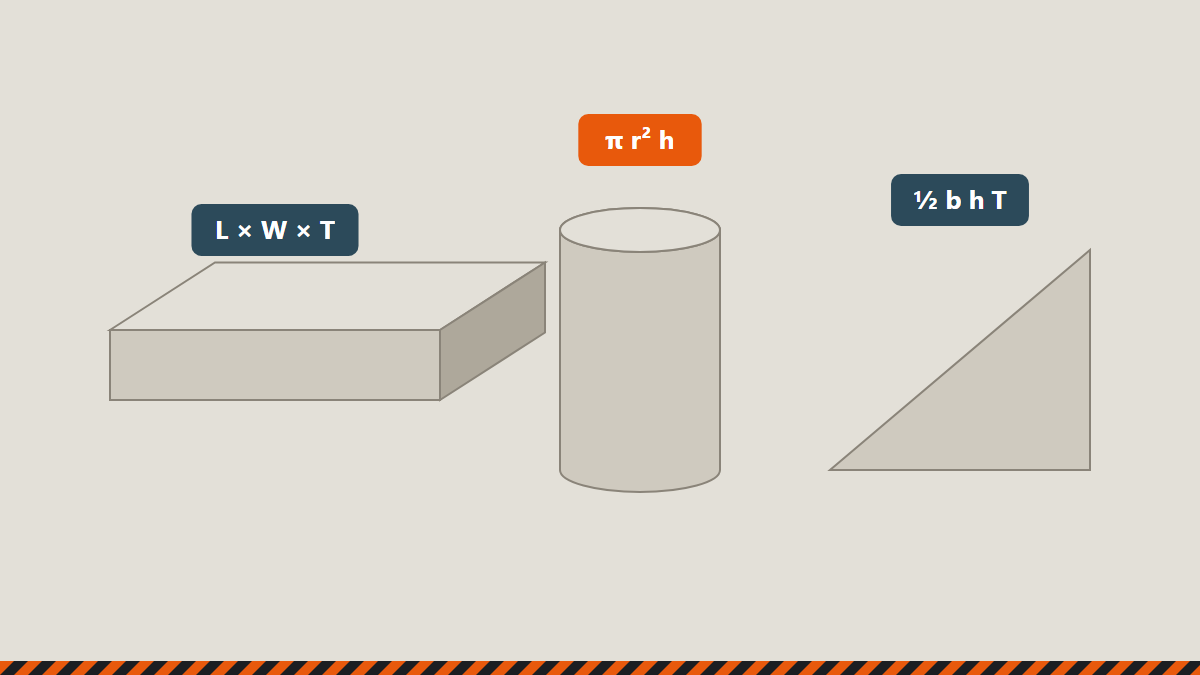
The overlay formula multiplies area × thickness. Area is length × width in square feet, and thickness is in inches ÷ 12. Divide cubic feet by 27 for cubic yards.
Area (ft²) = length (ft) × width (ft)
Volume (ft³) = area (ft²) × thickness (in) ÷ 12
Cubic yards (yd³) = volume (ft³) ÷ 27
- Length and width: the surface size, in feet (ft).
- Thickness: the average topping depth, in inches (in).
- 12: inches in 1 foot.
The metric overlay formula uses square meters and meters and gives cubic meters (m³). 1 m³ is 1,000 liters.
Volume (m³) = area (m²) × thickness (m)
1 m³ = 1.308 yd³ = 35.3 ft³
Worked Example: 12 × 20 ft Patio at ½ Inch
A 12 × 20 ft (3.66 × 6.1 m) patio resurfaced ½ inch (1.3 cm) thick needs 10.00 cubic feet, or 0.37 cubic yards (0.28 m³) of overlay.
- Find the area: 12 ft × 20 ft = 240 ft².
- Convert the thickness to feet: 0.5 in ÷ 12 = 0.0417 ft.
- Multiply: 240 ft² × 0.0417 ft = 10.00 ft³, and 10.00 ÷ 27 = 0.37 yd³.
- Add 10% for waste: 11.00 ft³ (311 liters).
To count bags, divide 11.00 ft³ by the coverage per bag on the product label. Overlay and leveler products vary, so the calculator gives no bag count.
Try it
Drag the sliders and the diagram redraws to scale.
Linked to the calculator above: moving a slider updates your estimate.
With your values
12 ft × 20 ft × 0.042 ft = 10.00 ft³
- Cubic feet
- 10.00
- Cubic yards
- 0.37
- Cubic meters
- 0.28
Where to Use the Overlay Calculator
The overlay calculator covers 4 common resurfacing jobs, including patios, driveways, and garage floors. The sizes below are sample inputs:
- Driveway resurfacing: a 20 × 24 ft driveway at 1 in needs 40.00 ft³ (1.13 m³).
- Walkway toppings: a 4 × 30 ft path at ½ in needs 5.00 ft³ (142 liters).
- Garage floor leveling: a 20 × 22 ft floor at ½ in needs 18.33 ft³ (0.52 m³).
- Step and landing repair: a 4 × 6 ft landing at 2 in needs 4.00 ft³ (113 liters).
Concrete Leveler, Topping, and Epoxy Coverage
A concrete topping calculator or concrete leveler calculator gives the volume to fill. Each product lists its own coverage on the bag, in square feet at a set depth or in cubic feet per bag. Use the label figure for the product you buy.
For a concrete epoxy calculator, the useful figure is the floor area. The 12 × 20 ft patio covers 240 ft² (22.30 m²). Divide the area by the coverage on the coating label. The calculator gives area and volume only and no coating amounts.
Overlays That Taper to Nothing
To level a dip or blend a patch into the old surface, an overlay runs from a set depth down to a feather edge. The layer is a wedge, so use the average of the deep and thin edges as the thickness in the calculator:
Average thickness = (deepest point + thinnest point) ÷ 2
A 10 × 12 ft low spot that is 1 in deep at one side and 0 at the other averages ½ in. That is 5.00 ft³, or 156 litres with 10% waste. Check the bag for the product's minimum thickness before you feather an edge.
| Deep edge | Thin edge | Average | Cubic feet | Litres |
|---|---|---|---|---|
| ½ in | 0 in | 0.25 in | 2.08 | 59 |
| 1 in | 0 in | 0.50 in | 4.17 | 118 |
| 1½ in | 0 in | 0.75 in | 6.25 | 177 |
| 2 in | 0 in | 1.00 in | 8.33 | 236 |
| 1½ in | ½ in | 1.00 in | 8.33 | 236 |
Overlay Volume per 100 Square Feet
To estimate overlay by area, find the thickness below and multiply by your area ÷ 100.
| Thickness | Cubic feet | Cubic yards | Cubic meters | Liters |
|---|---|---|---|---|
| 0.25 in (0.6 cm) | 2.08 | 0.077 | 0.059 | 59 |
| 0.5 in (1.3 cm) | 4.17 | 0.154 | 0.118 | 118 |
| 0.75 in (1.9 cm) | 6.25 | 0.231 | 0.177 | 177 |
| 1 in (2.5 cm) | 8.33 | 0.309 | 0.236 | 236 |
| 1.5 in (3.8 cm) | 12.50 | 0.463 | 0.354 | 354 |
| 2 in (5.1 cm) | 16.67 | 0.617 | 0.472 | 472 |
Common Overlay Calculation Mistakes
The 4 most common overlay mistakes are listed below.
- Use the average thickness, not the thinnest edge. The 12 × 20 ft patio at 1 in instead of ½ in needs 20.00 ft³, double the volume.
- Enter the thickness in inches, if the field shows inches. A thickness of ½ entered as feet gives a volume 12 times too large.
- Take bag coverage from the product label. Overlay and leveler yields differ from regular concrete bags.
- Fill deep holes and cracks first, if the surface has them, and add that volume to the total.
Concrete Overlay & Topping Calculator FAQ
How much overlay do I need for a patio?
A 12 × 20 ft patio resurfaced ½ inch thick needs 10.00 cubic feet (0.28 m³) of overlay. With a 10 percent waste allowance, plan for 11.00 cubic feet. Divide that figure by the coverage on the product bag to count the bags you need to buy.
How do I calculate a concrete overlay?
To calculate a concrete overlay, multiply length × width × thickness, with the thickness in inches divided by 12. The result is cubic feet. Divide by 27 for cubic yards. Then divide the cubic feet by the coverage per bag printed on the overlay product to find the bag count.
Does the overlay calculator show the number of bags?
No, the overlay calculator shows volume, not bags. Overlay, topping, and self-leveling products each list a different coverage on the bag. Read the coverage per bag on the label, then divide the cubic feet from the calculator by that figure and round up to a whole bag.
Can I use the overlay calculator for epoxy?
Yes, the overlay calculator works for epoxy, if you use the floor area. Epoxy coatings list coverage in square feet per unit on the label. Multiply length × width for the area, then divide by the label coverage. The calculator gives no epoxy amounts of its own.
How do I calculate an overlay that tapers to a feather edge?
Average the deepest and thinnest points and enter that as the thickness. A 10 × 12 ft area that runs from 1 inch down to 0 averages half an inch, so it needs 5.00 cubic feet, about 142 litres before waste. Compare that with the yield printed on the overlay bag.
Sources
Every result on this page uses plain geometry and the exact unit definitions below. The full list of formulas and constants is on the How we calculate page.
Related guides