Irregular & L-Shape Concrete Calculator
This concrete calculator for irregular shapes splits an odd outline into rectangles, triangles, trapezoids, and circles, then adds the parts. Load the L-shape or trapezoid preset, or add your own pieces in feet, inches, or meters. The results show total cubic yards, cubic feet, and cubic meters, plus bag counts.
 By Muhammad AsimPublished Updated How we calculate
Your estimate
Total volume with waste
1.63yd³
- Cubic meters
- 1.25 m³
- Cubic feet
- 44.0 ft³
Premixed bags
- 80 lb bags74
- 60 lb bags98
- 40 lb bags147
- 25 kg bags108
- 20 kg bags134
- Weight
- 6,592 lb · 2,990 kg
- Ready-mix truck loads (10 yd³ each)
- 0.16
- Concrete cost
Volume by shape
Formula with your numbers
12 ft × 10 ft × 0.333 ft × 1.1 = 44.00 ft³
Includes a 10% waste allowance. Bags are rounded up. Weight uses 2,400 kg/m³ (150 lb/ft³).
Your estimate1.63 yd³ · 74 × 80 lb
How to Use the Irregular Shape Calculator
The irregular shape calculator works in 4 steps.
- Sketch the outline and split it into simple pieces.
- Pick a preset, or add pieces: rectangle/slab, triangle, trapezoid, or circle.
- Enter the sizes and the same thickness for every piece.
- Read the total for all pieces, with waste.
Irregular Shape Concrete Formula
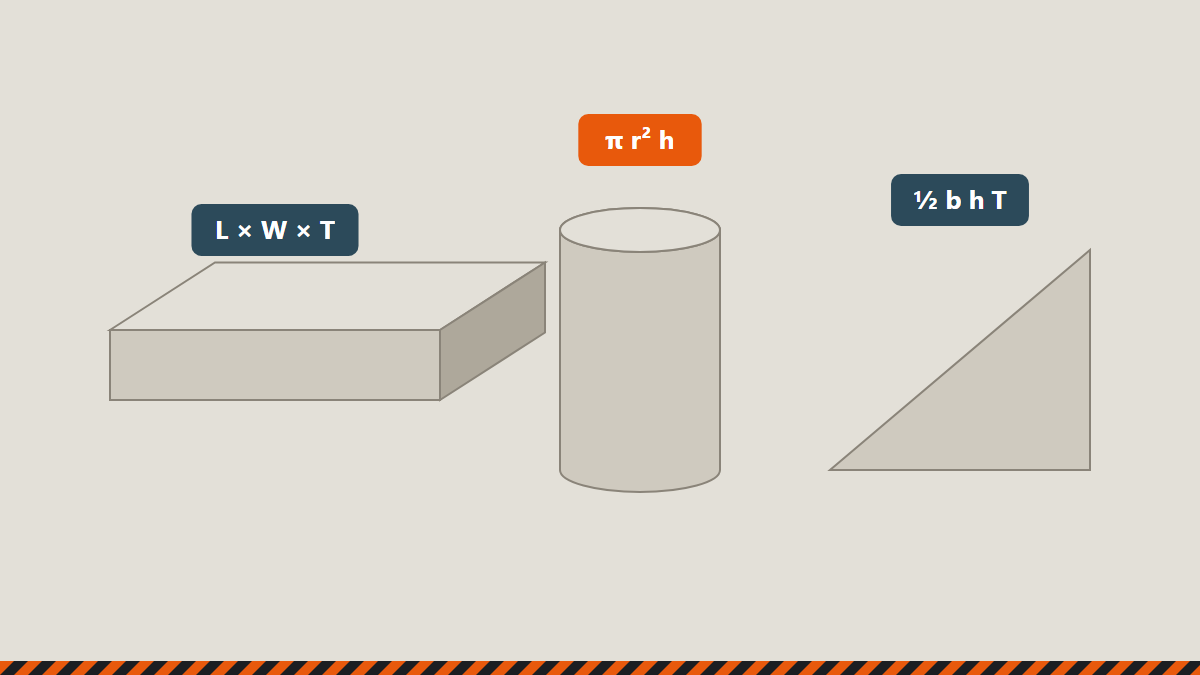
The total volume of an irregular shape equals the sum of the volumes of its parts. Each part uses its own formula.
Total (ft³) = part 1 + part 2 + … + part n
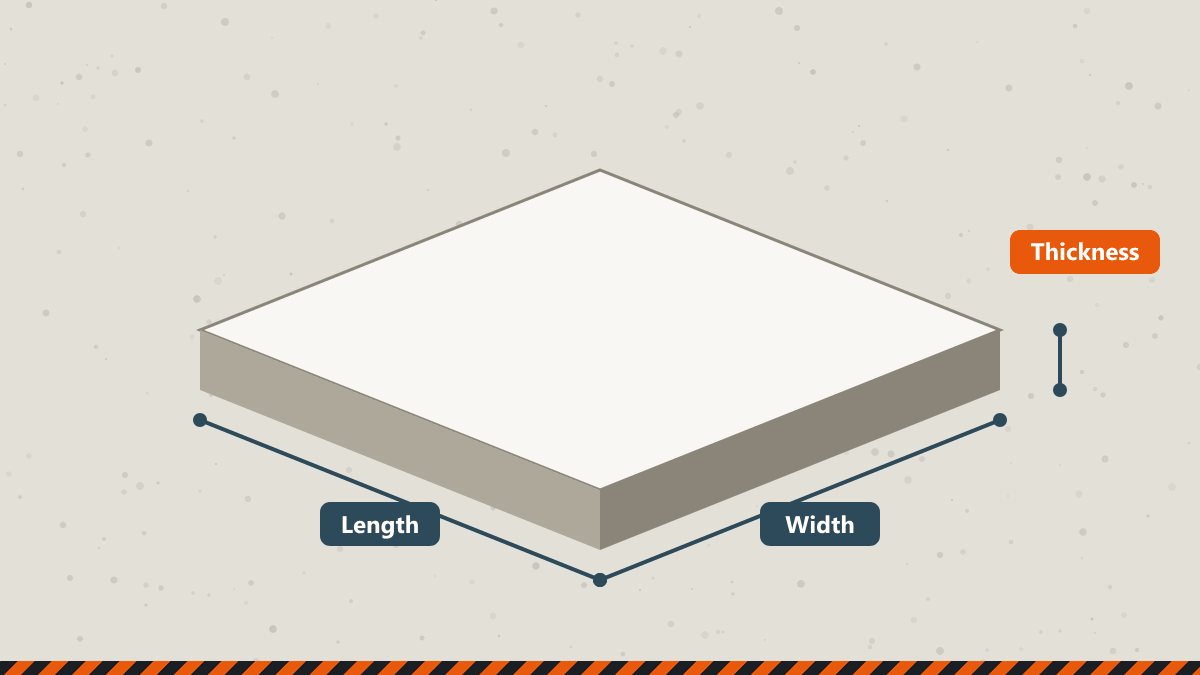
Rectangle = length × width × thickness
Triangle = ½ × base × height × thickness
Trapezoid = ½ × (a + b) × h × thickness
Circle = π ÷ 4 × diameter² × thickness
- a and b: the 2 parallel sides of a trapezoid, in feet (ft).
- h: the distance between the parallel sides, measured at 90°, in feet.
- Thickness: the slab depth in inches (in) ÷ 12.
In metric, enter every part in meters; the sum is in cubic meters (m³).
Total (m³) = sum of each part in m³
Worked Example: L-Shape Patio, 20 × 10 ft Plus 10 × 8 ft
An L-shaped patio made of a 20 × 10 ft rectangle and a 10 × 8 ft rectangle, both 4 inches (10 cm) thick, needs 93.3 cubic feet, or 3.46 cubic yards (2.64 m³). The 4 steps below show the math.
- Find part 1: 20 × 10 × (4 ÷ 12) = 66.7 ft³.
- Find part 2: 10 × 8 × (4 ÷ 12) = 26.7 ft³.
- Add the parts: 66.7 + 26.7 = 93.3 ft³, and 93.3 ÷ 27 = 3.46 yd³.
- Add 10% for waste: 3.80 yd³, or 172 bags of 80 lb concrete.
Tap the L-shape preset in the calculator to load these 2 rectangles.
Where to Use the Irregular Shape Calculator
These 4 odd-shaped pours are each 4 inches thick:
- L-shaped patios: 20 × 10 ft + 10 × 8 ft need 3.46 yd³ (2.64 m³).
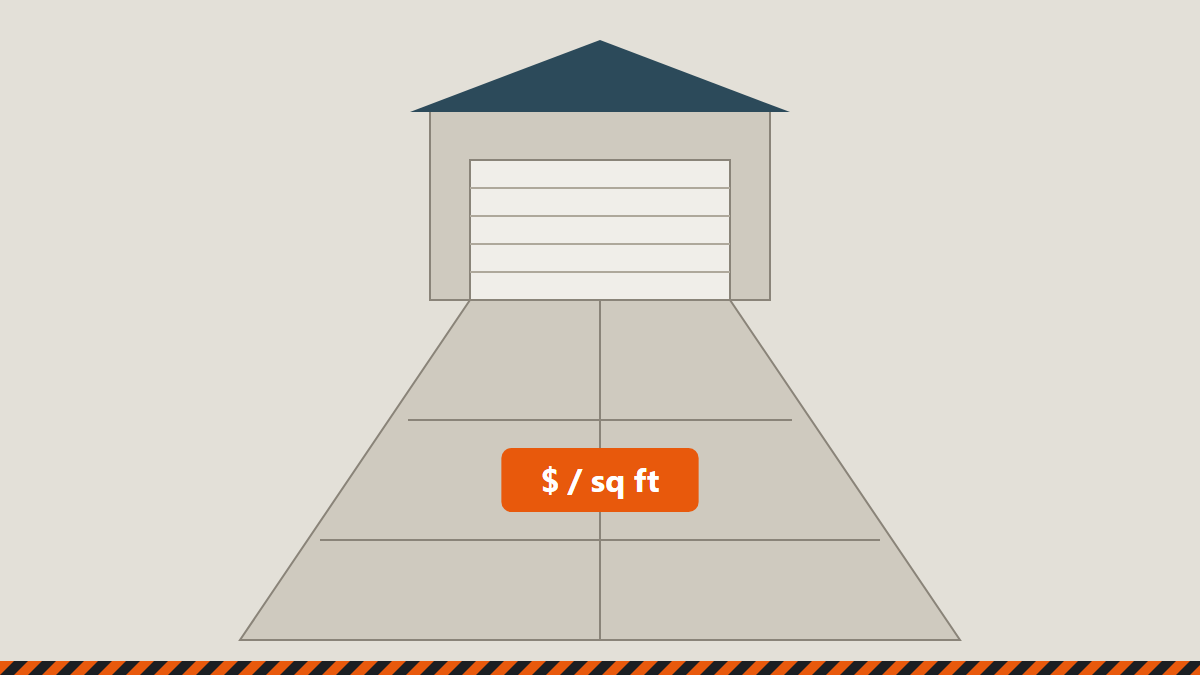
- Driveways with a flared apron: a 20 × 12 ft drive plus a 16/12 ft trapezoid need 3.65 yd³.
- Octagon gazebo pads: a 12 × 12 ft octagon needs 1.38 yd³ (1.06 m³).
- Patios with a round fire pit pad: 16 × 12 ft plus an 8 ft circle need 2.99 yd³.
How to Split an Odd Shape
To split an odd shape, draw straight lines that cut the outline into rectangles first, then cover the angled leftovers with triangles or trapezoids and the curves with circles.
An octagon splits into 1 rectangle and 2 trapezoids. A 12 × 12 ft pad with 4 × 4 ft corners cut off is a 12 × 4 ft middle band (16.0 ft³) plus 2 trapezoids with parallel sides of 12 and 4 ft and a 4 ft height (10.7 ft³ each). The total is 37.3 ft³ at 4 in.
Concrete for Common Irregular Shapes
The trapezoid preset (sides 10 and 6 ft, 8 ft height) at 4 inches needs 21.3 cubic feet, or 36 bags of 80 lb concrete.
| Shape | Parts | Cubic feet | Cubic yards | Cubic meters | 80 lb bags |
|---|---|---|---|---|---|
| L-shape | 20 × 10 ft + 10 × 8 ft rectangles | 93.3 | 3.46 | 2.64 | 156 |
| Trapezoid | sides 10 and 6 ft, 8 ft height | 21.3 | 0.79 | 0.60 | 36 |
| Rectangle + triangle | 12 × 10 ft + triangle 12 ft base, 6 ft height | 52.0 | 1.93 | 1.47 | 87 |
| Driveway with flared apron | 20 × 12 ft + trapezoid 16/12 ft, 4 ft height | 98.7 | 3.65 | 2.79 | 165 |
| Octagon pad | 12 × 4 ft rectangle + 2 trapezoids 12/4 ft, 4 ft height | 37.3 | 1.38 | 1.06 | 63 |
| Patio with round pad | 16 × 12 ft + 8 ft circle | 80.8 | 2.99 | 2.29 | 135 |
Free-Form and Curved Patios: The Offset Method
A kidney or curved patio has no straight sides to split. Stretch a string along its longest line, then measure the width across it at equal steps. Each pair of neighbouring widths forms a trapezoid, so the trapezoid piece in the calculator adds them up.
| Strip | Widths (ft) | Area (sq ft) | Volume (ft³) |
|---|---|---|---|
| 0–5 ft | 6 and 9 | 37.5 | 12.50 |
| 5–10 ft | 9 and 10 | 47.5 | 15.83 |
| 10–15 ft | 10 and 8 | 45.0 | 15.00 |
| 15–20 ft | 8 and 5 | 32.5 | 10.83 |
The 4 strips add up to 162.5 sq ft and 54.2 ft³, or 2.01 yd³. With 10% waste, the curved patio needs 2.21 yd³, or 100 bags of 80 lb concrete.
Common Irregular Shape Mistakes
The 3 most common irregular shape mistakes involve overlaps, heights, and thickness.
- Split the outline so the pieces do not overlap. Measuring the L-shape as 20 × 10 ft plus a full 10 × 10 ft corner counts 33.3 ft³ that does not exist.
- Measure triangle and trapezoid heights at a right angle, not along a slanted edge.
- Enter the same thickness for every piece, unless one area is poured deeper.
Irregular & L-Shape Concrete Calculator FAQ
How do I calculate concrete for an irregular shape?
To calculate concrete for an irregular shape, split the outline into rectangles, triangles, trapezoids, and circles, find each volume, and add them. Use the same thickness for each part. Divide the total cubic feet by 27 for cubic yards, then add 5 to 10 percent for waste.
How much concrete does an L-shaped slab need?
An L-shaped slab of 20 × 10 ft plus 10 × 8 ft at 4 inches needs 3.46 cubic yards (2.64 m³), before waste. Treat the L as 2 rectangles that do not overlap. With 10 percent for waste, plan for 3.80 yd³, or 172 bags of 80 lb concrete.
How do I calculate concrete for a trapezoid?
To calculate concrete for a trapezoid, multiply ½ × (side a + side b) × height × thickness, with every measurement in feet. Sides a and b are the 2 parallel sides. A trapezoid with sides of 10 and 6 ft and an 8 ft height at 4 inches holds 21.3 cubic feet.
Can the calculator handle an octagon?
Yes, split the octagon into 1 middle rectangle and 2 trapezoids, then enter each piece. The rectangle spans the full width, and each trapezoid covers one angled end. Enter the same thickness for all 3 pieces. The calculator adds them and shows total cubic yards, cubic meters, and bags.
How do I calculate concrete for a curved or free-form patio?
Run a straight string along the patio, measure the width every 5 feet, and treat each pair of widths as a trapezoid. A 20 ft patio with widths of 6, 9, 10, 8, and 5 feet covers 162.5 square feet, so a 4 inch pour needs 2.21 cubic yards with waste.
Sources
Every result on this page uses plain geometry and the exact unit definitions below. The full list of formulas and constants is on the How we calculate page.
Related guides