
Why Is Concrete Measured in PSI? Strength Explained
What psi and MPa mean for concrete, typical strengths for patios and driveways, how curing affects strength, and what decides how much weight a slab holds.


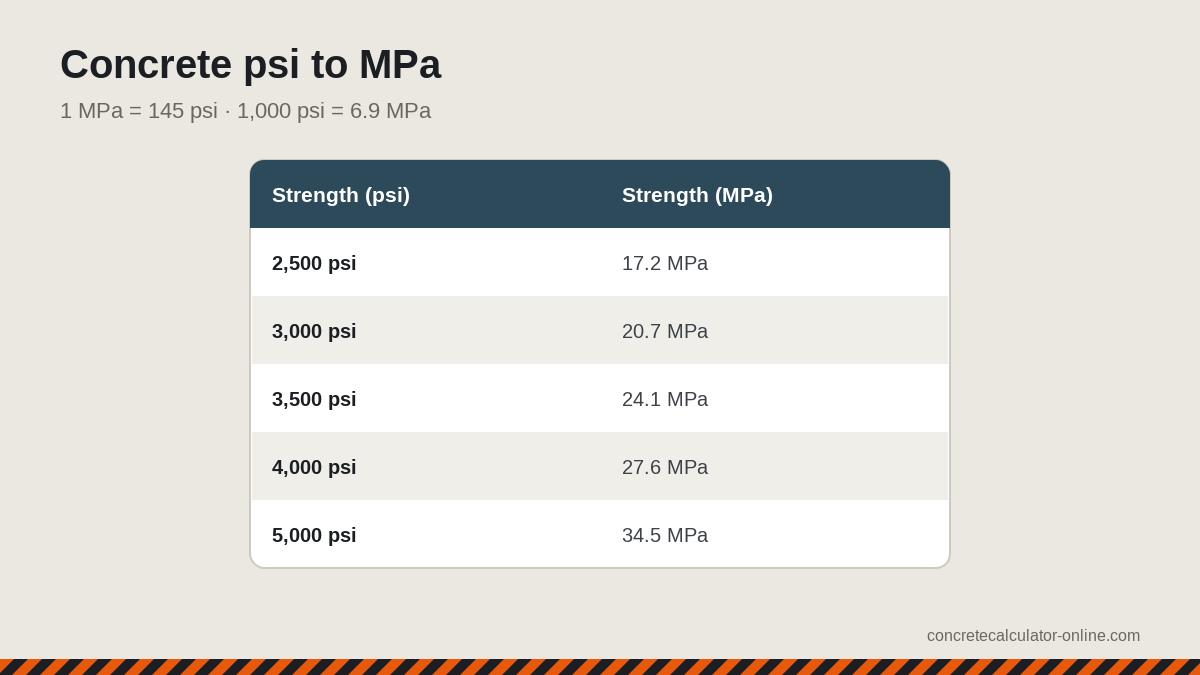
Concrete is measured in pounds per square inch (psi) because psi states its compressive strength: the pressure a hardened sample withstands before it crushes. A 3,000 psi mix withstands about 3,000 pounds of force on every square inch of a test sample. Metric countries give the same strength in megapascals (MPa), so 3,000 psi appears as about 20 MPa on a metric plan. This guide covers what both units mean, which strengths suit common projects, how curing builds strength, and what decides how much weight a slab carries.
Why Is Concrete Measured in PSI?
Concrete is measured in psi because compression is the load concrete handles best, and psi is the United States unit for pressure. A column, a footing, or a slab on the ground mostly carries weight that pushes down on it. A strength figure in psi tells the supplier, the builder, and the inspector how hard the hardened concrete resists that push.
The psi number describes the concrete material, not the finished slab. Two driveways poured from the same 4,000 psi mix behave differently, if one sits on a firm base and the other sits on soft soil.
What PSI Means
PSI stands for pounds per square inch. It is a unit of pressure: a force in pounds spread over an area of 1 square inch. For concrete, the psi rating is the compressive strength, measured by crushing a hardened sample of the mix in a testing machine.
A higher psi rating means a stronger mix. Ready-mix suppliers in the United States and Canada sell concrete by its psi rating, and premixed bags list a rated strength on the label.
What MPa Means
MPa stands for megapascals, the metric unit for the same pressure. Plans and suppliers in the United Kingdom, Ireland, Australia, and most other countries state concrete strength in MPa. The 2 common strengths for home projects convert as follows:
- 3,000 psi is about 20 MPa.
- 4,000 psi is about 28 MPa.
A higher MPa number means a stronger mix, the same as a higher psi number. The concrete strength guide lists grades in both units.
Typical Concrete Strength by Project
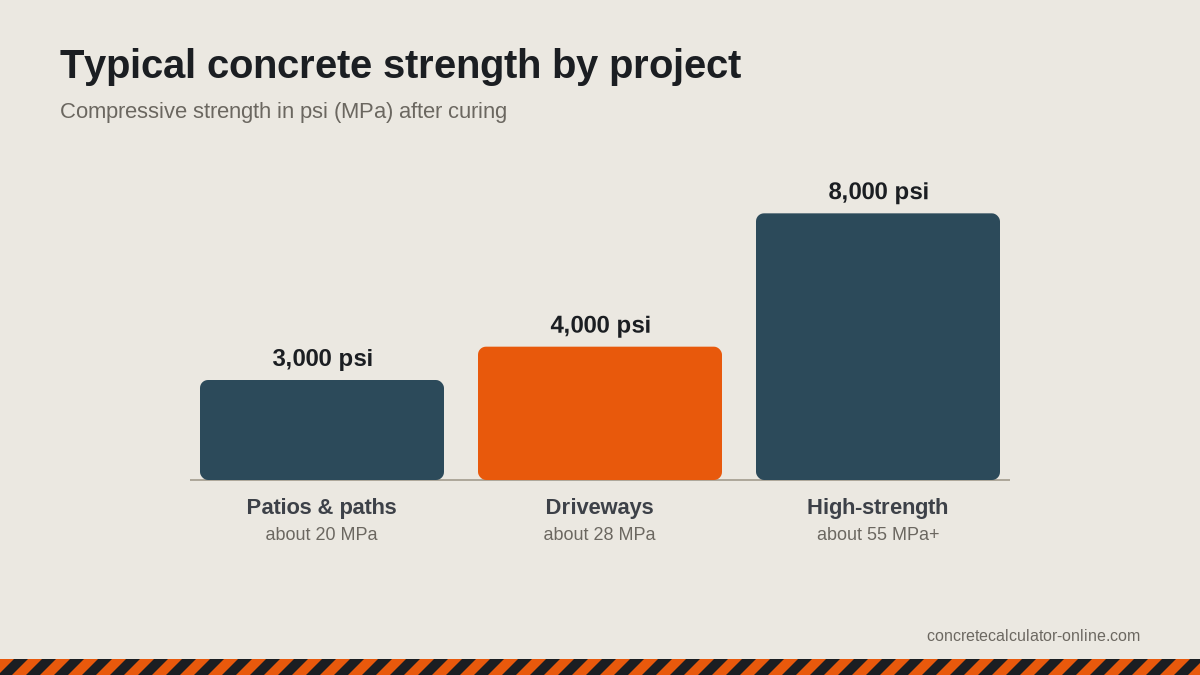
Typical concrete strength depends on the job. Patios and paths use about 3,000 psi (20 MPa), and driveways use about 4,000 psi (28 MPa) to carry vehicle loads.
| Project | Typical strength |
|---|---|
| Patios and garden paths | About 3,000 psi (20 MPa) |
| Driveways | About 4,000 psi (28 MPa) |
| Footings, walls, and structural slabs | Set by local codes or a structural engineer |
Footings, foundation walls, columns, and suspended slabs carry a building, and their strength comes from local codes and the engineer’s drawings. Use the strength on the plans for those pours, not a figure from a table.
How Curing Affects Concrete Strength
Curing is the period when concrete hardens and gains strength, as the cement reacts with water. Concrete reaches most of its design strength after about 28 days. The psi rating on a ticket or a bag describes concrete that has cured, not concrete that has just set.
Three curing habits protect the strength of the mix:
- Keep the surface damp, or cover the slab, so the concrete does not dry out early.
- Keep heavy loads off the slab until the concrete has had time to gain strength.
- Protect fresh concrete from freezing, since frozen water in the mix damages the surface.
A strong mix that dries out too fast does not reach its rated strength. Water added on site to make the mix easier to place has the same effect, because extra water weakens the hardened concrete.
How Much Weight Can Concrete Hold per Square Foot?
How much weight concrete holds per square foot depends on the slab thickness, the base, the reinforcement, and the type of load, so no single number fits every slab. A psi rating does not convert into a load per square foot. The question needs a structural engineer, who looks at the whole slab and the ground under it.
These 4 factors decide what a concrete slab carries:
- Thickness. A thicker slab spreads a load over more concrete and resists bending better than a thin one.
- Base. A firm, compacted base supports the slab evenly. A soft or uneven base lets the slab bend and crack under a load the concrete itself handles.
- Reinforcement. Rebar or wire mesh holds cracked sections together and helps the slab carry loads across weak spots in the ground.
- Load type. A spread load, such as a parked car on 4 tires, acts differently from a point load, such as a hot tub leg or a jack stand on a small area.
For a garage floor, a hot tub pad, or a slab under machinery, ask a structural engineer and follow local codes. The slab thickness guide covers common thicknesses for home projects.
Does Higher PSI Mean More Concrete?
No, a higher psi rating does not change the volume of concrete. A 4,000 psi mix and a 3,000 psi mix fill the same formwork, so the order quantity stays the same. The strength changes what goes into the mix, not how much space the concrete fills.
Driveway at 4,000 psi
Volume (yd³) = length (ft) × width (ft) × thickness (ft) ÷ 27
A 20 × 12 ft driveway at 5 in (13 cm): 3.70 yd³ (2.83 m³), or 4.07 yd³ with 10% waste. The volume is the same at 3,000 psi or 4,000 psi.
Patio at 3,000 psi
Volume (ft³) = length (ft) × width (ft) × thickness (ft)
A 14 × 12 ft patio at 4 in (10 cm): 56 ft³ = 2.07 yd³ (1.59 m³), or 103 bags of 80 lb concrete with 10% waste.
Work out the volume with the driveway calculator, the patio calculator, or the slab calculator, then state the psi or MPa rating on the order. For a driveway budget, the guide to concrete driveway cost prices common sizes and finishes.
How to Choose a Concrete Strength
To choose a concrete strength, start with the project type and then check local codes. Use these 4 steps:
- Match the project to a typical strength: about 3,000 psi (20 MPa) for patios and paths, about 4,000 psi (28 MPa) for driveways.
- Check local codes and the plans for any footing, wall, or structural slab.
- Ask the supplier for the rating in psi or MPa, and write it on the order.
- Check the label for the rated strength, if you buy premixed bags.
For mixing on site, the mix ratio calculator splits the volume into cement, sand, and gravel. The concrete strength guide covers grades and strength classes in more detail, and the concrete calculator gives the volume for any shape.


