
Why Does Concrete Scale?
Why does concrete scale? Learn how freeze-thaw cycles, de-icing salts, poor finishing, and weak curing cause scaling, and how to prevent it on a new slab.


Concrete scales because water inside a saturated surface freezes, expands, and breaks off the top layer of hardened concrete. De-icing salts, concrete without entrained air, poor finishing, and short curing make the damage worse. This guide covers the 6 main causes of scaling and the steps that prevent scaling on a new slab.
What Is Concrete Scaling?
Concrete scaling is local flaking or peeling of the finished surface of hardened concrete. The National Ready Mixed Concrete Association (NRMCA) Concrete in Practice sheet CIP 2 describes scaling as damage from cycles of freezing and thawing. Scaling starts as small patches, and the patches later merge and spread over large areas.
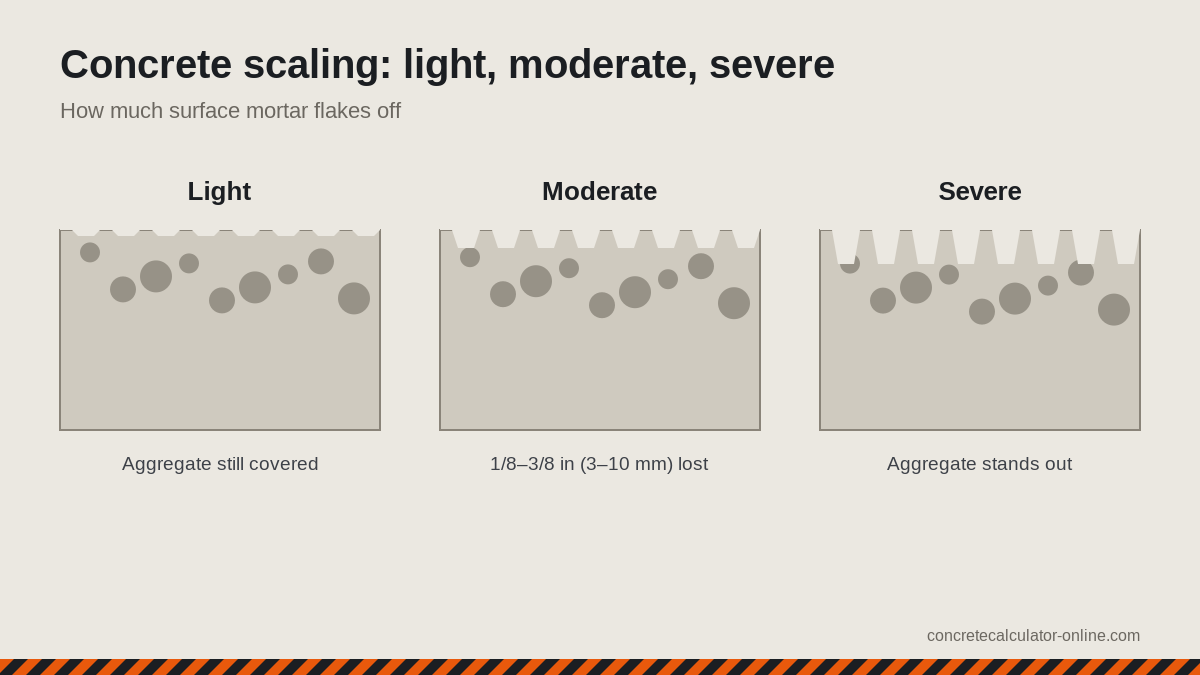
NRMCA sorts scaling into 3 levels:
- Light scaling leaves the coarse aggregate covered.
- Moderate scaling exposes the aggregate and removes up to 1/8 to 3/8 inch (3 to 10 mm) of surface mortar.
- Severe scaling removes more surface, and the aggregate stands out clearly.
Why Does Concrete Scale in Freezing Weather?
Concrete scales in freezing weather because water expands as it turns to ice, and the expansion creates stress inside a saturated slab. Each cycle of freezing and thawing adds stress, so the risk of scaling rises with the number of cycles.
Air-entrained concrete holds millions of small air bubbles. The bubbles give the expanding water and ice room to move and stop the stress from building up.
6 Causes of Concrete Scaling
There are 6 main causes of concrete scaling, including non-air-entrained concrete, de-icing chemicals, and poor finishing. Each cause leaves a surface that holds water or breaks under ice pressure.
Non-Air-Entrained Concrete
Non-air-entrained concrete scales because the mix has no small air bubbles to absorb the pressure of freezing water. Too little entrained air near the surface causes the same problem. Over-finishing removes entrained air from the top layer, so a good mix still scales after too much finishing work.
Low-Strength Concrete
Low-strength concrete lets water soak into the surface. A permeable surface stays saturated longer, and saturated concrete is the concrete that scales. A wrong mix or wrong mix proportions for the job leads to the same result.
De-Icing Chemicals
De-icing chemicals raise the risk of scaling because the chemicals keep the surface wetter and increase the number of freeze-thaw cycles. Heavy use on new concrete does the most harm, since new concrete tends to be saturated and lower in strength. Salt solutions that sit on a slab with poor drainage make the exposure more severe.
Poor Finishing
Poor finishing causes scaling when the finisher works the surface with bleed water on top, uses a steel trowel too early, or over-finishes the slab. Bleed water is the water that rises to the surface of fresh concrete. A jitterbug or vibrating screed used on high-slump concrete has the same effect, because the tool separates the mix and leaves a weak layer on top.
Too Much Water in the Mix
Too much water in the mix causes scaling because extra water added on site raises the slump and leads to separation and heavy bleeding. The result is a weak mortar layer at the surface. NRMCA recommends a slump of 3 to 5 inches (75 to 125 mm) for most slab work, with water-reducing admixtures in place of added water when the crew needs a more workable mix.
Insufficient Curing
Insufficient curing causes scaling because a slab that dries out early ends up with a weak surface. Curing keeps the concrete at the right temperature and moisture while it gains strength.
Does Concrete Scale Without Freezing?
Yes, concrete sometimes peels or scales without any freezing and thawing. NRMCA links this type of scaling to early use of a steel trowel, over-finishing, or finishing while bleed water is on the surface.
How to Prevent Concrete Scaling
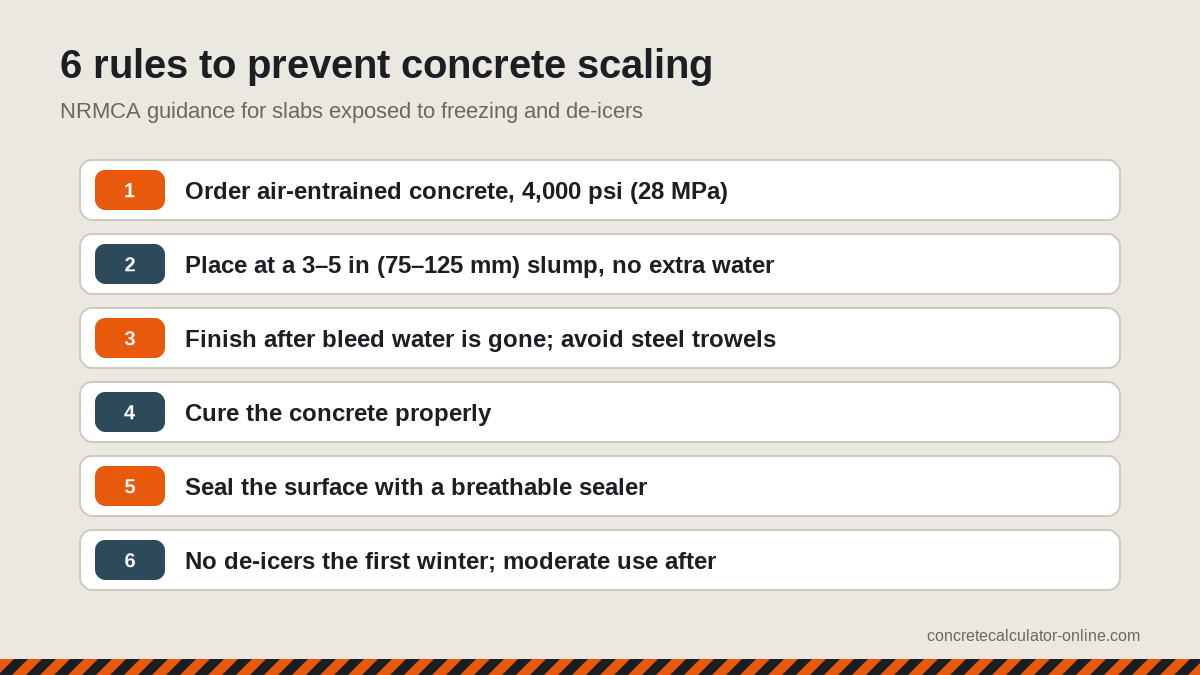
To prevent concrete scaling, order air-entrained concrete of the right strength, keep extra water out of the mix, finish at the right time, cure the slab, and limit de-icers. NRMCA gives these 6 rules for slabs exposed to severe freezing and thawing:
- Order good-quality air-entrained concrete with a strength of 4,000 psi (28 MPa).
- Place the concrete at a slump of 3 to 5 inches (75 to 125 mm), without excess water.
- Finish the concrete after bleed water has gone, and avoid steel trowels.
- Cure the concrete properly.
- Seal the surface with a breathable sealer.
- Skip de-icing chemicals in the first winter, and use moderate amounts after that.
For exterior slabs that stay moist and face de-icers, NRMCA recommends a total air content of 6 percent for concrete with 3/4-inch (19 mm) or 1-inch (25 mm) coarse aggregate. For concrete that does not stay moist, or where no de-icers are used, NRMCA gives a specified strength of 3,500 psi (24 MPa). The concrete strength guide lists common grades in psi and MPa.
These 5 habits on the job site protect the surface:
- Bull float the slab right after the first screeding, then wait for bleed water to rise and disappear before the next finishing step.
- Use fog sprays or evaporation retarders in dry, windy weather, where the surface looks dry while the concrete still bleeds.
- Apply a broom finish on most exterior surfaces, in place of a hard trowel finish.
- Cure the slab with a pigmented liquid membrane curing compound, or cover the slab with wet burlap and plastic sheets.
- Avoid pouring exterior concrete in late fall, winter, or early spring, if the slab will freeze soon after placement while still saturated.
Which De-Icers Are Safe for Concrete?
The de-icers NRMCA considers acceptable for concrete are calcium chloride and sodium chloride (rock salt), used in moderate amounts. NRMCA warns against ammonium sulfate, ammonium nitrate, and magnesium-based salts, which attack and destroy concrete surfaces. Hose off road salt tracked onto driveways and garage floors, when the weather allows.
On a new slab, use clean sand for traction in the first winter. A silane or siloxane-based breathable sealer made for concrete slabs gives the surface more protection. Apply the sealer to reasonably dry concrete; NRMCA names late summer, after a few dry days, as an ideal time.
Can Scaled Concrete Be Repaired?
Yes, light to moderate scaling can be repaired with a thin bonded resurfacing layer. Minor scaling is a cosmetic issue and does not always need repair. Severe scaling that keeps spreading is often not practical to repair.
To repair a scaled surface, remove the unsound concrete with a hammer and chisel, sandblasting, a high-pressure washer, or a jackhammer. Clean off dirt, oil, and paint, so the repair bonds to a sound, rough base. NRMCA lists 3 resurfacing materials:
- Portland cement concrete resurfacing
- Latex-modified concrete resurfacing
- Polymer-modified cementitious repair mortar
The repair is only as strong as the surface underneath, and the color does not match the original concrete.
Plan a Scale-Resistant Slab
To plan a scale-resistant slab, work out the volume first, then order air-entrained concrete at the right strength. The driveway calculator and the patio calculator give the cubic yards for the most common exterior slabs. The slab calculator handles any rectangular pour. State the strength in psi and ask for air-entrained concrete on the order, if the slab will face freezing winters or de-icing salt.


