
Why Is Concrete Measured in Cubic Yards?
Why concrete is sold by the cubic yard in the US and Canada, what a cubic yard holds, and a conversion table for cubic feet, cubic meters, and bags.


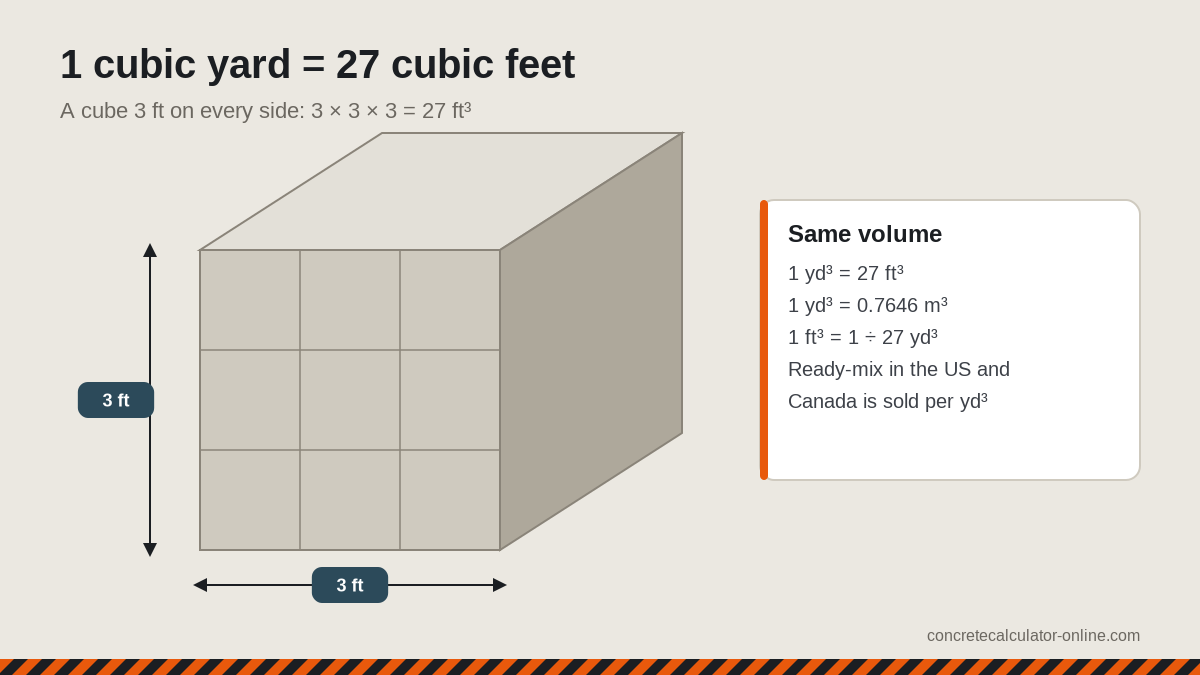
Concrete is measured in cubic yards because concrete fills a space with length, width, and depth, and the cubic yard is the volume unit that keeps a ready-mix order in the United States to a short, readable number. One cubic yard is a cube 3 feet (0.91 m) on each side, and it holds 27 cubic feet (0.76 m³). The United States and Canada order concrete in cubic yards, while most other countries order in cubic meters.
What Is a Cubic Yard of Concrete?
A cubic yard of concrete is the amount that fills a box 3 ft long, 3 ft wide, and 3 ft high. Multiply 3 × 3 × 3 and the box holds 27 cubic feet. The National Institute of Standards and Technology (NIST) defines 1 yard as exactly 0.9144 m, so 1 cubic yard equals 0.7646 cubic meters.
Concrete weighs about 150 lb per cubic foot (2,400 kg per m³). At that density, 1 cubic yard weighs about 4,050 lb (1,835 kg).
Is Concrete Measured in Yards or Cubic Yards?
Concrete is measured in cubic yards, not in yards. A “yard of concrete” on a job site is short for 1 cubic yard. A plain yard is a length, and a length cannot describe how much concrete fills a slab or a footing. When a contractor asks for “4 yards,” the order is 4 cubic yards (3.06 m³).
Why Concrete Is Sold by Volume
Concrete is sold by volume because every pour is a volume. A slab, a footing, a wall, and a post hole each have a length, a width or diameter, and a depth. Multiply those sizes and the result is the amount to order, with no extra conversion.
Weight works for gravel and sand, which sit in a pile. Fresh concrete flows into formwork and takes the shape of the form, so the form’s volume is the number that matters. A ready-mix plant batches cement, sand, gravel, and water to make a set volume, and the delivery ticket shows that volume.
Why Concrete Is Measured in Cubic Yards, Not Cubic Feet
Cubic yards keep the numbers small. A 20 × 20 ft garage floor at 4 inches (10 cm) holds 133.3 cubic feet, which is only 4.94 cubic yards. A 10 cubic yard truck load equals 270 cubic feet (7.65 m³). Short numbers are easier to read on a quote, easier to say on the phone, and harder to mistype.
Cubic feet still matter for small jobs. Premixed bags list their yield in cubic feet: an 80 lb bag makes 0.60 ft³ and a 60 lb bag makes 0.45 ft³. A post hole or a single step is easier to count in cubic feet and bags than in fractions of a yard.
Which Countries Use Cubic Yards?
Two countries order concrete in cubic yards: the United States and Canada. Canada uses both units, and some Canadian suppliers quote in cubic meters, so check the unit on each quote. The Canada concrete calculator shows both totals side by side.
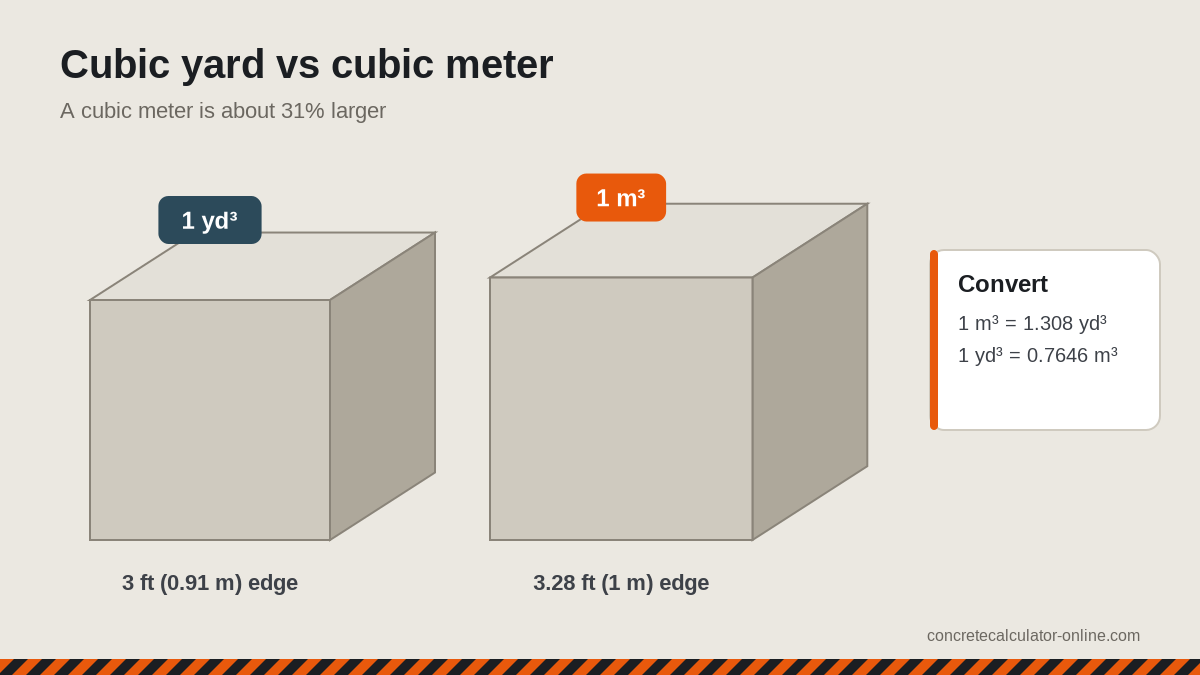
Most other countries order concrete in cubic meters, including the United Kingdom, Ireland, Australia, and New Zealand. A 3 m³ pour in those countries equals 3.92 cubic yards. The UK concrete calculator and the Australia concrete calculator start in metric units.
How to Convert to Cubic Yards
To convert a measurement to cubic yards, find the volume in cubic feet and divide by 27. For a metric volume, multiply cubic meters by 1.308.
Feet to cubic yards
Cubic yards = length (ft) × width (ft) × depth (ft) ÷ 27
A 30 × 5 ft walkway at 4 in: 30 × 5 × 0.333 = 50 ft³, and 50 ÷ 27 = 1.85 yd³ (1.42 m³).
Cubic meters to cubic yards
Cubic yards = cubic meters × 1.308
A 3 m³ pour × 1.308 = 3.92 yd³.
The square feet to cubic yards calculator handles the conversion when the area is already known.
Cubic Yard Conversion Table
The cubic yard conversion table lists common order sizes in cubic feet, cubic meters, and 80 lb bags.
| Cubic yards | Cubic feet | Cubic meters | 80 lb bags |
|---|---|---|---|
| 0.5 yd³ | 13.5 | 0.38 | 23 |
| 1 yd³ | 27 | 0.76 | 45 |
| 2 yd³ | 54 | 1.53 | 90 |
| 3 yd³ | 81 | 2.29 | 135 |
| 5 yd³ | 135 | 3.82 | 225 |
| 10 yd³ | 270 | 7.65 | 450 |
Bag counts use 0.60 ft³ per 80 lb bag and round up to a whole bag. One cubic yard takes 45 bags of 80 lb concrete, which is why most jobs above 1 cubic yard use ready-mix concrete.
How Many Cubic Yards to Order
To work out how many cubic yards to order, calculate the volume, add 5 to 10 percent for waste, and round up. The 20 × 20 ft garage floor holds 4.94 cubic yards, and a 10 percent waste allowance brings the order to 5.43 cubic yards.
Three habits keep a cubic yard order accurate:
- Measure inside the formwork, at 2 or more points along each side.
- Check the depth across the base, if the ground is uneven.
- Ask the supplier for the ordering step and the minimum load before you round.
Calculators for Cubic Yards and Cubic Meters
The cubic yards calculator gives the order in cubic yards from feet and inches, with bag counts and truck loads. The cubic meters calculator does the same in metric units. For a job with several shapes, such as a slab with footings and steps, the concrete calculator adds every part into one total.


